As early as next week, some UPI payments to shops will carry a fee for the first time. Here is exactly who pays, how much, and why most of your UPI payments will stay free.
By Rajan | Published 3 November 2026 | Updated 3 November 2026 | 5 min read
Key takeaways
- NPCI will charge a 0.4% merchant discount rate (MDR) on UPI payments to merchants above ₹2,000, starting “immediately post Diwali” on a date still to be notified.
- Customers do not pay. The fee is charged to merchants, and banks have been told to make sure shops do not pass it on.
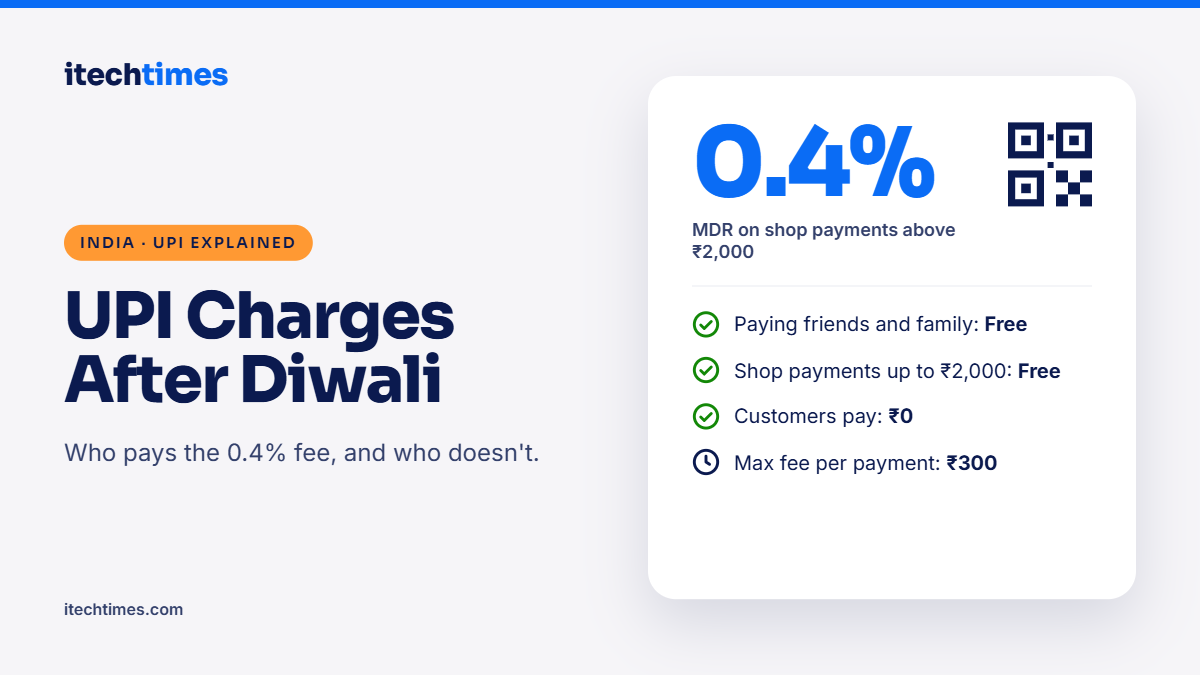
- Sending money to friends and family (P2P) stays free at any amount, and so do shop payments up to ₹2,000.
- Small merchants receiving up to ₹1 lakh a month through UPI QR codes are fully exempt.
- The Ministry of Finance estimates only about 4% of merchant transactions will be affected.
Will I have to pay charges on UPI after Diwali? No, not as a customer. NPCI’s new 0.4% fee, called the merchant discount rate (MDR), applies only to merchants, and only on UPI payments above ₹2,000. Paying a friend, splitting a bill or paying your local kirana store up to ₹2,000 stays completely free.
What is changing with UPI after Diwali?
For the first time, banks and payment apps will be allowed to charge merchants a small fee on some UPI payments. NPCI’s UPI and Services Steering Committee set the MDR at 0.4% in September 2026, with an original start date of 15 October.
On 13 October, NPCI deferred it, citing the festive season. Its press note says the MDR on select person-to-merchant (P2M) transactions will be implemented “immediately post Diwali”, on a date to be notified separately. Reports point to the second week of November. The rate structure itself has not changed.
How much is the UPI merchant fee?
| Payment type | Fee charged to the merchant |
|---|---|
| Person to person (P2P), any amount | Free |
| Shop payment up to ₹2,000 | Free |
| Shop payment above ₹2,000 | 0.4% of the amount |
| Shop payment of ₹75,000 or more | Capped at ₹300 |
| Railways, telecom, insurance, fuel, agricultural inputs (above ₹2,000) | Flat ₹5 |
| Mutual funds, stockbrokers, securities dealers | 0.02%, capped at ₹300 |
| Small merchants receiving up to ₹1 lakh a month via UPI QR | Exempt |
In practice, a ₹5,000 payment at an electronics shop would cost the shop ₹20. A ₹10,000 payment would cost ₹40, and anything from ₹75,000 upwards maxes out at ₹300.
Who pays the UPI MDR: the customer or the shop?
The shop. MDR is a fee merchants pay to the banks and payment companies that process a digital payment, and it is shared among them. Banks have been advised to ensure merchants do not pass the cost on to customers. If a shop adds a “UPI surcharge” to your bill, you can raise it with the shop’s bank or payment provider.
Which merchants are exempt?
Small businesses are protected. Merchants receiving up to ₹1 lakh a month through UPI QR codes are exempt from MDR on all their UPI payments. Reports say a merchant loses this status only if monthly UPI receipts cross ₹1 lakh for three months in a row. NPCI has also said 5% of MDR collections will go into a fund to promote UPI among small merchants.
Why is NPCI introducing UPI charges now?
UPI has been free for merchants since 2020, but running it costs banks and apps money. NPCI says the MDR is meant to make UPI self-sustainable and fund its expansion into rural and semi-urban India, while keeping most payments free.
The scale is huge. In September 2026, UPI processed a record average of 802 million transactions a day. Monthly volume reached 24.07 billion transactions worth ₹29.37 lakh crore, up 22.6% in volume from a year earlier.
Why are traders unhappy?
Retail traders’ associations opposed the fee and called a “No UPI Day” for 2 October. They withdrew it after meeting Finance Minister Nirmala Sitharaman in September. For a shop selling phones, appliances or jewellery, where most bills cross ₹2,000, a 0.4% fee eats into thin margins. The proposal has also drawn opposition from political groups.
What should you do?
If you are a customer: nothing changes. Keep paying by UPI as usual, and do not accept an extra UPI surcharge on your bill.
If you run a shop:
- Check your monthly UPI receipts. Under ₹1 lakh a month on your QR, you stay exempt.
- Watch your bank or payment provider’s notification for the exact start date.
- Factor 0.4% into pricing for big-ticket items, rather than adding a surcharge.
- Compare provider terms, since MDR is shared among banks and payment apps.
Frequently asked questions
Is UPI still free in India? Yes, for customers. Person-to-person UPI transfers are free at any amount, and merchant payments up to ₹2,000 carry no fee for anyone.
When do UPI charges start? NPCI says the MDR will start “immediately post Diwali” on a date to be notified separately. Reports point to the second week of November 2026.
Do I pay 0.4% when I pay a shop by UPI? No. The 0.4% is charged to the merchant, not the customer. Banks have been advised to stop merchants passing it on.
How much is the UPI charge on a ₹10,000 payment? The merchant pays 0.4%, which is ₹40. The maximum fee on any single payment is ₹300.
Are small shopkeepers charged MDR on UPI? No. Merchants receiving up to ₹1 lakh a month through UPI QR codes are exempt on all UPI payments.
Will UPI AutoPay or bill payments be charged? UPI AutoPay mandates carry no MDR, according to reports on NPCI’s FAQs. Some categories such as fuel, telecom and insurance pay a flat ₹5 per payment above ₹2,000.