Razorpay’s new licence lets it move money in and out of India from GIFT City, and its first target is the growing number of Indians buying foreign stocks.
Key takeaways
- Razorpay has received its final Payment Service Provider (PSP) licence from IFSCA, the regulator for GIFT City, after an in-principle nod in April 2026.
- The licence covers international collections, settlements, foreign currency transfers and multi-currency accounts.
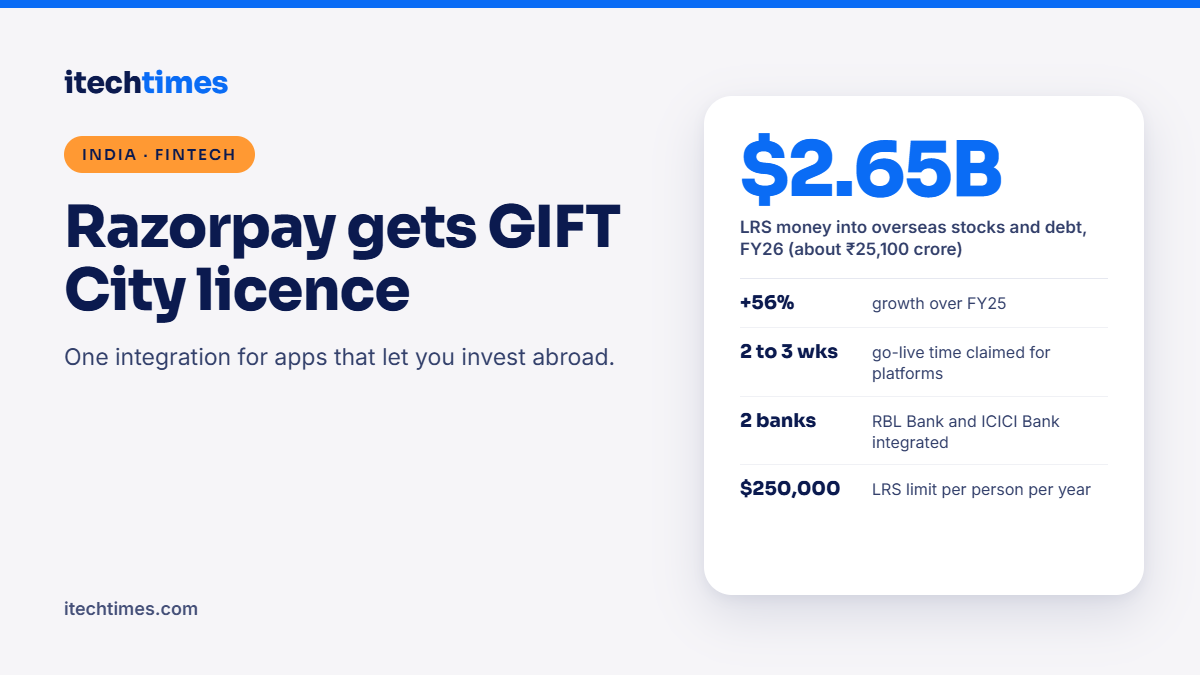
- Brokers and wealth apps can use one integration for overseas investment payments, which Razorpay says cuts go-live time from months to two to three weeks.
- Indians put about $2.65 billion (roughly ₹25,100 crore) into overseas stocks and debt under LRS in FY26, up from about $1.7 billion in FY25.
- RBL Bank and ICICI Bank are integrated, with more banks expected in the coming months.
What does Razorpay’s GIFT City licence do? It allows Razorpay to move money into and out of India from GIFT City, Gujarat, under one regulatory framework. In practice, Indian brokers and wealth apps can plug into a single Razorpay integration to let customers send money abroad to invest in foreign stocks, instead of stitching together banks, remittance partners and compliance tools themselves.
What exactly has Razorpay received?
The International Financial Services Centres Authority (IFSCA) has granted Razorpay its final PSP licence, news reports said on 2 and 3 November 2026. It follows an in-principle approval in April 2026. Under IFSCA’s rules, an in-principle approval alone does not allow a company to operate, so this final step is what lets Razorpay go live.
The licence adds foreign currency transfers and multi-currency accounts to Razorpay’s cross-border services. Razorpay COO Rahul Kothari said the licence lets the company serve money flows that the domestic framework could not.
How is this different from Razorpay’s earlier cross-border licence?
Razorpay already holds a Payment Aggregator Cross-Border (PA-CB) licence from the RBI, received in December 2025. That one covers trade: exporters and importers collecting or paying for goods and services.
| RBI PA-CB licence | IFSCA PSP licence | |
|---|---|---|
| Regulator | Reserve Bank of India | IFSCA (GIFT City) |
| Received | December 2025 | November 2026 (final) |
| Covers | Export and import payments for goods and services | Cross-border transfers, collections, settlements, multi-currency accounts |
| Investment flows abroad | Not covered | Covered, including residents investing overseas |
| First use case | Businesses collecting from overseas customers | Brokers and wealth apps offering global investing |
The key difference is that a PA-CB licence covers only current-account flows like trade, while the IFSCA licence also covers capital-account flows such as an Indian resident buying US shares.
Why are investment apps interested?
Demand for global investing is rising. According to RBI data on the Liberalised Remittance Scheme (LRS), Indian residents sent about $2.65 billion abroad for equity and debt investments in FY26, up 56% from about $1.7 billion in FY25.
| LRS item (RBI data) | FY26 | Change |
|---|---|---|
| Equity and debt investment abroad | $2.65 billion (about ₹25,100 crore) | Up 56% |
| Total LRS outward remittances | $28.98 billion | Down nearly 2% |
| Overseas education | $2.31 billion | Down about 21% |
| Property purchases abroad | $528.7 million | Up 63.8% |
So while overall LRS money going out dipped, the investment slice grew fast. Today, platforms offering US stocks usually connect separately with banks, remittance partners and compliance systems. Razorpay says this has meant long onboarding and patchy user experiences. Its pitch is one integration that handles payments while staying within FEMA and GIFT City rules.
Razorpay says platforms can go live in two to three weeks rather than several months. That is the company’s own estimate, and actual timelines will depend on each platform.
Who else is in this space?
Razorpay is not alone. Vested Finance said in July 2026 that its GIFT City entity had received IFSCA PSP authorisation. More players are expected as regulators increasingly route cross-border investment flows through GIFT City. Razorpay has also said it plans to extend the setup to services for NRIs.
What it means for Indian investors
If you invest in US stocks through an Indian app, here is what to keep in mind.
- Faster, smoother transfers may come. If your broker plugs into Razorpay’s GIFT City rails, adding money to your global account could become quicker. No platform has been named yet.
- LRS limits still apply. Each resident individual can send up to $250,000 abroad per financial year under LRS. A new payment rail does not change that.
- Tax rules do not change either. Tax collected at source on foreign remittances and reporting of foreign assets in your tax return still apply. Check with a tax adviser if unsure.
- Watch the fees. Razorpay has not shared pricing. Compare the total cost, including currency conversion margins, before and after your app switches.
- For fintech founders, a single regulated integration could lower the cost of launching global investing products, but you still carry your own regulatory obligations.
This article is for information only and is not investment advice.
FAQs
What is GIFT City?
GIFT City (Gujarat International Finance Tec-City) is India’s international financial services centre near Gandhinagar. It is regulated by IFSCA and is designed to handle international financial transactions under a separate framework.
Can I invest in US stocks through Razorpay directly?
No. Razorpay provides payment infrastructure to brokers and wealth platforms. You would still invest through an app that integrates with Razorpay’s GIFT City service.
Which banks are part of Razorpay’s GIFT City setup?
RBL Bank and ICICI Bank integrations are complete, according to Razorpay. More banking partners are expected in the coming months.
Does this raise the LRS limit?
No. The LRS limit of $250,000 per person per financial year stays the same. The licence only changes how the money can move, not how much you can send.
When will investment apps start using it?
Razorpay says integrations with investment platforms are expected to go live soon, but it has not named any platform or given a date.
What did Razorpay’s earlier RBI licence allow?
The RBI PA-CB licence from December 2025 lets Razorpay handle export and import payments, so businesses can collect from overseas customers in many currencies. It does not cover residents investing abroad.
Sources
- Razorpay secures final IFSCA PSP licence to move money into and out of India from GIFT City, Indian Startup News
- Razorpay Gets IFSCA Licence to Simplify Cross-Border Payments, CIOL
- Razorpay Launches GIFT City Payments Platform After IFSCA Approval, Fintech News Singapore
- Rupee rises 13 paise to settle at 94.71 against US dollar, HDFC Sky