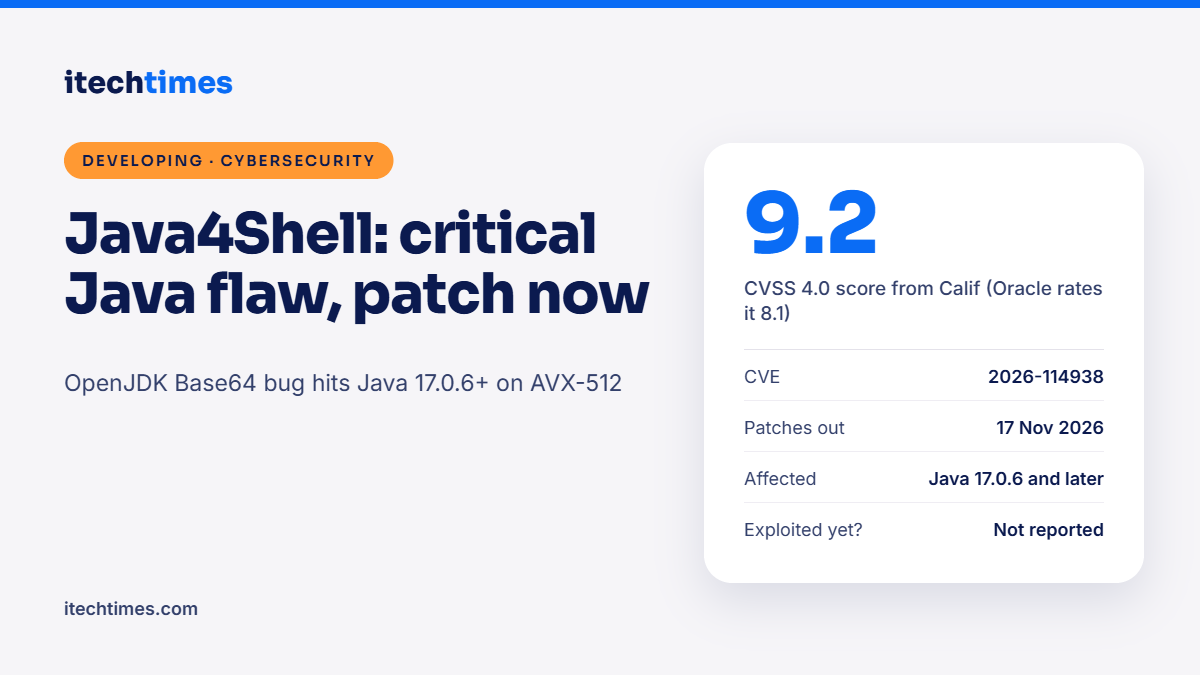
A critical bug in Java’s Base64 decoder can let attackers take over some servers. Patches are out, and no attacks have been reported yet.
DEVELOPING STORY. Last updated: 18 November 2026, 11:45 IST. We will update this page as vendors ship fixes and if exploitation is reported.
Key takeaways
- Java4Shell (CVE-2026-114938) is a memory corruption flaw in OpenJDK’s Base64 decoder, disclosed on 17 November 2026.
- It affects Java 17.0.6 and later, including the 21, 25 and 27 lines, but only on x86-64 servers with AVX-512 VBMI chips.
- Calif, which found it, rates it 9.2 (CVSS 4.0); Oracle rates it 8.1 (CVSS 3.1) with high attack complexity.
- Oracle and OpenJDK released fixes on 17 November, and CISA urged organisations to patch immediately.
- No exploitation in the wild had been reported at the time of writing.
Is Java4Shell real, and is my Java at risk? Yes, it is real. Java4Shell can let an attacker crash, read memory from or, in some cases, take control of a Java application by sending crafted Base64 text. You are exposed only if you run unpatched Java 17.0.6 or later on an x86-64 CPU with AVX-512 VBMI, and your app decodes untrusted Base64 input.
What is Java4Shell?
Java4Shell is the nickname for CVE-2026-114938. The bug sits in a hand-tuned shortcut that speeds up Base64 decoding on newer Intel and AMD processors. According to CyberScoop, a specific malformed string makes the decoder miscalculate a length and write 64 bytes into a buffer sized for 50, overwriting nearby memory.
Usually that just crashes the program. But Calif showed that by carefully arranging memory first, an attacker can turn the overflow into a full takeover of the server. The same bug can also leak nearby memory, which CyberScoop likened to the 2014 Heartbleed bug; Calif says it could expose keys and tokens.
Base64 is everywhere in web software. It is used in login headers, tokens such as JWTs and many APIs, which is why a flaw in Java’s built-in decoder gets attention quickly.
Who found it, and how?
Security firm Calif reported the flaw. Oracle credits Quang Luong of Calif.io and Albert Yang. CyberScoop reports that Luong found the bug in about an hour while auditing OpenJDK with OpenAI’s Codex, at a cost of under $200 in compute, and that Calif says AI agents built most of its exploit chains. Calif also says details leaked before a fix was ready.
Which versions and systems are affected?
Three conditions must all be true for a system to be at risk.
| Condition | At risk | Not at risk |
|---|---|---|
| Java version | OpenJDK-based 17.0.6 and later, plus 21, 25 and 27 lines (unpatched) | Builds before 17.0.6, including standard Java 8 and 11 |
| Processor | x86-64 with AVX-512 VBMI, such as Intel Xeon Ice Lake to Granite Rapids, AMD Zen 4 and newer | ARM64 (including Graviton-type servers) and x86-64 without AVX-512 VBMI |
| Application | Decodes Base64 from untrusted sources, such as web requests | Never handles untrusted Base64 |
One exception: Oracle lists its Java SE 8 Enterprise Performance Pack build 8u511b33-perf as affected. Tenable notes distributions from Amazon Corretto, Eclipse Temurin, Microsoft, Azul Zulu, BellSoft Liberica, SAP and Red Hat are all based on the affected code, so check your vendor’s advisory.
Which apps have been shown to be exploitable?
In Calif’s testing with default settings, these products could be attacked:
- Before login: Keycloak, Jira, Confluence, JFrog Artifactory, Jenkins and PingFederate.
- After login: Kafka, Solr, Elasticsearch, Gerrit and Spinnaker.
Calif says there is no universal exploit, and each application needs its own attack chain. It is holding back product-specific exploit details for now. Separately, researcher samczsun showed that a Java program connecting over TLS to a malicious server could be compromised, so client software is not automatically safe.
Are 450 Fortune 500 companies really at risk?
That claim, which went viral on X, overstates things. Calif estimates that OpenJDK runs at around 90% of Fortune 500 companies, which is where the “450” figure comes from. But using Java is not the same as being vulnerable. Each company is exposed only where all three conditions above line up on an unpatched system. Nobody has published a count of actually vulnerable servers or companies.
The real picture is serious but narrower: a widely used platform, popular internal tools such as Jira and Jenkins in the affected list, and a working proof of concept for the crash, but no confirmed attacks so far.
Has it been exploited yet?
Not as of the latest reports. Tenable, Sophos and Cisco Talos all said they knew of no in-the-wild exploitation, and The Hacker News reported that the flaw was not yet in CISA’s Known Exploited Vulnerabilities catalog. Talos expects probing to begin soon now that details are public. The Hacker News also reported that other labs have reproduced the crash and a memory leak, but not remote code execution.
CISA issued an alert on 17 November strongly urging organisations to patch the flaw immediately.
What are the fixed versions?
| Vendor | Fix status (as of 18 Nov) |
|---|---|
| Oracle Java SE | 17.0.21.1, 21.0.13.1, 25.0.5.1, 27.0.1.1; 8u513-perf |
| Amazon Corretto | Fixed builds released, including 17.0.21.1.2 |
| Azul Zulu | Fixed builds for 17, 21, 25 and 27 |
| GraalVM | November releases include the fix |
| Red Hat (RHEL 8, 9, 10) | Fixes not yet available at last check |
| Eclipse Temurin, Microsoft OpenJDK, BellSoft Liberica | Fixed builds not yet listed at last check |
What should Indian companies and developers do now?
Indian IT services firms, banks, fintechs and startups rely heavily on Java and on tools like Jira, Confluence, Jenkins and Keycloak. Here is a practical checklist:
- Find your Java. Run
java -versionon servers and check runtimes bundled inside products and Docker images, not just the system Java. - Check the CPU. On Linux, see whether all four flags avx512f, avx512bw, avx512vbmi and bmi2 appear in /proc/cpuinfo. Cloud instances on recent Intel or AMD chips often qualify.
- Patch internet-facing systems first. Start with login portals, SSO (Keycloak, PingFederate), CI servers and Atlassian tools.
- Use a stopgap if you cannot patch today. Calif and Qualys suggest starting the JVM with
-XX:-UseBASE64Intrinsics, or-XX:UseAVX=2on x86-64 only. Both need a restart, can slow things down and do not replace patching. - Rebuild containers once your vendor ships fixed base images.
- Watch for crashes. Repeated JVM crashes on public services could be a sign of probing.
- Report incidents. If you suspect a compromise, follow CERT-In’s incident reporting rules. We could not find a CERT-In advisory specific to this flaw at the time of writing.
FAQs
What is CVE-2026-114938?
It is a memory corruption flaw in OpenJDK’s Base64 decoder, nicknamed Java4Shell. On affected hardware it can let an unauthenticated attacker crash an app, leak memory or run code.
Is Java 8 or Java 11 affected?
Standard Java 8 and 11 are not affected, because the bug arrived in 17.0.6. The exception is Oracle’s Java SE 8 Enterprise Performance Pack build 8u511b33-perf, which Oracle lists as affected.
Are ARM servers safe?
Yes. ARM64 systems are not affected. Do not use the -XX:UseAVX=2 workaround on ARM, as Java will not start with it.
Is Java4Shell being exploited?
No in-the-wild exploitation had been reported as of 18 November. Security firms expect attackers to start probing, so patching should not wait.
Is Java4Shell as bad as Log4Shell?
It is serious, but the conditions are narrower. Log4Shell hit a common library on almost any system, while Java4Shell needs specific Java versions, specific CPUs and untrusted Base64 input, and each app needs its own exploit.
How do I fix it?
Update to your vendor’s fixed Java build, such as Oracle 17.0.21.1 or 21.0.13.1. If you cannot patch yet, the JVM flag -XX:-UseBASE64Intrinsics is a temporary workaround.
Sources
- Tenable: Java4Shell FAQ
- CyberScoop: Researchers disclose critical flaw in Java with help of AI
- Cisco Talos: CVE-2026-114938 critical vulnerability in OpenJDK
- Qualys: How to find, mitigate and patch Java4Shell
- The Hacker News: Java4Shell enables pre-auth RCE
- Sophos: Java4Shell could allow remote code execution
- Cyber Daily: CISA, Oracle and experts recommend urgent action