


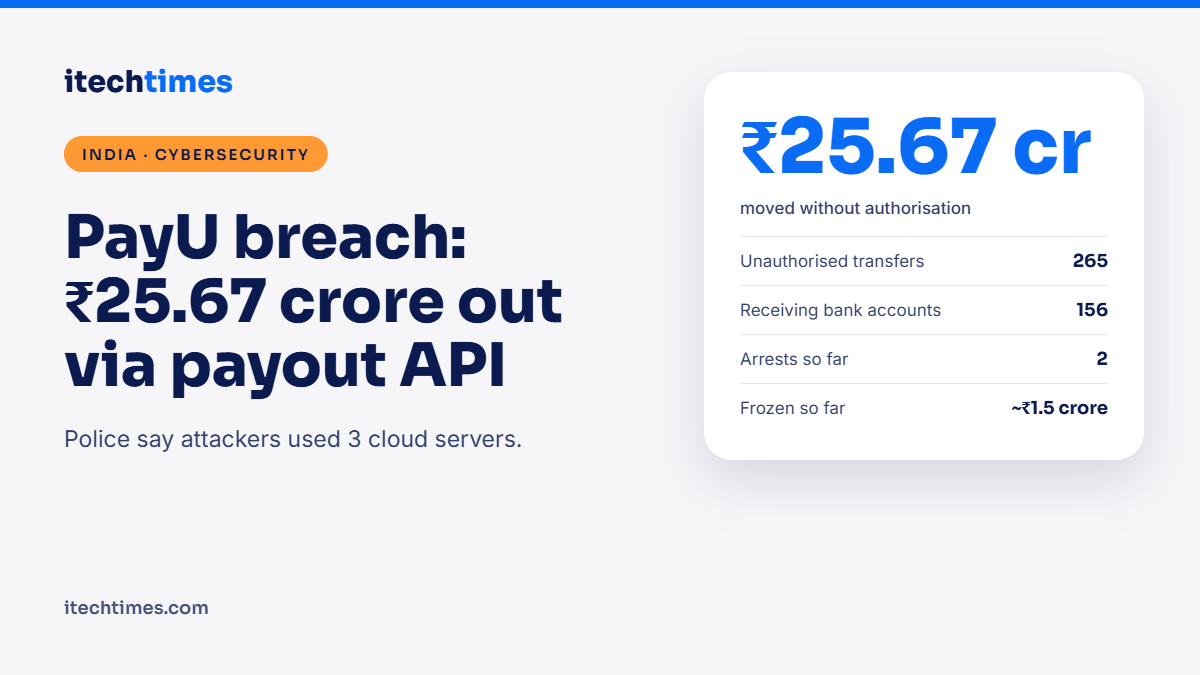
Attackers allegedly got into three of PayU’s cloud servers and used its own payout system to send money to 156 bank accounts. Here is what we know, what is still unclear, and what every Indian business using payout APIs should check this week.
Key takeaways
- Payment company PayU lost ₹25.67 crore in an alleged cyberattack on its cloud servers, according to police and media reports.
- Police say attackers accessed three cloud servers, manipulated the payout API and made 265 unauthorised transfers to 156 bank accounts.
- PayU’s security team spotted unusual API activity at about 11:30 pm on 5 November, after the transfers had already gone through.
- Gurugram Cyber Police arrested two men in Ludhiana on 15 November for allegedly supplying mule accounts; about ₹1.5 crore has been frozen so far.
- CERT-In and CSIRT-Fin had warned financial firms about exactly this kind of payout API abuse in an advisory dated 9 October 2026.
What happened in the PayU breach? Attackers allegedly accessed three cloud servers belonging to PayU Payments Private Limited and misused its payout API to add new beneficiaries and move ₹25.67 crore without approval. Police say 265 unauthorised transactions went to 156 bank accounts. Two men have been arrested, and only about ₹1.5 crore has been frozen so far.
How did the attackers move ₹25.67 crore?
According to the police account reported by MediaNama, the attackers did not break into customer wallets or cards. They went after the machinery PayU uses to send money out. A payout API is the system a payment company uses to push money to bank accounts in bulk, for things like vendor payments, refunds, salaries or seller settlements.
Police say the attackers got into three cloud servers and manipulated this payout API. They then added new beneficiaries and transferred funds without PayU’s authorisation. Because the requests came through PayU’s own trusted system, the banks on the receiving side would have seen them as normal payouts.
The scale is what makes this case stand out. There were 265 separate transactions spread across 156 bank accounts, which is a classic way of breaking a large sum into smaller pieces that are harder to stop.
| Detail | What has been reported |
|---|---|
| Company | PayU Payments Private Limited |
| Amount moved | ₹25.67 crore |
| Servers accessed | 3 cloud servers |
| Unauthorised transactions | 265 |
| Receiving bank accounts | 156 |
| Detected | About 11:30 pm, 5 November 2026 |
| Complaint filed | 9 November 2026 |
| Arrests | 2, in Ludhiana on 15 November 2026 |
| Funds frozen so far | About ₹1.5 crore |
When was the PayU attack spotted?
The first warning came from PayU’s cloud service provider, which flagged suspicious access. PayU’s own security team then picked up unusual API activity at around 11:30 pm on 5 November. By that point, the money had already left.
PayU filed a police complaint on 9 November. The case is being handled by Gurugram Cyber Police. Officers are waiting for an audit report to establish exactly how the systems were breached, so the entry point has not been made public yet.
Who has been arrested so far?
Police arrested two men, Atar Singh and Lovepreet Singh, in Ludhiana, Punjab, on 15 November. They are not accused of carrying out the hack itself. Police say they supplied the bank accounts that received the stolen money, which is what investigators call mule accounts.
Around ₹6.20 lakh was traced to Atar Singh’s account. Police allege he handed the account to Lovepreet Singh for a 2% commission, and Lovepreet passed it on to another person for a further 2%. Both have been remanded to police custody. The people who actually got into PayU’s servers have not been publicly identified.
This chain of small commissions is typical of how mule networks work in India. Ordinary account holders are paid a cut to let strangers use their accounts, often without realising they could end up facing criminal charges.
Was this attack predictable?
In a sense, yes. On 9 October 2026, CERT-In and CSIRT-Fin issued an advisory (reference CIAD-2026-0046) warning financial institutions about attacks on payment and disbursement APIs. It described attackers stealing API credentials, using trusted systems to send money to mule accounts, and getting around beneficiary checks and transaction limits.
That description closely matches what police say happened at PayU. However, investigators have not confirmed whether the PayU attack actually used any of the weaknesses described in that advisory, so the link should not be treated as proven.
PayU is also not the first Indian payments player to be hit this way. MediaNama points to earlier cases, including a ₹7.38 crore fraud reported by Razorpay in May 2022, where 831 failed transactions were treated as successful, and the July 2024 ransomware attack on C-Edge Technologies, which led NPCI to temporarily cut the provider off from retail payment systems.
Is this part of a bigger pattern this month?
The PayU case lands in a week when third-party and back-end systems are under the spotlight. On 19 November, crypto exchange CoinDCX told users that unauthorised access at Plotline, a vendor it uses for in-app messages, exposed names, email IDs and bank names for a small number of users in two windows in late October. CoinDCX said its own systems, wallets and customer funds were not affected.
The two incidents are different. One involves money leaving through a payout system, the other involves contact details leaking through a messaging vendor. But both show that attackers are increasingly going after the plumbing around a fintech, not just its front door.
What is still unclear?
- How the attackers first got access to the three cloud servers.
- Whether specific security controls, such as beneficiary approval or transaction limits, failed or were bypassed.
- Whether any merchant funds were affected, or whether the loss sits only with PayU.
- Who carried out the intrusion, as the two arrested men are accused only of supplying accounts.
Until the audit report is out, treat any detailed explanation of the method as speculation.
What should Indian businesses using payout APIs do now?
If your company uses a payout or disbursement API from any provider, this is a good week to review how it is locked down. Practical steps:
- Rotate API keys and secrets and make sure they are not stored in code repositories, shared drives or chat tools.
- Restrict API access by IP address so payout calls only work from your known servers.
- Turn on maker-checker approval for new beneficiaries, so no single key or person can add a payee and pay them in one go.
- Set daily and per-transaction limits that match your real business volumes, and alert on anything above them.
- Watch for odd timing. A burst of payouts late at night, like the one seen at PayU, should trigger an automatic hold.
- Read the CERT-In and CSIRT-Fin advisory from 9 October and check your setup against it.
- Report incidents quickly. Cyber fraud can be reported on the national helpline 1930 or at cybercrime.gov.in, and regulated entities have their own CERT-In reporting duties.
For individuals, the lesson is simpler. Never lend or rent out your bank account, even for a small commission. As this case shows, account holders are often the first people police can trace.
Frequently asked questions
How much money did PayU lose in the breach?
According to police and media reports, ₹25.67 crore was moved out through 265 unauthorised transactions. About ₹1.5 crore has been frozen so far, and recovery efforts are ongoing.
Were PayU customers’ cards or UPI accounts hacked?
Nothing reported so far suggests customer cards or UPI accounts were accessed. Police say the attackers misused PayU’s payout API on its cloud servers. Whether any merchant funds were affected has not been confirmed.
Who was arrested in the PayU case?
Gurugram Cyber Police arrested Atar Singh and Lovepreet Singh in Ludhiana on 15 November. Police say they supplied bank accounts used to receive the money, not that they carried out the hack.
What is a payout API?
It is a system that lets a business send money to many bank accounts automatically, for refunds, vendor payments or seller settlements. If attackers control it, they can make transfers look like legitimate business payments.
Did CERT-In warn about this kind of attack?
Yes. A CERT-In and CSIRT-Fin advisory dated 9 October 2026 warned about attacks on payment and disbursement APIs using stolen credentials and mule accounts. Investigators have not yet confirmed whether the PayU attack used those methods.
How do I report cyber fraud in India?
Call the national cyber crime helpline 1930 as soon as possible, or file a complaint at cybercrime.gov.in. Reporting quickly improves the chances of freezing money before it is withdrawn.
Sources
- MediaNama: PayU loses Rs 25.67 crore in alleged cloud server breach; two arrested (19 November 2026)
- Inc42: Breach at external vendor exposes CoinDCX user data (19 November 2026)
- EpiFive: Tech news today, 19 November 2026

One thought on “PayU Breach: How ₹25.67 Crore Left Through a Payout API”