


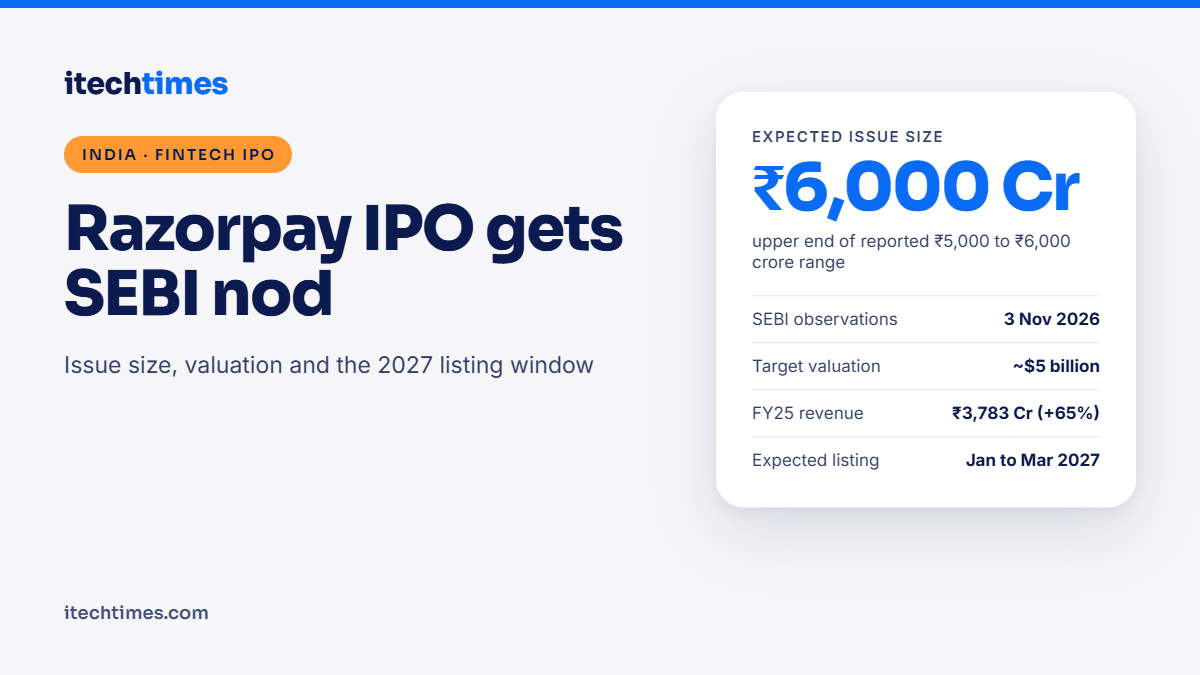
India’s best-known payments startup has cleared the market regulator’s review. Here is what we know about the size of the issue, the valuation, the numbers behind the business and when retail investors may get a chance to apply.
Key takeaways
- SEBI issued its observations on Razorpay’s draft IPO papers on 3 November 2026, which allows the company to go ahead with a public issue.
- Reports put the issue size at ₹5,000 crore to ₹6,000 crore (about $530 million to $630 million), with a mix of fresh shares and an offer for sale. The final split has not been disclosed.
- The company is reportedly targeting a valuation of around $5 billion (about ₹47,000 crore), lower than the $7.5 billion it was valued at in 2021.
- In FY25, Razorpay’s operating revenue rose 65% year on year to ₹3,783 crore, but the company slipped into a loss because of ₹1,209 crore in ESOP costs and one-time costs linked to moving its base from the US to India.
- Listing is expected between January and March 2027.
When is the Razorpay IPO coming? Razorpay has received SEBI’s go-ahead for its IPO, with the regulator issuing observations on its draft papers on 3 November 2026. Reports suggest a ₹5,000 crore to ₹6,000 crore issue at a valuation near $5 billion, with listing likely between January and March 2027. Price band and dates are not out yet.
What exactly did SEBI approve?
Razorpay filed its draft IPO papers in June 2026 through SEBI’s confidential pre-filing route. Under this route, the company does not have to make its draft document public while the regulator reviews it. Reports citing SEBI’s processing status say observations were issued on 3 November, and the update was widely reported on 13 and 14 November.
In plain terms, “observations” are SEBI’s final comments on the draft. Once a company receives them, it is free to move to the next stages of the IPO. It is not a guarantee that the issue will open on a particular date, and it says nothing about whether the shares are fairly priced.
Razorpay was cleared in the same batch as Sembcorp Green Infra and MakeMyTrip India, according to CNBC-TV18’s report.
How big is the Razorpay IPO and what is the valuation?
The company has not officially announced the size. People familiar with the matter told reporters it could be between ₹5,000 crore and ₹6,000 crore. The issue is expected to include a fresh issue of shares, which brings new money into the company, and an offer for sale, where existing shareholders sell part of their stake. Selling shareholders have not been named publicly.
On valuation, reports say Razorpay is aiming for around $5 billion. At the time of its confidential filing in June, the target range was reported at $5 billion to $6 billion. Both numbers are below the $7.5 billion valuation from its 2021 funding round, which reflects how the market for late-stage startup valuations has cooled since the funding boom.
| Item | What is known |
|---|---|
| Draft papers filed | June 2026, confidential route |
| SEBI observations | 3 November 2026 |
| Expected issue size | ₹5,000 crore to ₹6,000 crore (reported) |
| Structure | Fresh issue plus offer for sale (split not disclosed) |
| Target valuation | About $5 billion (about ₹47,000 crore), reported |
| Last private valuation | $7.5 billion (2021) |
| Expected listing | January to March 2027 |
| Founded | 2014, by Harshil Mathur and Shashank Kumar |
What do Razorpay’s financials look like?
The latest full-year numbers in public reports are for FY25. Operating revenue grew 65% year on year to ₹3,783 crore. That is strong growth for a company of its size.
However, the company reported a loss for the year. Reports link this to ₹1,209 crore in ESOP (employee stock option) expenses, plus one-time restructuring and tax costs connected to its “reverse flip”, the move of its parent company from the US back to India ahead of listing. Investors should look closely at how much of the loss is one-off and how much is recurring once the full offer document is public.
| FY25 metric | Figure |
|---|---|
| Operating revenue | ₹3,783 crore |
| Year-on-year growth | 65% |
| ESOP expenses | ₹1,209 crore |
| Bottom line | Loss (reported), due to ESOP and one-time redomicile costs |
What does Razorpay actually do?
Razorpay started as a payment gateway that lets online businesses accept cards, UPI, net banking and wallets. It now offers business banking, payouts, payroll and lending, and serves startups, small businesses and large companies.
Over the past year it has also pushed into AI. It expanded a partnership with OpenAI to help Indian brands advertise on ChatGPT through its Razorpay Engage platform, built a payments-focused AI model called Vulcan using NVIDIA and AWS technology, and ran a beta of Agent Studio, a platform for task-specific AI agents that around 200 businesses were using as of August.
The company has raised more than $800 million from investors. Reported backers include Y Combinator, Tiger Global, Ribbit Capital, Lightspeed, Peak XV Partners, GIC, Lone Pine Capital, Alkeon Capital and TCV.
What happens next in the confidential IPO route?
Because Razorpay used the confidential route, retail investors have not yet seen a full draft prospectus. The next steps under SEBI’s rules for pre-filed offer documents are:
- UDRHP-I: The company files an updated draft red herring prospectus that is made public. This must happen within 16 months of SEBI’s observations.
- Public comments: The UDRHP-I stays open for public comments for at least 21 days.
- RHP and launch: The company then files the red herring prospectus with the price band and dates. The issue must open within 18 months of SEBI’s observations.
So the first time you will see detailed financials, risk factors and the exact offer for sale break-up is when the UDRHP-I is published.
What should Indian investors do now?
This is not investment advice. Do your own research or speak to a SEBI-registered adviser before investing.
- Wait for the public document. Read the UDRHP-I when it comes out, especially the sections on losses, ESOP costs, related-party deals and risk factors.
- Watch the offer for sale share. A large offer for sale means more money goes to existing investors rather than into the business.
- Compare with listed peers. Look at how listed fintech and payments companies trade relative to their revenue and profits before judging the price band.
- Be careful with grey market chatter. Unofficial grey market premiums are not regulated and often change sharply before listing.
- Keep your demat and UPI mandate ready. Most retail IPO applications today go through ASBA with a UPI mandate, so check that your UPI ID is linked to the bank account you want to use.
Why does this IPO matter for India’s startup market?
Razorpay is one of the largest Indian fintech names to head towards the public market after a reverse flip. A successful listing would add weight to the argument that Indian startups can raise large sums at home rather than listing abroad. A weak listing, on the other hand, could make late-stage investors more cautious about valuations across fintech.
Frequently asked questions
Has Razorpay announced its IPO date?
No. SEBI has issued its observations, but the company has not announced a price band or subscription dates. Reports suggest a listing between January and March 2027.
How big will the Razorpay IPO be?
Reports put the size at ₹5,000 crore to ₹6,000 crore. The company has not confirmed the final number or the split between fresh shares and the offer for sale.
What valuation is Razorpay targeting?
Reports say about $5 billion, or roughly ₹47,000 crore. That is below its 2021 private valuation of $7.5 billion.
Why can’t I read Razorpay’s draft prospectus yet?
Razorpay used SEBI’s confidential pre-filing route, so the first draft was not made public. An updated public draft, called UDRHP-I, will be released before the issue and will stay open for comments for at least 21 days.
Is Razorpay profitable?
Razorpay reported a loss in FY25, mainly because of ₹1,209 crore in ESOP costs and one-time costs linked to shifting its base to India. Operating revenue grew 65% to ₹3,783 crore in the same year.
What is a reverse flip?
A reverse flip is when an Indian startup that had its parent company abroad, often in the US, moves its legal base back to India. Many startups do this before listing on Indian stock exchanges.
Sources
- Inc42: Razorpay Gets SEBI Nod For ₹6,000 Cr IPO
- BW Disrupt: Razorpay Gets Sebi Nod For Rs 5,000-6,000 Cr IPO, Listing Likely In Q1 2027
- CNBC-TV18 via TradingView: Razorpay IPO gets Sebi nod
- Corporate Professionals: SEBI’s confidential IPO route explained

One thought on “Razorpay IPO Gets SEBI Nod: Size, Valuation and Timeline”