RBI has rolled its cyber security rules for wallets, payment gateways, card networks and NPCI into one rulebook, and several of the changes show up right on your phone.
By Rajan | Published 12 November 2026 | 7 min read
Key takeaways
- On 5 November 2026, RBI issued one consolidated set of Master Directions on cyber resilience and digital payment security for non-bank payment system operators (PSOs).
- The rules apply immediately to large and medium operators such as NPCI, card networks, payment aggregators and large wallet issuers. Small operators have until 1 April 2028.
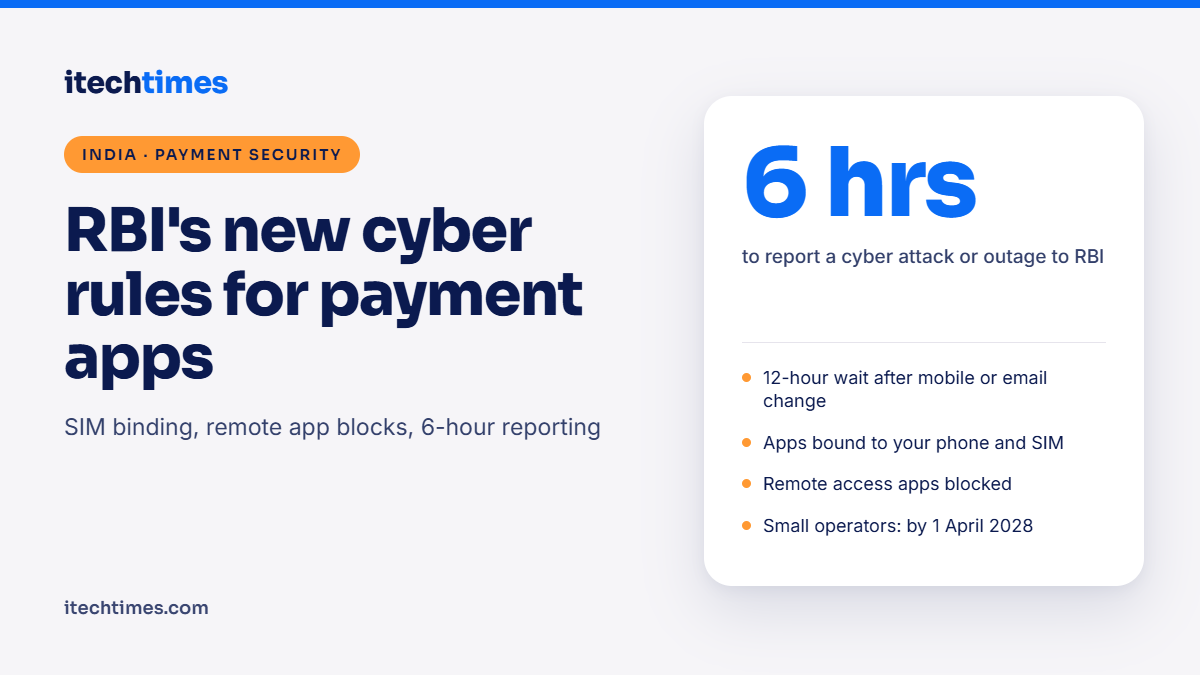
- Payment apps must bind to your phone and SIM, try to detect remote access apps and block the app while they run, and wait at least 12 hours before allowing online payments after you change your registered mobile number or email.
- Operators must report cyber attacks, critical outages, internal fraud and settlement delays to RBI within 6 hours of detection, and report cyber incidents to CERT-In.
- SMS and email alerts must show the real merchant name and amount, put the OTP at the end of the message and mask account and card numbers where possible.
What has RBI changed for payment apps? RBI has replaced its July 2024 cyber security directions for non-bank payment companies with one consolidated rulebook dated 5 November 2026. It covers NPCI, card networks, payment aggregators, wallet issuers and white label ATM operators, and it adds phone-level safeguards such as SIM binding, remote access app blocking and clearer transaction alerts.
What exactly did RBI issue on 5 November?
The document is called the Master Directions on Cyber Resilience and Digital Payment Security Controls for non-bank Payment System Operators (reference RBI/DPSS/2026-27/475). It was issued under the Payment and Settlement Systems Act, 2007.
RBI’s stated aim is a single reference point. The new directions take the cyber resilience and payment security rules first issued on 30 July 2024 and merge them with older instructions on ATM switch service providers (December 2019) and annual system audits (January 2020). Six earlier circulars, the oldest from 2009, have been repealed.
Who has to follow the new rules, and by when?
RBI sorts payment system operators into three groups. Banks are not part of this framework; it is aimed at non-bank players.
| Category | Who is included | Deadline |
|---|---|---|
| Large | NPCI, NPCI Bharat BillPay, card networks, payment aggregators, large prepaid wallet issuers, non-bank ATM networks, white label ATM operators, CCIL, Bharat Bill Payment operating units, TReDS platforms | Immediately, from the date the directions were placed on RBI’s website |
| Medium | Inbound cross-border money transfer operators, medium prepaid wallet issuers | Immediately |
| Small | Small prepaid wallet issuers, instant money transfer operators | 1 April 2028 |
What will you notice on your phone?
Several controls are customer-facing. Expect your payment apps to behave a little differently over the coming months.
- Device and SIM binding: the app must be tied to both your handset and your SIM. If you leave the app unused beyond a set period, it must bind again.
- Remote access app blocking: apps must try to detect screen sharing and remote control apps and block the payment app while one is running. This targets the common scam where fraudsters ask victims to install a remote access tool.
- 12-hour cooling period: after you change the mobile number or email linked to a payment instrument, online payments must wait at least 12 hours. This safeguard was already in the 2024 rules and has been carried forward.
- Wallet top-up cooling: prepaid wallet issuers must apply a cooling period before newly loaded money can be transferred or withdrawn.
- Clearer alerts: SMS and email alerts must name the actual merchant (not the payment gateway) and the amount, show the beneficiary’s name for fund transfers, place the OTP at the end of the message and mask account and card numbers where possible. RBI encourages OTPs and alerts in regional languages.
- One-tap fraud flagging: you must be able to mark a transaction as fraudulent inside the app or website so the issuer is notified straight away.
- Two-factor authentication: every electronic debit, including cash withdrawals, needs more than one authentication factor unless RBI has explicitly relaxed it.
What must payment companies do behind the scenes?
The bigger workload sits with the operators. The main obligations include:
| Requirement | What the rules say |
|---|---|
| Incident reporting | Report cyber attacks, critical outages, internal fraud and settlement delays to RBI within 6 hours of detection; report cyber incidents to CERT-In |
| Fraud desk | A manned facility running 24x7x365 to handle customer fraud complaints and respond to law enforcement |
| Annual audit | System audit report within two months of the financial year end (1 June for April to March companies); fix open findings within three months |
| Logs | Keep system audit logs for at least five years |
| Disaster recovery | Drills at least once every six months; backup site in a different seismic zone |
| Vendor software | Hold source code for critical bought-in applications, or keep it in escrow; otherwise get a developer certificate that it is free of known vulnerabilities and malware |
The board is now directly responsible for cyber risk. It can delegate oversight to a committee led by someone with information or cyber security experience, and that committee must meet at least once a quarter. Each operator also needs a senior security head, such as a CISO, real-time or near real-time fraud monitoring and a security operations centre.
How does this fit with RBI’s other recent moves?
These directions arrive in a busy month for payment security. MediaNama reports that a confidential RBI advisory dated 3 November asks banks to tighten security on the APIs that NBFCs and fintechs use, with beneficiary whitelisting or maker-checker approval by 3 December 2026 and audits of NBFC API clients by CERT-In-empanelled auditors by 3 February 2027. RBI is also examining a customer “kill switch” to block all debits, though that idea is not final.
What should you do now?
If you use UPI, wallets or cards:
- Update your payment apps as soon as new versions arrive, since many of these controls ship as app updates.
- Never install a screen sharing or remote access app because a caller asked you to. If your payment app refuses to open while such an app is running, that is the new rule working as intended.
- Read the merchant name and amount in every alert. If something looks wrong, use the in-app fraud flag, call the national cyber crime helpline 1930 and file a complaint at cybercrime.gov.in.
- Expect a short wait for online payments after you change your registered number or email. Plan big payments around it.
If you run or build for a payment company:
- Map your licence to the large, medium or small category and confirm your deadline.
- Test your 6-hour RBI reporting workflow end to end, including who decides that an event is reportable.
- Review vendor contracts for source code access or escrow and developer certificates.
Frequently asked questions
Does this apply to UPI apps like Google Pay or PhonePe?
The directions apply to authorised non-bank payment system operators, a list that includes NPCI, payment aggregators and wallet issuers. How individual app features change will depend on each company’s licences and its role in the payment chain, so watch for app updates and notices from your provider.
When do these rules take effect?
For large and medium operators, they applied as soon as RBI placed them on its website in November 2026. Small wallet issuers and instant money transfer operators have until 1 April 2028.
Why can’t I make online payments right after changing my mobile number?
RBI requires a minimum 12-hour cooling period after you change the registered mobile number or email linked to a payment instrument. It stops fraudsters who take over an account from draining it immediately.
Why does my payment app not open when a screen sharing app is running?
The new rules require apps to detect remote access apps where possible and block the payment app while one is active. Scammers often use these tools to watch or control a victim’s phone.
How quickly must a payment company report a cyber attack?
Within 6 hours of detection to RBI, using RBI’s format. Cyber security incidents must also be reported to CERT-In.
Sources
- RBI: Master Directions on Cyber Resilience and Digital Payment Security Controls for non-bank PSOs
- MediaNama: What RBI’s consolidated cyber security rules mean for payment apps and users
- Vinod Kothari Consultants: RBI’s consolidated master directions on cyber resilience for non-bank PSOs
- Outlook Money: RBI issues new cyber security rules for non-bank payment operators