


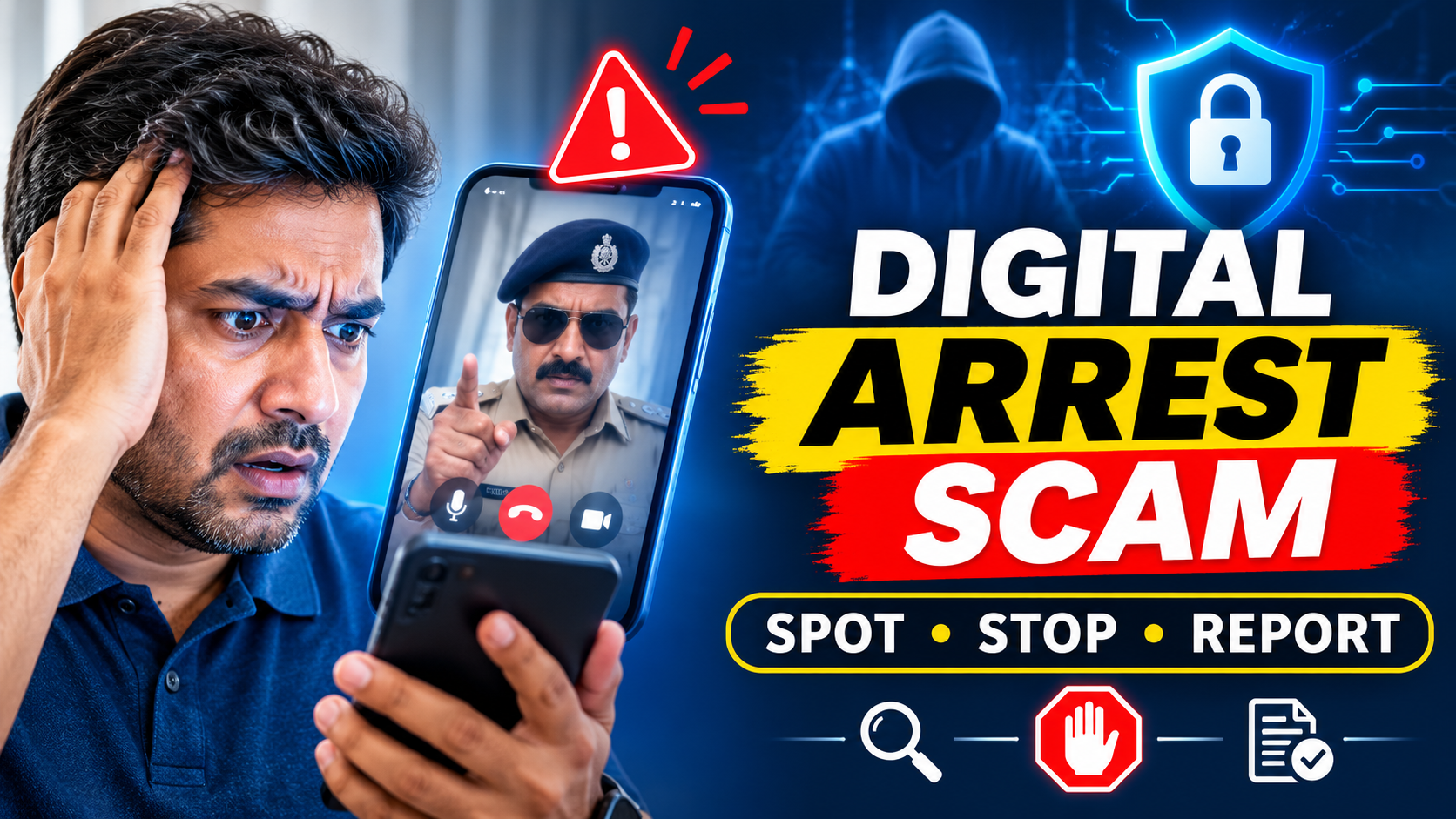
Fake police and CBI officers are still trapping Indians on video calls. This step-by-step guide shows you how to recognise the scam, what to do in the moment, and how to get your money back.
By Rajan | Published 6 November 2026 | Updated 6 November 2026 | 7 min read
Key takeaways
- There is no such thing as a “digital arrest” under Indian law. The Ministry of Home Affairs says police and agencies never arrest or question anyone over WhatsApp, Skype or Zoom.
- The National Cybercrime Reporting Portal logged 1,23,672 digital arrest complaints in 2024, 58,239 in 2025 and 16,377 up to 30 June 2026.
- If you are targeted, hang up, do not pay, and call 1930 immediately. Speed is the biggest factor in getting money back.
- Report every case at cybercrime.gov.in and inform your bank straight away.
- On 4 August 2026, the Supreme Court told the RBI to bring in a procedure for banks to hold suspicious transactions linked to these scams.
What is a digital arrest scam? It is a fraud in which criminals pose as police, CBI, ED, customs or RBI officials on a phone or video call. They claim you are linked to a crime and keep you “under arrest” on camera until you transfer money to “verify” your innocence. No Indian law allows this. A real officer will never arrest you on a video call or ask for money.
How does the digital arrest scam work?
Most cases follow the same pattern:
- The hook: you get a call, SMS or WhatsApp message saying a parcel in your name holds drugs, your Aadhaar or SIM is linked to money laundering, or your bank account is under investigation.
- The handover: you are “transferred” to a senior officer, often on a video call. They may wear a uniform, sit in a fake police station set, and show forged ID cards, FIRs or court notices.
- The isolation: you are told to stay on camera, not to tell your family, bank or a lawyer, and not to hang up, sometimes for hours or days.
- The demand: to “clear your name”, you must move money to a “safe”, “RBI verification” or “escrow” account, or share OTPs and banking details.
- The vanishing act: once the money moves, it is quickly split across mule accounts and the callers disappear.
What are the warning signs?
One red flag is enough to stop and check:
- Threats of immediate arrest or jail
- A demand for money to “close” or “settle” a case
- Orders to stay on video or keep the line open
- Instructions to keep it secret from family, your bank or local police
- Requests for OTPs, UPI PINs, card details or passwords
- Payments to a personal or unfamiliar account
- Requests to install an app, open a link or share your screen
- IDs or notices you cannot verify independently
What to do during the call: step by step
- Stay calm and hang up. You are not under arrest. You do not have to stay on the call.
- Do not pay anything. No government agency collects money over a call to prove innocence.
- Share nothing. Never give OTPs, PINs, passwords or Aadhaar details.
- Do not install apps or share your screen. Remote access apps let criminals control your phone.
- Verify independently. Find the agency’s official number on its government website and call it yourself. Never use a number the caller gives you.
- Tell someone you trust. Scammers rely on secrecy. A family member or friend can help you think clearly.
How to report a digital arrest scam
| Situation | What to do | Where |
|---|---|---|
| Money already sent | Call immediately, ideally within the first hour | 1930 National Cyber Fraud Helpline |
| Any scam attempt | File a complaint with all details | cybercrime.gov.in |
| Money sent from your account | Ask your bank to block and flag the transaction | Your bank’s official helpline or branch |
| Suspicious call, SMS or WhatsApp number | Report the number so it can be blocked | Chakshu on sancharsaathi.gov.in |
| Someone at risk right now | Contact local police | Nearest police station or 112 |
Before you delete anything, save screenshots of chats, the caller’s numbers, UPI IDs, account numbers, transaction IDs and any documents they sent. This evidence helps the police trace the money.
What to do if you have already paid
- Call 1930 at once. The helpline can alert banks to freeze the money before it moves further.
- Call your bank’s official helpline and ask them to flag the transaction and block your cards or UPI if needed.
- File the complaint on cybercrime.gov.in and note your acknowledgement number.
- If you shared an OTP or password, change your banking and email passwords from a different, safe device.
- If you installed an app, uninstall it, disconnect from the internet and get the phone checked before using banking apps again.
Recovery is not guaranteed, but it is possible. Government data shared with the Supreme Court shows money was restored to victims in 36,290 cases, totalling about ₹18.05 crore.
What is the government doing about it?
In a suo motu case, the Supreme Court issued interim directions on 4 August 2026. They include:
- The RBI must bring in a procedure for banks to put temporary holds on money linked to mule accounts and cyber fraud.
- States must run a money restoration mechanism and a grievance process for victims, now covering 57 banks and all 36 states and union territories.
- States must expand the e-Zero FIR system, which turns cyber fraud complaints into FIRs faster.
- The government must study a “kill switch” that could cut off suspicious audio and video calls. This is a proposal under review, not yet in force.
- The government will consider a compensation framework for victims.
How to protect your family
- Talk to elderly parents and relatives. Many victims are senior citizens. Explain that no real officer arrests anyone on video.
- Save 1930 in everyone’s phone under “Cyber Fraud Helpline”.
- Set a family rule: never send money because of a phone call without first speaking to a family member.
- Turn on transaction alerts and set daily UPI limits in your banking apps.
Frequently asked questions
Is digital arrest legal in India? No. The Ministry of Home Affairs has said there is no concept of digital arrest under any Indian law. Police and agencies cannot arrest or hold anyone in custody over a video call.
Can the CBI or police call me on WhatsApp? Officials may contact people by phone, but they will never arrest you on a call, keep you on video, or ask you to transfer money. Verify any such call through the agency’s official website.
What is the cyber fraud helpline number in India? Call 1930, the National Cyber Fraud Helpline. You can also file a complaint online at cybercrime.gov.in.
How quickly should I report a digital arrest scam? Immediately. The sooner you call 1930 and your bank, the better the chance of freezing the money before it is moved.
Can I get my money back after a digital arrest scam? Sometimes. Money has been restored to victims in more than 36,000 cases through the government’s restoration mechanism, but recovery depends on how fast you report.
How do I report a scam phone number? Use the Chakshu facility on the Sanchar Saathi portal (sancharsaathi.gov.in) to report suspicious calls, SMS and WhatsApp messages.
Sources
- Alert against incidents of “Blackmail” and “Digital Arrest” by cyber criminals, Ministry of Home Affairs via PIB
- Steps taken to address the issue of digital arrest scams, PIB
- National Cyber Crime Reporting Portal, I4C, Ministry of Home Affairs
- Sanchar Saathi (Chakshu: report suspected fraud communication), Department of Telecommunications
- SC issues interim directions on digital arrest scams, SCC Online
- Digital arrest scams in India: what the law says, Cyber Advocate
- Digital arrest scam in India: fake police calls and safety tips, MyArjuna

4 thoughts on “Digital Arrest Scam: How to Spot, Stop and Report It”