India’s consumer watchdog says paying extra before a driver accepts your ride is not a tip, and Ola must switch the prompt off.
By Rajan | Published 13 November 2026 | 6 min read
Key takeaways
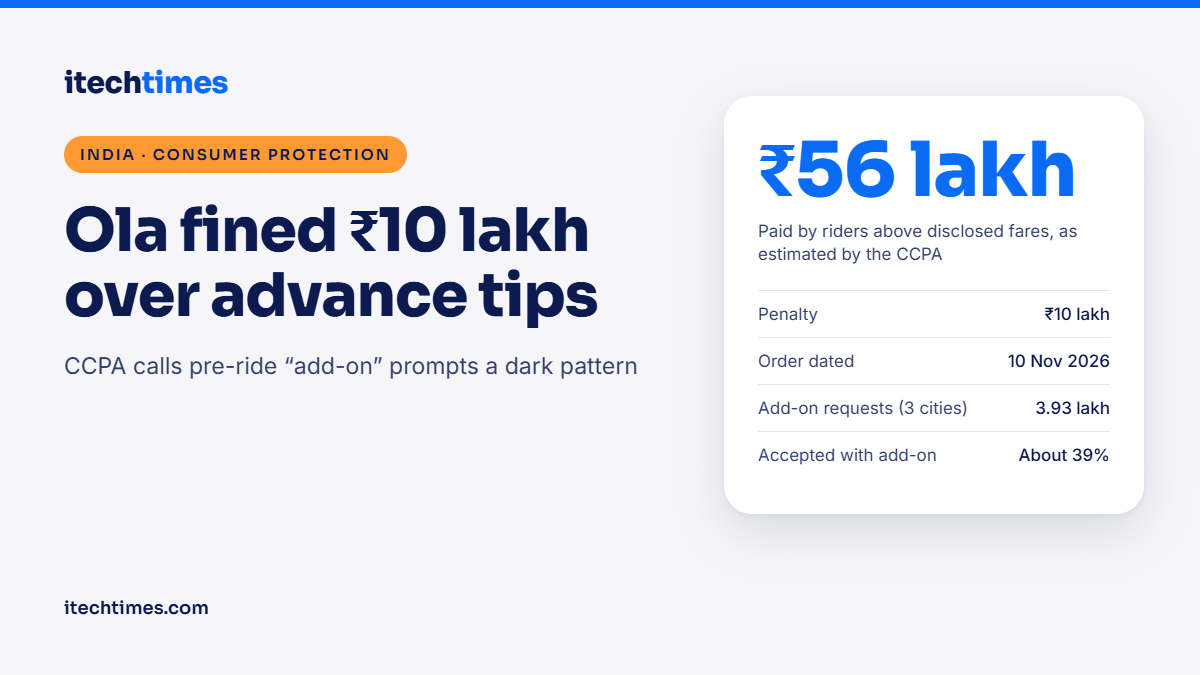
- The Central Consumer Protection Authority (CCPA) has fined ANI Technologies, which runs Ola, ₹10 lakh in an order dated 10 November 2026.
- The CCPA found Ola’s pre-ride “tip”, later renamed “add-on”, amounted to misleading advertising, an unfair trade practice, an unfair contract and the “confirm shaming” dark pattern.
- In Delhi, Bengaluru and Mumbai between 1 and 15 June 2026, about 3.93 lakh of 39.94 lakh ride requests carried an add-on, but only about 39% of those were accepted.
- The CCPA estimates riders paid about ₹56 lakh above the disclosed fare through the feature.
- Ola must stop the practice, pay within 15 days and file a compliance report. Rapido was fined the same amount for a similar feature earlier this year.
Why was Ola fined ₹10 lakh? The CCPA says Ola’s prompt, shown while riders waited for a driver, pushed people to pay extra by implying it would get them a cab faster. Payments taken before a ride is accepted are not voluntary tips, the regulator held, and the interface used guilt-style “confirm shaming” with no clear way to decline.
What exactly was the Ola add-on prompt?
While you waited for a driver to accept your booking, the Ola app showed a box suggesting you add money on top of the quoted fare. According to the order, as reported by Inc42 and MediaNama, the suggested amounts started at ₹10 to ₹40 when the feature appeared in April 2025 and later rose to as much as ₹140. Riders could also type in a custom amount, up to ₹499.
The wording mattered most. The prompt said adding a tip “might help” increase the chances of getting a ride faster. In May 2025 Ola renamed the “tip” an “add-on”, but the CCPA found the message still implied quicker confirmation. At a hearing in June 2026, the app was still showing a line inviting users to improve their chances of quicker ride confirmation.
What did the CCPA find in Ola’s own data?
The most damaging part of the order is the data. Ola shared ride request figures for Delhi, Bengaluru and Mumbai for 1 to 15 June 2026. They suggest that paying extra did not make a ride more likely to be accepted. If anything, the opposite was true.
| City | Acceptance with add-on | Acceptance without add-on |
|---|---|---|
| Delhi | 38% | 62% |
| Bengaluru | 40% | 68% |
| Mumbai | 39% | 68% |
Across the three cities, 39,94,464 requests were made in that fortnight. Of these, 3,93,221 (about 9.8%) carried an add-on, and 1,51,829 of those were accepted. The CCPA estimated that customers paid about ₹56 lakh over the disclosed fare through the feature.
The share of riders adding money was also rising. Between June 2025 and June 2026, uptake rose from 8.2% to 11.04% in Delhi, from 9.7% to 10.64% in Bengaluru and from 7.9% to 8.37% in Mumbai.
Why does the CCPA say it is not a tip?
Ola argued that the full add-on goes to drivers, that “might help” only signalled a probability, and that the add-on was part of the fare rather than a tip. The CCPA rejected each point.
- A tip rewards service already given. Money asked for before a driver has even accepted the trip works more like a payment for priority.
- The claim was misleading either way. If the add-on did not speed up rides, the promise was false. If it did, riders who did not pay were put at a disadvantage.
- Ola still benefited. Even if the money reached drivers, the feature could keep drivers on the platform and improve ride fulfilment.
- Low uptake was no defence. Every rider booking a trip saw the prompt, so every rider was exposed to it.
The regulator also pointed out that people booking from hospitals, railway stations, bus terminals and airports are often in a hurry, which makes them more likely to pay under pressure.
What is “confirm shaming” and why does it matter?
India’s Guidelines for Prevention and Regulation of Dark Patterns, 2023, list practices that trick or pressure users online. “Confirm shaming” is one of them. It means using fear, guilt or shame to nudge someone into an action, for example by suggesting that you will be stuck waiting if you do not pay more.
The CCPA also flagged that Ola’s prompt gave no simple option to decline or close it. For anyone who builds apps or online stores in India, this order is a clear reminder that the wording and design of a prompt, not just the price, can break consumer law.
Is this the first such penalty?
No. The CCPA imposed a ₹10 lakh penalty on Rapido for its advance tipping feature earlier this year, in an order reported in September 2026. In the Rapido case, the CCPA closed proceedings against Namma Yatri. Uber received a CCPA notice over its “Advance Tip” option in May 2025, and no outcome has been announced.
Separately, the Ministry of Road Transport and Highways has told ride-hailing aggregators to remove tipping prompts shown before or during a ride. Under its aggregator guidelines, tips are allowed only after a trip ends, must go fully to the driver and must not be presented in a misleading way.
Is ₹10 lakh a big fine for Ola?
Not in money terms. The CCPA itself noted that the penalty is less than 0.01% of Ola’s revenue from operations of about ₹1,060 crore in 2024-25. Ola operates in more than 200 cities and has over 4 crore users.
The cap is set by law. Under the Consumer Protection Act, 2019, the CCPA can impose up to ₹10 lakh for a first offence involving misleading advertisements and up to ₹50 lakh for repeat offences. The bigger impact is the direction to stop the practice, whatever it is called, and the precedent it sets for the entire ride-hailing and quick commerce sector.
What you should do as a rider
- Do not pay extra before a ride is accepted. According to the CCPA’s reading of Ola’s own data, it did not improve your chances.
- Tip after the trip, if you want to. A tip after a good ride is your choice and, under the aggregator guidelines, should go fully to the driver.
- Take screenshots. If any app still shows a pre-ride “pay more” prompt, save a screenshot with the date and time.
- Complain. You can call the National Consumer Helpline toll-free on 1915 (it works in 17 languages) or use the INGRAM portal, the NCH app or WhatsApp. For a formal case before a consumer commission, use the e-Daakhil portal.
- Check your fare breakdown. Look at the final receipt to see whether any add-on was charged and whether it was shown clearly before you agreed.
FAQs
What is the CCPA?
The Central Consumer Protection Authority is India’s regulator under the Consumer Protection Act, 2019. It can investigate unfair trade practices and misleading ads, order companies to stop them and impose penalties.
Will the tip option disappear from the Ola app?
The CCPA has directed Ola to stop showing any prompt that asks riders to pay above the upfront fare before a ride ends, whatever name it uses. Tipping after a completed ride is still allowed under the aggregator guidelines.
Can I get back the add-on money I paid earlier?
The order, as reported, does not set out a refund scheme for riders. If you believe you were misled, you can file a complaint through the National Consumer Helpline, keeping proof such as receipts and screenshots.
Is ₹10 lakh the maximum the CCPA can charge?
For a first offence of this kind, yes. The Consumer Protection Act, 2019 caps the penalty at ₹10 lakh for a first offence and ₹50 lakh for repeat offences, which is why both Ola and Rapido received the same amount.
Is Uber also facing action?
Uber received a CCPA notice in May 2025 over its “Advance Tip” feature, which offered ₹50, ₹75 or ₹100 upfront for faster pickup. No outcome has been made public yet.
What other apps use dark patterns?
The 2023 guidelines cover all platforms selling goods or services in India, including shopping, travel and food delivery apps. Common examples include false urgency, basket sneaking and drip pricing.
Sources
- Inc42: CCPA Fines Ola ₹10 Lakh For Advance Tipping Prompts
- MediaNama: CCPA fines Ola Rs 10 lakh for ‘confirm shaming’ tip prompts
- Bar and Bench: Why Rapido was fined but Namma Yatri wasn’t
- StartupTalky: Daily Indian Funding Roundup, 12 November 2026
- PIB: Department of Consumer Affairs note on National Consumer Helpline and e-Daakhil (PDF)