


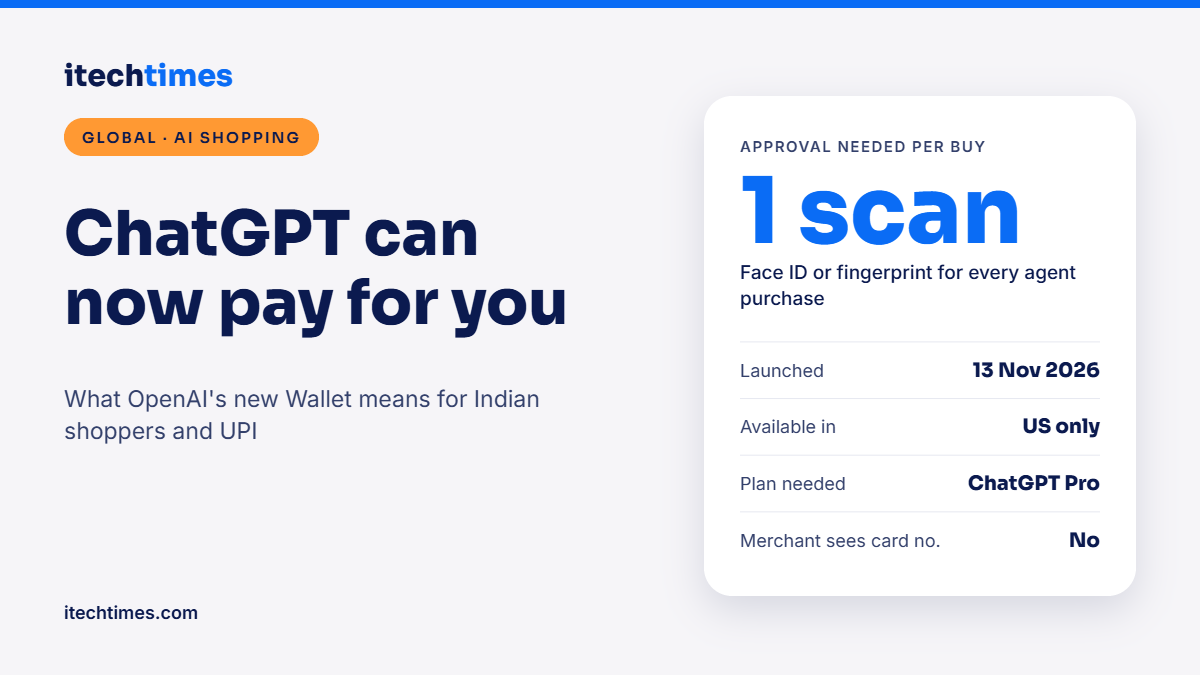
OpenAI’s new Wallet lets ChatGPT agents pay for things after a quick Face ID or fingerprint check. It is US-only for now, but India already has its own UPI version in the works.
Key takeaways
- OpenAI launched ChatGPT Wallet on 13 November 2026 (US time), letting its “dots” agents complete purchases for users.
- Every purchase must be approved with Face ID or a fingerprint, and the merchant never sees the real card number.
- It is limited to US residents aged 18 or above with a ChatGPT Pro plan and a US-issued Amex, Chase, Mastercard or Visa card.
- OpenAI has not given any timeline for India or other countries.
- In India, NPCI, Razorpay and OpenAI have been piloting UPI-based agent payments inside ChatGPT since October 2025.
What is ChatGPT Wallet and can Indians use it? ChatGPT Wallet is a new OpenAI feature that lets AI agents inside ChatGPT buy items for you using a saved card, after you approve each purchase with a biometric check. Indians cannot use it yet. It is open only to US residents on the ChatGPT Pro plan with US-issued cards, and OpenAI has not announced a date for other markets.
What did OpenAI launch?
OpenAI introduced ChatGPT Wallet on 13 November 2026. It works inside “dot” conversations, which are the agents in ChatGPT that can carry out tasks such as shopping. It does not work in regular ChatGPT chats, and you have to set up a dot before you can use it, according to Online Tech Tips, which reviewed OpenAI’s help documentation.
OpenAI built the feature with American Express, Mastercard and Visa, and its help pages also list Chase. Tech Times reports that fraud-prevention firms Forter, Riskified, Sardine and Signifyd, and payment providers Adyen, Checkout.com and Stripe, are also involved. The Wallet holds no cash or crypto balance. It simply stores your card for agent purchases.
How does ChatGPT Wallet work?
The flow is designed so that you stay in control of each payment:
- You save an eligible card to Wallet once.
- When a dot is ready to buy, ChatGPT shows you the merchant, the items, the total and the card it will use.
- You approve the purchase with Face ID or a fingerprint on a supported device.
- The card network issues a substitute payment credential, which can include a stand-in card number, security code and expiry date, for that one transaction.
- The merchant charges this token, and your real card is billed. Neither the agent nor the merchant sees your actual card details.
OpenAI says your card’s usual rewards and protections still apply. Mastercard’s Sherri Haymond said an agent’s purchase “should strengthen, not bypass, the trust built into payments,” as quoted by Tech Times.
Who can use it, and what are the limits?
| Requirement | Detail |
|---|---|
| Country | US residents only; dots are not available in the EEA, Switzerland or the UK |
| Age | 18 or older |
| Plan | ChatGPT Pro subscription |
| Card | US-issued Amex, Chase, Mastercard or Visa with a US billing address |
| Approval | Face ID or fingerprint for every purchase |
| Rollout | Gradual, so some eligible users may not see it yet |
OpenAI also plans to let users pre-approve purchases within set limits, such as spending caps, product categories and time windows, but has not given a date. Approval in ChatGPT also does not guarantee the order goes through. Merchants can still decline or flag an agent order, and not every website supports agent purchases.
What are the risks of letting an AI agent pay?
Tokens protect your card number, but they do not check whether the agent made a sensible choice. Tech Times highlights a few open problems:
- Prompt injection: A malicious web page could try to trick an agent into a bad purchase. There is no known complete fix for this class of attack.
- Disputes: It is unclear whether a purchase you approved but your agent got wrong counts as unauthorised. Existing card rules were not written with agents in mind.
- Merchant pushback: Some companies restrict outside agents. United Airlines, for example, plans to block AI agents from booking flights.
- Past attempts: OpenAI’s earlier Instant Checkout feature was pulled in March 2026.
What does ChatGPT Wallet mean for India?
India matters a lot to OpenAI. The country has become ChatGPT’s largest market, and OpenAI says around 1.2 billion people use ChatGPT every week worldwide. But Wallet in its current form is built around US cards, which is not how most Indians pay online.
India is taking a different route through UPI. In October 2025, NPCI, Razorpay and OpenAI announced a pilot for “agentic payments” inside ChatGPT, as TechCrunch reported. It started with BigBasket for groceries and Vi for mobile recharges, with Axis Bank and Airtel Payments Bank on the banking side. Two NPCI features make it work:
- UPI Reserve Pay lets a user block a set amount for future debits by a chosen merchant.
- UPI Circle lets UPI authentication be delegated, so a payment can be completed inside ChatGPT without switching apps.
Users pre-authorise the amount with two-factor authentication, and Razorpay’s CEO said AI companies would not get access to payment data. The idea is the same as Wallet, a human approves and the agent executes, but the rails are UPI rather than card tokens.
What should Indian users and businesses do now?
- Shoppers: You cannot use ChatGPT Wallet from India, so be wary of any app or site claiming to offer it here. Never share card details or UPI PINs with a chatbot.
- Online sellers: Agent shopping is coming, whether through cards or UPI. Make sure product pages, prices and stock are clear and machine-readable so agents can read them correctly.
- Payment teams: Keep an eye on NPCI’s agentic payment pilots and on how disputes for agent-made purchases will be handled.
- Everyone: Treat every biometric approval like a real payment. Read the merchant, items and total before you tap.
FAQs
Is ChatGPT Wallet available in India?
No. It is currently limited to US residents with a ChatGPT Pro plan and an eligible US-issued card. OpenAI has not announced a timeline for India.
Does ChatGPT see my card number?
No. After you approve a purchase, the card network issues a substitute credential for that transaction. The agent and the merchant receive the token, not your real card details.
Can the agent buy things without asking me?
Not in the current version. Every purchase needs Face ID or fingerprint approval. OpenAI plans to add pre-approved spending limits later, without a date so far.
Can I pay through UPI in ChatGPT in India?
NPCI, Razorpay and OpenAI have been piloting UPI agent payments in ChatGPT since October 2025, starting with BigBasket and Vi. Availability depends on the pilot’s rollout.
What happens if the agent buys the wrong item?
Dispute rules for agent purchases are still unclear. OpenAI advises checking the merchant’s final confirmation and reviewing shipping and recurring-payment terms.
Which cards work with ChatGPT Wallet?
Eligible US-issued American Express, Chase, Mastercard and Visa cards with a US billing address. For Chase cards, only primary cardholders qualify.
Sources
- Tech Times: OpenAI launches ChatGPT Wallet with Face ID approval
- Online Tech Tips: OpenAI introduces ChatGPT Wallet for agent purchases with user approval
- TechCrunch: India pilots AI chatbot-led e-commerce with ChatGPT
One thought on “ChatGPT Wallet Explained: What It Means for India”