American voters backed dozens of local curbs on data centres in the midterms, and the slowdown in the world’s biggest AI build-out could shape where the next wave of capacity goes, including India.
Key takeaways
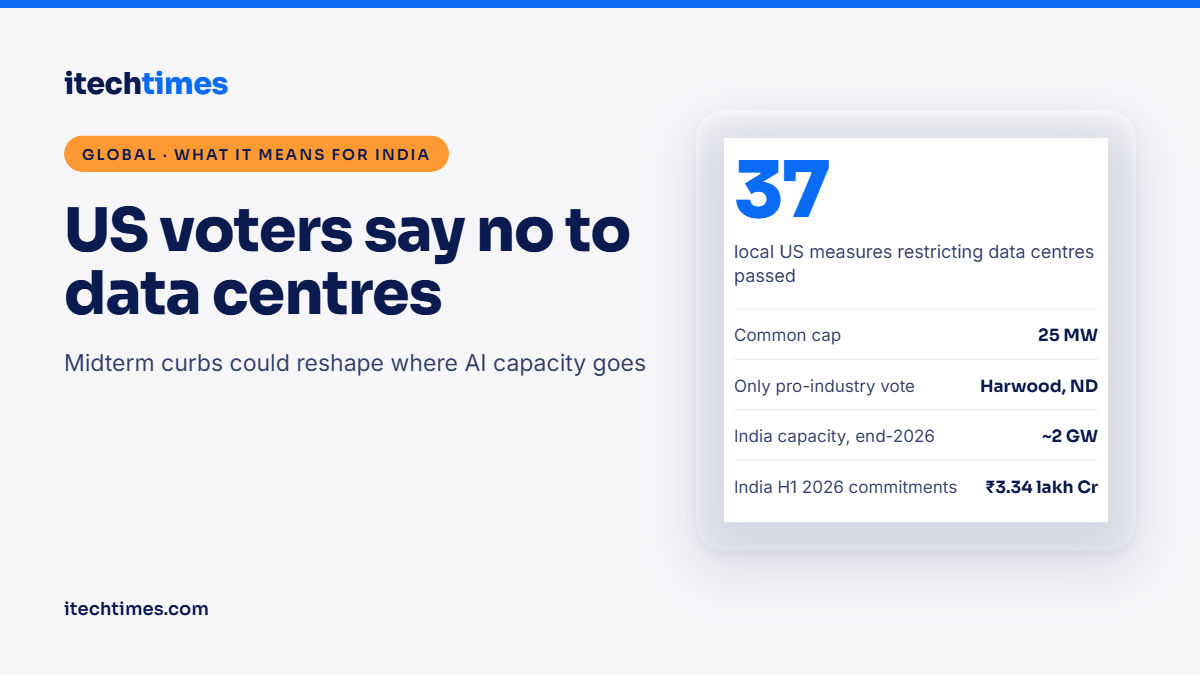
- In the 3 November US midterms, voters approved 37 local ballot measures restricting data centres, according to Redbud Consulting as cited by CBS News.
- Restrictions included bans, moratoriums, 25 MW power caps, rejected rezoning and limits on tax benefits.
- Harwood, North Dakota, was the only place where a measure went the industry’s way.
- New governors in Texas and Georgia, two of the biggest data centre markets, campaigned on pausing construction.
- India’s data centre capacity is on track to reach about 2 GW by end-2026, with ₹3.34 lakh crore (US$38 billion) committed in H1 2026 alone, per CBRE.
What happened to data centres in the US midterm elections? Voters across the US overwhelmingly backed local limits on new data centres in the 3 November 2026 midterms. Around 37 to 38 local measures passed, ranging from outright bans to power caps, while only one vote favoured the industry. Analysts expect this to slow America’s AI data centre build-out and raise costs for developers.
What did US voters actually approve?
Data centres were on local ballots in dozens of communities across states including California, Illinois, Maine, Ohio, New York, Wisconsin and Florida. CBS News, citing Redbud Consulting, reported that 37 measures restricting data centres had passed as of Wednesday afternoon US time. PC Gamer’s count of completed races found restrictions favoured in 38 of 39 closed counts, with some races still being tallied and certified.
The measures took several forms:
| Type of measure | Closed races where restriction won |
|---|---|
| Power caps (usually 25 MW) | 10 |
| Non-binding advisory questions favouring limits | 9 |
| Rejected rezoning for data centre sites | 7 |
| Outright bans | 5 |
| Moratoriums or conditions on tax benefits | 6 |
| Voter-approval requirements (passed or leading) | 2 |
Source: PC Gamer tally of completed counts as of 4 November 2026. Figures may change as results are certified.
To put the 25 MW caps in context, PC Gamer noted that a single planned OpenAI facility in Effingham County, Georgia, is expected to need 3,200 MW.
The one exception was Harwood, North Dakota, where voters rejected a charter amendment that would have required an independent review before new data centre construction.
Why are Americans turning against data centres?
Opposition has been building for a while. A CBS News poll from this summer found that Americans opposed a new data centre in their own area by more than two to one. Common complaints include strain on electricity grids and bills, water use, noise and the environmental footprint of very large facilities. An NBC exit poll cited by PC Gamer found 56% of midterm voters said AI data centres were crucial or a major factor in choosing their member of Congress.
What about Texas and Georgia?
The state races may matter even more than the local votes. In Texas, Democrat Gina Hinojosa defeated Republican incumbent Greg Abbott in the governor’s race, according to CBS News. She proposed a temporary ban on data centre construction during her campaign. Abbott had already suspended data centre approvals, and GLJ Research CEO Gordon Johnson told CBS that the pause could continue without new legislation. Johnson estimated that 13 GW of data centre power in Texas could be stalled.
Texas is expected to account for 25% to 30% of US data centre capacity coming online by 2030, according to Dan Ives of Yorkville Ives & Co.
In Georgia, the third-largest data centre market, Democrat Keisha Lance Bottoms won the governor’s race after campaigning on a pause. She told CBS Mornings she would sign an executive order for the pause immediately and review tax incentives that have drawn developers.
Will this slow the AI build-out?
Analysts quoted by CBS News expect a slowdown but not a collapse. Franklin Templeton’s Stephen Dover expects new rules and higher costs for developers. Principal Asset Management’s Seema Shah said developers may have to invest in grids and could lose tax breaks. Oxford Economics analysts said tighter rules would stretch project timelines but would not necessarily hurt the wider economy.
Meanwhile, spending has not stopped. Meta said its 2026 capital spending could reach $145 billion, and Google has announced a $15 billion investment plan in Malaysia for 2027 to 2028, according to TechStartups’ daily roundup citing the companies.
What it means for India
India is one of the markets that could benefit if US projects slow down, but it is not a simple swap. Here is where India stands, according to recent industry reports:
| India data centre metric | Figure | Source |
|---|---|---|
| Operational capacity, mid-2026 | 1.6 GW | JLL |
| Expected capacity by end-2026 | About 2 GW | CBRE |
| Forecast capacity by 2029 | About 6 GW | JLL |
| Investment committed in H1 2026 | ₹3.34 lakh crore (US$38 billion) | CBRE |
| Cumulative commitments since 2021 | ₹15.29 lakh crore (US$173 billion) | CBRE |
| Share of operational capacity in Mumbai, Chennai, Delhi-NCR | Over 80% | CBRE |
The opportunity: hyperscalers and AI firms that face delays in Texas or Georgia will look harder at other regions for capacity. India already moved into CBRE’s “Leading Data Centre Markets” category in Asia-Pacific in 2026, alongside Japan, Australia and Mainland China. Strong local demand from BFSI, cloud, government and OTT players also helps.
The catch: AI training needs huge, steady power and plenty of land and water, the same pressures driving the US backlash. Indian capacity is concentrated in a few cities, with Mumbai alone taking 94% of new supply in H1 2026, according to CBRE. Grid access, renewable power supply and local water use will decide how fast India can absorb more demand.
For Indian cloud and DevOps teams: a slower US build-out could keep GPU and cloud capacity tight and pricing firm for longer. It is worth planning for multi-region deployments, keeping workloads portable across providers, and checking that your India region choices also meet DPDP Act data rules.
For policymakers: the US results are a warning that public support can fade fast when communities feel they carry the costs. Clear rules on power, water and local benefits could help India avoid a similar backlash as data centre parks grow.
FAQs
How many US data centre measures passed in the midterms?
About 37 to 38 local measures restricting data centres passed, depending on the count used. Only one vote, in Harwood, North Dakota, went the industry’s way.
What kinds of restrictions were approved?
They included power caps of around 25 MW, outright bans, moratoriums, rejected rezoning and conditions on tax benefits. Some were non-binding advisory votes.
Will big tech stop building data centres in the US?
Unlikely. Analysts expect delays and higher costs rather than a halt, since companies are still spending heavily on AI infrastructure.
Will this bring more data centres to India?
It could add to interest in India, which is already a fast-growing market heading for about 2 GW by end-2026. Power, land and water availability will decide how much extra demand India can take.
Does this affect cloud prices in India?
There is no direct effect yet. If global capacity stays tight for longer, GPU and AI cloud pricing could stay firm, so teams should plan capacity early.
Which Indian cities have the most data centres?
Mumbai, Chennai and Delhi-NCR together hold more than 80% of India’s operational capacity, according to CBRE.
Sources
- CBS News: Midterm elections could zap the data center buildout, experts say
- PC Gamer: Data centers were some of the biggest losers in the US midterm elections
- TechStartups: Top tech news roundup, 4 November 2026
- IBEF: India to add over 200 MW of data centre capacity in H2 2026 (CBRE)
- JLL: India data centre 2026 mid-year report