


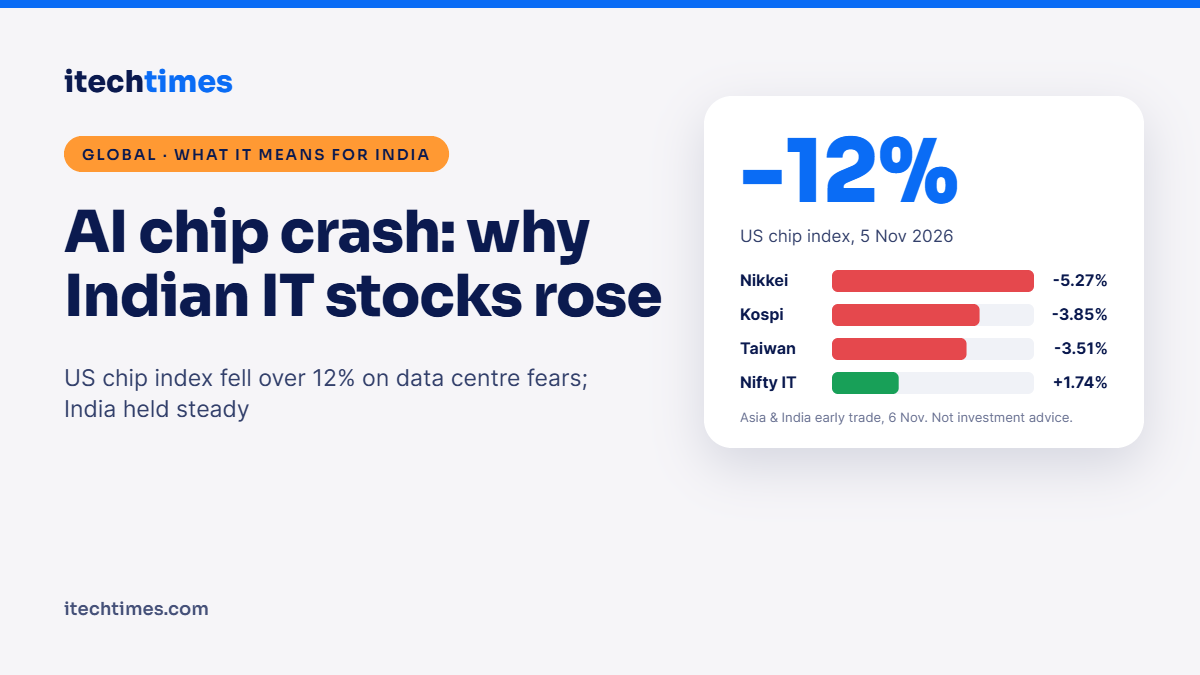
A one-day rout erased trillions from US tech stocks and hit Asian markets hard, but India’s benchmarks barely moved and IT shares climbed.
Key takeaways
- On Thursday, 5 November 2026, the Philadelphia Semiconductor Index fell more than 12%, Nvidia dropped 9.26% and the Nasdaq Composite lost 5.52%.
- The trigger was fear that the US midterm results will slow AI data centre construction, after voters and new governors backed curbs and pauses.
- Asian markets fell on Friday: Japan’s Nikkei was down 5.27% and South Korea’s Kospi 3.85% in early trade.
- India held steady: at 9:25 am IST on 6 November the Sensex was up 0.04% and the Nifty IT index rose 1.74%, led by TCS, Infosys and HCL Technologies.
- This is market information only and not investment advice.
Why did AI chip stocks crash, and how did India react? US chip stocks had one of their worst days on record on 5 November 2026 as investors bet the midterm results will slow AI data centre building. The chip index fell more than 12%. Indian benchmarks stayed nearly flat on 6 November, and IT stocks rose as investors saw India as relatively insulated.
Note: This article is for information only and is not investment advice. Market figures for India are from early trade on 6 November 2026 and may change during the session.
What happened on Wall Street on 5 November?
A day after the Dow’s best post-midterm rally in 44 years, US stocks reversed sharply. Fortune reported that roughly $3 trillion in US market value was lost. The selling was concentrated in AI chipmakers, data centre operators and the power companies that supply them.
| Index or stock | Move on 5 Nov 2026 | Close |
|---|---|---|
| Dow Jones Industrial Average | -3.44% (-1,833 points) | 51,523.06 |
| S&P 500 | -4.36% | 7,353.73 |
| Nasdaq Composite | -5.52% | 24,315.00 |
| Philadelphia Semiconductor Index | More than -12% | Not stated |
| Nvidia | -9.26% | $181.60 |
| AMD | -17.26% | $404.40 |
| Broadcom | -10.43% | $291.53 |
Fox Business said the Nasdaq closed in correction territory, at least 10% below its 6 October record, and had its worst day since April 2025. Data centre operators such as IREN, Applied Digital and Nebius each fell more than 14%. Tesla also fell 10.77%.
Why are investors worried about AI data centres?
The concern is political. In the 3 November midterms, voters passed most of the roughly 41 local ballot measures aimed at slowing data centre construction, according to Fortune. Rising electricity bills have turned data centres into an election issue.
Texas, where Wells Fargo estimates 27% of planned US data centre gigawatts sit, elected Democrat Gina Hinojosa as governor. Fortune reported that she wants an immediate moratorium on new data centres. Governor Greg Abbott had already paused new data centre grid permits in September pending an audit. Candidates in Ohio and Georgia also campaigned on restricting data centre development.
An eToro analyst quoted by Fox Business said the market now expects the AI infrastructure build-out to become slower and more expensive, lowering growth hopes across the supply chain. Investors also had other worries, including high interest rates, elevated oil prices and doubts about returns on huge AI spending, according to Business Today.
How did Asian markets react?
Markets with heavy exposure to chips took the biggest hits on Friday morning. HDFC Sky reported these early moves:
| Market | Move (Friday, 6 Nov, early trade) | Level |
|---|---|---|
| Japan Nikkei | -5.27% | 57,858.61 |
| South Korea Kospi | -3.85% | 5,176.68 |
| Taiwan | -3.51% | 40,117.44 |
| Singapore Straits Times | -2.36% | 5,171.49 |
| Hong Kong Hang Seng | -0.53% | 24,666.69 |
| India Sensex (9:25 am IST) | +0.04% | 79,344.27 |
| India Nifty 50 (9:25 am IST) | -0.21% | 24,484.10 |
Business Today reported that Kospi fell as much as 8.8% at one point and hit a circuit breaker, with Samsung and SK Hynix each down more than 6%.
Why did Indian IT stocks rise?
India’s large IT services firms do not make chips and are not big builders of AI data centres. Business Today said IT stocks led the gainers because they were seen as beneficiaries of a pause in AI-related investment. In early trade, the Nifty IT index rose 1.74% to 33,408.10, according to HDFC Sky.
| Stock | Early move on 6 Nov | Price (₹) |
|---|---|---|
| TCS | +2.26% | 2,552.10 |
| Infosys | +2.02% | 1,191.00 |
| HCL Technologies | +1.89% | 1,457.60 |
Foreign investors were also buyers. Business Today cited provisional data showing FPIs bought ₹13,801.83 crore of Indian shares on Thursday. V K Vijayakumar of Geojit Investments told the publication that India was the least affected by the global rout.
The picture is not all positive. The Nifty Midcap 100 fell 1.17% and the Smallcap 100 fell 1.67% in early trade, and India VIX, the fear gauge, rose 5.74% to 16.48. Hariselvan Radhakrishnan of HST Wealth told Business Today that IT and other globally sensitive stocks could still face near-term pressure, and that prolonged global selling could eventually hit domestic sectors through foreign outflows.
What does this mean for India?
- India is less exposed to the AI hardware trade: unlike Korea, Taiwan and Japan, India’s markets have few listed chipmakers, which helped them hold up.
- Oil is the bigger local risk: Brent crude was near $100 a barrel on Friday, according to HDFC Sky, which can pressure the rupee and inflation more than chip prices do.
- Data centre investment may shift: if US projects slow, some global capacity plans could look at other markets, though no company has announced such a move.
- Your global funds may be down: many Indians hold US tech exposure through international mutual funds or GIFT City platforms. A 5% to 10% fall in a day will show up in those holdings.
What should Indian investors do?
This is not investment advice. A few sensible general steps for readers:
- Check how much of your portfolio is in US tech or semiconductor funds, so you know your real exposure.
- Avoid making decisions based on one day’s move. Sharp falls are often followed by sharp swings in both directions.
- Watch upcoming dates: Nvidia’s next quarterly update is due on 17 November, according to Yahoo Finance.
- Speak to a SEBI-registered investment adviser before changing your allocation.
Frequently asked questions
How much did chip stocks fall on 5 November 2026?
The Philadelphia Semiconductor Index fell more than 12%, according to Fox Business. Nvidia lost 9.26% to $181.60, and AMD fell 17.26%.
Why did the US midterm elections hit tech stocks?
Investors fear that new governors and local ballot measures will pause or restrict data centre construction. That would slow demand for AI chips, servers and power equipment.
Did the Sensex and Nifty crash on 6 November?
No. In early trade at 9:25 am IST, the Sensex was up 0.04% and the Nifty 50 was down 0.21%, while most Asian markets fell 2% to 5%.
Why did TCS and Infosys shares rise?
IT services firms are not directly tied to chip demand or data centre construction. Business Today reported that investors saw them as beneficiaries of a pause in AI investment, and the Nifty IT index rose 1.74% in early trade.
Are Indian semiconductor plans affected?
No change to India’s semiconductor projects has been announced. The selloff was driven by US data centre policy fears, not by any Indian policy decision.
Is this a good time to buy US tech stocks?
iTechTimes does not give investment advice. Speak to a SEBI-registered adviser and consider your risk appetite before investing.
Sources
- Fox Business: Nasdaq tumbles 5%, Dow plunges more than 1,800 points
- Fortune: $3 trillion vanished as chip stocks plunged over AI fears
- Yahoo Finance: Stock market today, 5 November
- Business Today: Nifty, Sensex escape Wall Street, Asia rout; IT stocks rally
- HDFC Sky: Sensex, Nifty open report, 6 November 2026




One thought on “AI Chip Stock Crash: Why Indian IT Stocks Rose Instead”