


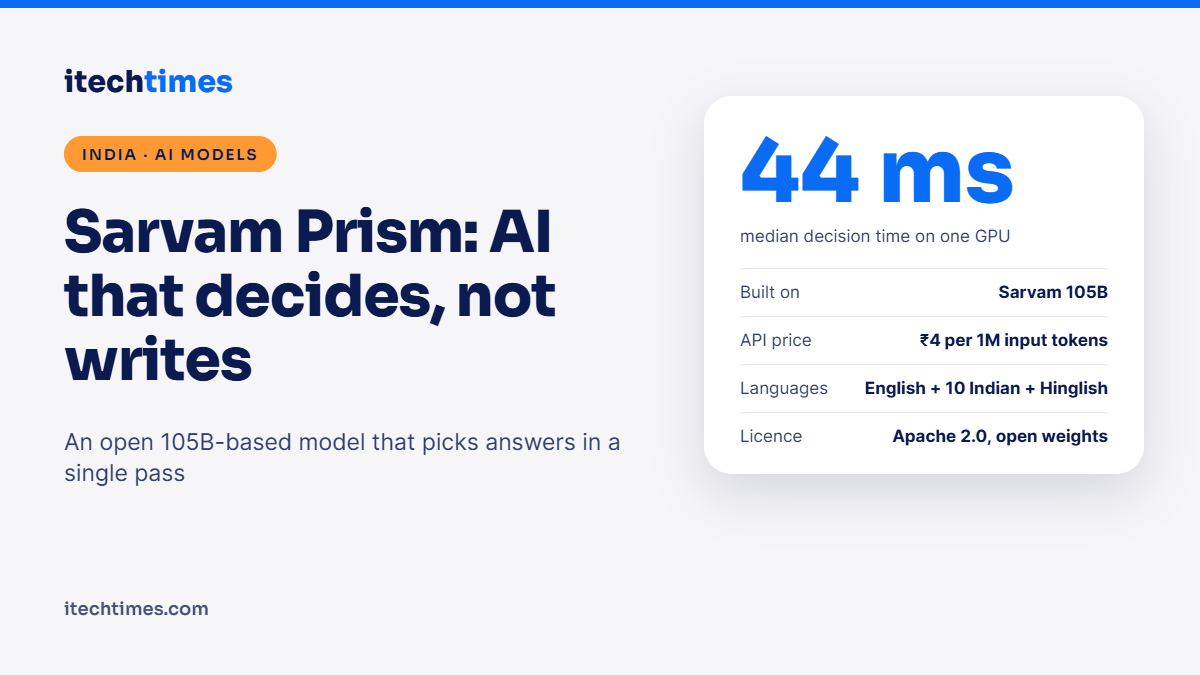
Bengaluru’s Sarvam has released a model that does not write a single word. It picks the best option from a list, with a confidence score, in about 44 milliseconds.
Key takeaways
- Sarvam released Prism on 3 November 2026 as a “decision model” built on its Sarvam 105B model.
- Instead of generating text, Prism returns a calibrated probability for each answer option in one pass, with a median latency of 44 ms on one NVIDIA B200 GPU.
- Weights are open under the Apache 2.0 licence on Hugging Face; the hosted API costs ₹4 per million input tokens, with output tokens at ₹0.
- It supports English, 10 Indian languages and Hinglish, and scored 82.5 on Sarvam’s Indian-language decision benchmark.
- All benchmark figures are reported by Sarvam on its own test runs and have not been independently verified.
What is Sarvam Prism? Sarvam Prism is an open-weights AI model from Bengaluru-based Sarvam that makes decisions instead of writing answers. You give it a situation, a question and a set of options, and it returns a probability for each option in about 44 ms. It is built on Sarvam 105B, supports Indian languages and costs ₹4 per million input tokens through Sarvam’s API.
How is a decision model different from a chatbot?
A chatbot such as a typical large language model writes its answer one token at a time. That is useful for essays and code, but slow and costly when the real task is a simple choice, such as “Is this customer angry: yes or no?” or “Which team should handle this ticket?”
Sarvam calls Prism a “System One” model, borrowing the idea of fast, instinctive thinking. It reads the full context once and scores every option in a single forward pass. According to the model card, the answer is always one of the options you supplied, so it cannot drift into an off-topic reply.
Sarvam says the probabilities are calibrated, meaning a 90% confidence score should be right about 90% of the time. In its English tests at 90% or higher confidence, the company says Prism predicted a 3.3% error rate and actually made 2.2% errors. For Indian languages, the figures were 5.4% predicted and 4.4% actual.
What are Sarvam Prism’s key specifications?
| Specification | Sarvam Prism |
|---|---|
| Release date | 3 November 2026 |
| Base model | Sarvam 105B (LoRA fine-tune) |
| Median latency | 44 ms on one NVIDIA B200 (95th percentile 420 ms) |
| Context per question | 131,072 tokens (open weights); 32,768 tokens on the hosted API |
| Languages | English, 10 Indian languages and Hinglish |
| Licence | Apache 2.0, open weights on Hugging Face |
| Hardware to self-host | One FP8-capable NVIDIA GPU with about 120 GB free memory, about 106 GB disk |
| API price | ₹4 per 1 million input tokens; ₹0 for output |
| Question types | Choice (2 to 255 options), yes/no, and score (2 to 10 levels) |
Sarvam says it cut median latency from 664 ms at the start of optimisation to 44 ms, roughly 15 times faster, using FP8 precision, a fused kernel for the model’s 128 experts and CUDA Graphs. One limitation for developers: the weights use a custom FP8 layout, so standard loaders and general-purpose inference servers cannot run them. You need Sarvam’s own prism.py code.
How well does Prism perform?
Sarvam published a set of results from its own runs. The company says Prism averaged 71.8 across three decision indices, the highest of 25 models it tested that respond in under 100 ms.
| Benchmark (company reported) | Prism score | Comparison given by Sarvam |
|---|---|---|
| Average of three decision indices | 71.8 | Top among 25 sub-100 ms models |
| Indian-language index | 82.5 | Not stated |
| Agent trace evaluation (700 runs) | 78.5% | Claude Haiku 5.5: 70.7% |
| Security decisions (5,517 questions) | 89.0% | Microsoft-Decision-1: 76.1% |
| Answer changes when options shuffled | 0 of 2,000 | Not applicable |
These are vendor benchmarks, so treat them as a starting point. The fairest test is to run Prism on your own data and compare it with the model you use today.
Where can businesses use Sarvam Prism?
Sarvam lists several use cases. Most of them involve quick yes/no or pick-one decisions that sit inside a bigger AI system:
- Customer support routing: deciding which team gets a ticket, how urgent it is and whether the customer is upset.
- Prompt injection guardrails: checking whether an incoming message is trying to manipulate an AI agent.
- Model routing: choosing whether a cheap or an expensive model should handle a request.
- Agent trace evaluation: scoring whether an AI agent’s run went well, which Sarvam says takes about half a second per run on one GPU.
- Voice bots and document intelligence: making fast decisions inside speech-to-speech systems and document workflows.
What does Prism mean for India?
For Indian companies, three things stand out. First, the price is in rupees and output is free, because the model generates no text. A decision call is billed only for the input you send. Second, native support for 10 Indian languages and Hinglish matters for banks, telecom firms, e-commerce players and government services that handle complaints in mixed languages.
Third, the Apache 2.0 licence lets companies download the weights and run Prism on their own servers. For regulated sectors that prefer to keep customer data in their own infrastructure, that is a real option, though it needs a high-end GPU with about 120 GB of memory.
Prism also fits a wider trend. Inc42 has described a growing race in India around AI “decision models” for enterprises, and Sarvam’s release puts a homegrown, open option into that market.
What you should do
- Developers: try the hosted API first. The model ID is sarvam-prism on the Decisions API, so you can test without buying GPUs.
- Product teams: list the yes/no and routing decisions your current chatbot makes by generating text. Those are the best candidates to move to a cheaper, faster decision model.
- CTOs: run a side-by-side test on a few thousand of your own tickets or transcripts before trusting the published numbers.
- Compliance teams: check whether self-hosting the open weights helps with your data-localisation needs.
Frequently asked questions
Is Sarvam Prism free to use?
The model weights are free to download under the Apache 2.0 licence, but you need a powerful GPU to run them. Using Sarvam’s hosted API costs ₹4 per million input tokens, with no charge for output tokens.
Can Sarvam Prism write text like ChatGPT?
No. Prism only scores the options you give it and returns probabilities, a top choice and a confidence value. If you send generation settings such as temperature or max tokens, the API rejects the request.
Which languages does Sarvam Prism support?
Sarvam says Prism supports English, 10 Indian languages and Hinglish. The documentation does not list the 10 languages by name.
What hardware do I need to run Prism myself?
The model card says you need one NVIDIA GPU with FP8 support and about 120 GB of free memory, such as a B200 or H200, plus about 106 GB of disk space and Sarvam’s own loading code.
Are Sarvam’s benchmark results reliable?
They come from Sarvam’s own test runs and have not been independently verified. They are useful as a guide, but businesses should test Prism on their own data.
When was Sarvam Prism launched?
Sarvam published Prism on 3 November 2026, with open weights on Hugging Face and access through its Decisions API.
Sources
- Sarvam: Sarvam Prism announcement blog
- Hugging Face: sarvam/prism model card
- Sarvam API docs: Sarvam Prism
- Inc42 homepage (Sarvam’s Prism enters India’s AI decision model race)
One thought on “Sarvam Prism: India’s Open AI Decision Model Explained”