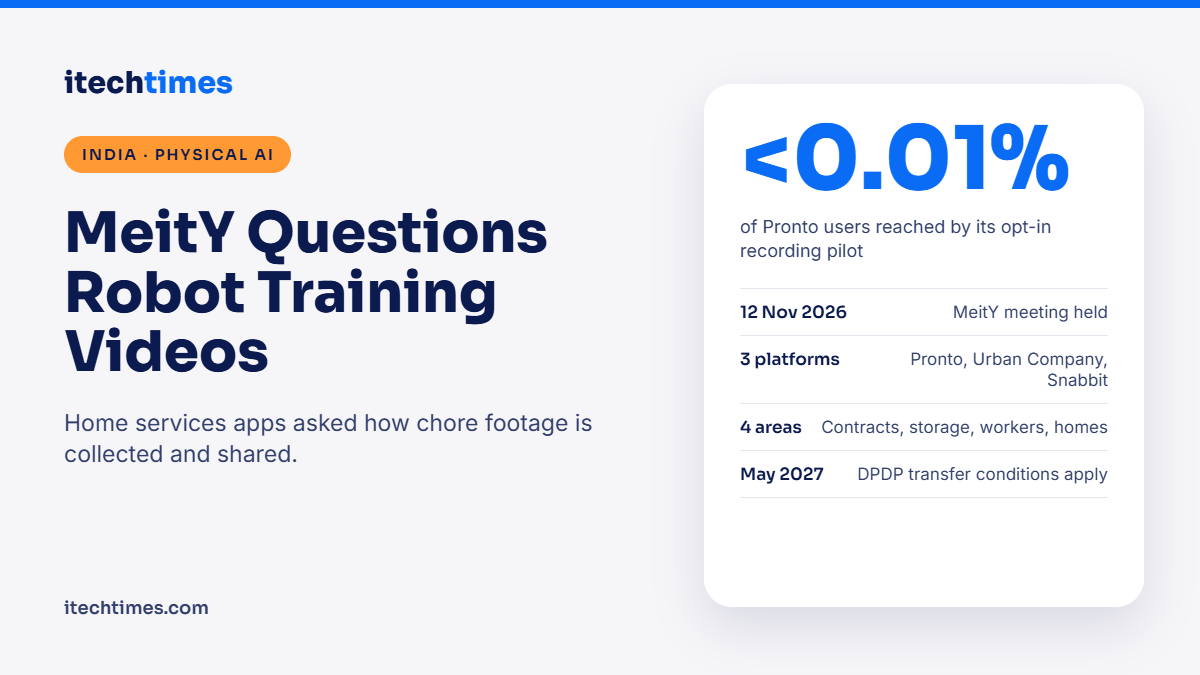
MeitY has asked home services platforms how they record household chores to train robots, who gets that footage and whether it leaves India. Here is what happened and why it matters for workers and families.
Key takeaways
- On 12 November 2026, MeitY Secretary S Krishnan chaired a meeting with Pronto, Urban Company, Snabbit and robotics companies on using first-person video of household chores to train physical AI.
- MeitY asked about data-sharing contracts, retention periods, worker consent, worker pay, protection for household members and whether data is sold or sent to AI developers abroad.
- Pronto was asked to submit its standard operating procedures and data practices. It says its opt-in pilot reached fewer than 0.01% of its users.
- Urban Company says it does not record inside customers’ homes. Snabbit says it ran only a one-time assessment at a training centre and did not proceed.
- India’s DPDP Act currently allows cross-border transfers of personal data unless the government restricts a country, and the DPDP Rules’ extra transfer conditions take effect only in May 2027.
Why is MeitY questioning Pronto and other home services apps? Because some platforms have explored recording first-person video of workers doing chores inside Indian homes to train physical AI, meaning robots and AI systems that act in the real world. MeitY wants to know how consent is taken, how the footage is stored and whether it is going to foreign AI companies.
What happened at the MeitY meeting?
According to reports by The Economic Times, cited by Inc42 and MediaNama, MeitY Secretary S Krishnan chaired a meeting on 12 November 2026 with senior executives from quick home services platforms and robotics companies. The agenda covered worker consent, consumer privacy and data sovereignty.
The ministry sought details on how these companies collect, process and store first-person video and sensor data recorded while gig workers clean, wash dishes, do laundry or cook. It also asked whether such data is sold, shared or transferred to physical AI developers outside India.
Some executives at the meeting reportedly criticised the practice of collecting data in India and selling it to overseas AI developers, and asked MeitY to regulate such sales. Robotics startups argued that India should build its own physical AI capabilities instead.
What exactly did MeitY ask the companies?
Based on the MediaNama and Inc42 reports, the ministry’s questions fall into four groups.
| Area | What MeitY asked |
|---|---|
| Contracts | Data-sharing contracts with vendors and clients, and who receives the footage |
| Storage | How much data is collected, how long it is kept and when it is deleted |
| Workers | How workers are informed and give consent, whether recordings are linked to their identity and how much they are paid |
| Households | How customers and other family members captured on camera are protected |
Pronto was specifically asked to submit a detailed representation of its SOPs and data collection practices.
What is physical AI and why does it need home videos?
Physical AI refers to AI systems that see, move and act in the physical world, such as household robots and robotic arms. To learn tasks like folding clothes or loading a dishwasher, these systems need large amounts of real-world examples, often recorded from a first-person view.
That is where gig workers come in. A worker wearing a head or body-mounted camera produces exactly the kind of footage that robot makers want. India, with its large home services workforce, has become an attractive source of such data.
What have Pronto, Urban Company and Snabbit said?
The three companies have given very different answers.
| Company | Position (as reported) |
|---|---|
| Pronto | Ran an opt-in pilot, later formalised as a premium service called “Verified”, in which professionals wear cameras. Says it reached fewer than 0.01% of users, raw footage is deleted after the work, customers can view an anonymised recording for 48 hours, and anonymised footage is then used for AI training as its terms state. |
| Urban Company | Founder Abhiraj Singh Bhal said the company does not record inside customers’ homes, has never done so and has no plans to. |
| Snabbit | Says it ran a limited, one-time assessment in a controlled training-centre setting and decided not to proceed. |
There is also a wider link that has drawn attention. Pronto founder Anjali Sardana recently launched Provision Labs, a San Francisco-based physical AI venture, which is acquiring Mumbai-based Basilisk Industries. MediaNama reports that Pronto has not said who trains on its anonymised footage or where, and Inc42 says the link between Pronto’s household data and Provision Labs is unclear.
How did this controversy start?
The issue has been building for months.
- May 2026: Reports based on an investor memo said Pronto was capturing household chore footage for robotics labs. Pronto confirmed an opt-in pilot.
- July 2026: The pilot became “Verified”, a paid, opt-in premium service.
- October 2026: Anjali Sardana launched Provision Labs in San Francisco.
- 8 November 2026: Pronto said raw footage is deleted after work and anonymised footage is used for AI training.
- 12 November 2026: MeitY chaired the meeting with platforms and robotics companies.
What does India’s data protection law say?
The Digital Personal Data Protection (DPDP) Act is the main law here, but it leaves gaps for this kind of data. As MediaNama points out:
- The Act allows cross-border transfers of personal data unless the government restricts a specific country, and no country has been restricted so far.
- The DPDP Rules let the government set further conditions on such transfers, but those provisions take effect only in May 2027.
- Truly anonymised data falls outside the Act. However, blurring faces does not necessarily make home footage anonymous, because a home’s layout, voices, documents or family members can still identify people.
This is why consent matters so much. A worker may agree to wear a camera, but the family in the house, including children or elderly relatives, may also appear in the footage.
What should you do if you book home services?
- Read the booking screen carefully. Look for any opt-in for recording, “verified” or premium services, and check what you are agreeing to.
- Ask the worker. If you see a head or body-mounted camera, you can ask whether it is recording and decline the service if you are not comfortable.
- Check the privacy policy. See whether it mentions video, sensors or AI training, and how long data is kept.
- Protect sensitive spaces. Keep documents, screens and children’s rooms out of view during the service.
- Ask questions. Write to the platform’s grievance or privacy contact to ask what data it holds about you and to request deletion of any recordings.
What does this mean for India’s AI ambitions?
The debate cuts both ways. On one side, Indian homes and workers could become a low-cost source of training data for foreign robot makers, which some executives at the meeting called a poor look for the country. On the other, Indian robotics startups say the same data could help India build its own physical AI industry. How MeitY responds, whether through guidance, rules on cross-border transfers or sector standards, will shape which of these paths India takes.
Frequently asked questions
Has MeitY banned recording inside homes for AI training?
No. MeitY has so far held a meeting and asked companies for details on their practices. No ban or new rule has been announced.
Is Pronto still recording homes?
Pronto has said its recording service is opt-in and reaches fewer than 0.01% of users. It says raw footage is deleted after the work and only anonymised footage is used for AI training.
Can my home footage be sent abroad legally?
Under the DPDP Act, personal data can currently be transferred abroad unless the government restricts a country, and none has been restricted yet. Extra conditions on transfers under the DPDP Rules apply only from May 2027.
Does Urban Company record inside homes?
Its founder Abhiraj Singh Bhal has said Urban Company does not record inside customers’ homes, has never done so and has no plans to.
What is first-person video data?
It is video recorded from the worker’s point of view, usually by a camera worn on the head or body. Robot makers use it to teach machines how humans perform physical tasks.
Are gig workers paid extra for recording?
The reports do not say how much workers are paid. MeitY has specifically asked the companies how workers are informed and compensated.
Sources
- Inc42: MeitY Reviews House Help Platforms’ Data Collection Process For Physical AI Training
- MediaNama: Is footage from Indian homes going abroad to train robots? MeitY questions Pronto and other platforms
- Inc42: How Pronto’s physical AI pilot raised questions around consent and surveillance