The IT Ministry is reportedly discussing whether platforms that rank and push content with algorithms should still be treated as neutral carriers under Indian law.
Key takeaways
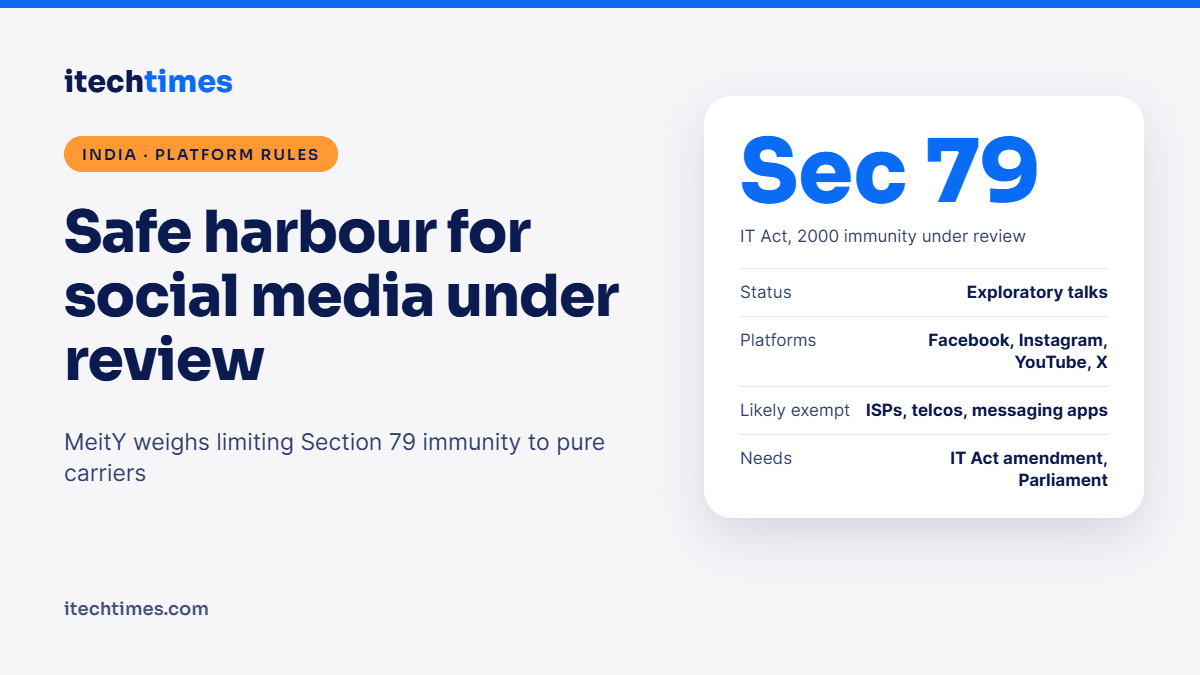
- The Ministry of Electronics and IT (MeitY) has begun exploratory talks on limiting Section 79 safe harbour, according to The Indian Express, as reported by Inc42 and Free Press Journal on 5 November 2026.
- Protection could be restricted to services that only carry data, such as internet providers, telecom operators and peer-to-peer messaging apps.
- Facebook, Instagram, YouTube and X are among the algorithm-driven platforms that could lose the shield.
- No decision has been taken. Any change would likely need an amendment to the IT Act, 2000 and approval from Parliament.
- On 15 October 2026 the Supreme Court said losing safe harbour should be a last resort and called for a separate framework of proportionate penalties.
Is India removing safe harbour for social media platforms? Not yet. MeitY is reportedly in early, exploratory talks on whether platforms that use algorithms to rank, promote or suppress posts should keep immunity under Section 79 of the IT Act. Protection may be limited to pure carriers such as telecom operators and messaging apps. Any change would need Parliament.
What is safe harbour under Section 79?
Section 79 of the Information Technology Act, 2000 protects “intermediaries” from legal liability for content that their users post. A platform that hosts a defamatory or illegal post is not treated as its author, as long as it follows due diligence rules and acts on lawful takedown orders.
The protection has conditions. As described in reporting on the current law, an intermediary must not start the transmission, choose who receives it, or change the content. It can lose the shield if it helps or encourages unlawful activity, or if it fails to remove illegal material after a government notice or court order.
This shield is the legal base on which large user-generated content businesses in India run. Without it, every post, video or comment could expose the platform to a lawsuit or criminal complaint.
What is the government reportedly considering?
According to The Indian Express, as cited by Inc42 and Free Press Journal, MeitY officials are asking a basic question: can a platform whose algorithm decides what millions of people see still be called a passive middleman?
The option being discussed would limit safe harbour to services that simply transmit information. Business Standard reported, as cited by Free Press Journal, that only messaging services that do not interfere with content between users would be exempt. Feed-based platforms such as Facebook, Instagram, YouTube and X would fall outside.
Two other ideas are reportedly on the table:
- Advance notice of big product changes: platforms may have to tell authorities before launching major features that affect user safety. This follows the ministry’s July direction to WhatsApp to pause a planned username feature over impersonation and fraud concerns.
- Tighter grievance handling: platforms could be required to act on user complaints about deepfakes and non-consensual intimate images, instead of leaving removal mostly to their own moderation teams.
The ministry, Meta and Google did not respond to The Indian Express’s questions, according to Free Press Journal. No official statement has been issued on the proposal.
Why is this coming up now?
The talks follow a year of friction between the Centre and large platforms. The key events, as reported, are below.
| When | What happened |
|---|---|
| September 2025 | Karnataka High Court dismissed X’s challenge to the government’s takedown framework, including the Sahyog portal. X has appealed. |
| July 2026 | MeitY summoned Meta’s global policy executives after Facebook briefly withheld a video posted by Prime Minister Narendra Modi. |
| July 2026 | The ministry asked WhatsApp to halt its planned username feature pending consultations. |
| August 2026 | The Parliamentary Standing Committee on Communications and IT recommended withdrawing protection from platforms that do not comply with Indian law. |
| 15 October 2026 | Supreme Court, in the Just Rights for Children Alliance case, called for proportionate penalties, including fines, with loss of safe harbour as a last resort. |
| 5 November 2026 | Reports say MeitY has started exploratory talks on limiting safe harbour to pure carriers. |
The reports also say some officials feel algorithms have at times amplified opposition-led or anti-establishment narratives over official messaging, and that Instagram played a major role in mobilising support during the July student protests. These are reported views of unnamed officials, not a stated government position.
Separately, the Supreme Court is hearing a public interest petition that alleges features such as infinite scroll, autoplay and push notifications encourage compulsive use, and raises concerns about age checks and child safety. The court has sought responses from the Centre and Meta.
What did the Supreme Court say about safe harbour?
The 15 October order matters because it points in a different direction. As reported, the court said taking away safe harbour is too drastic for routine non-compliance, yet too weak a deterrent for repeat offenders. It suggested a separate, graded penalty system with monetary fines, and kept withdrawal of immunity for the most serious cases.
Any new law would have to sit alongside that thinking. A blanket removal of protection for all algorithmic platforms would be a much bigger step than what the court described.
What would change for users, creators and brands?
If the idea becomes law, platforms would face direct legal risk for what their algorithms recommend. The most likely response would be far more cautious moderation. For people who use these apps every day, that could look like this:
| Who | Possible impact if safe harbour is narrowed |
|---|---|
| Everyday users | Faster removals and more posts held for review, especially on political or sensitive topics. |
| Creators and influencers | Lower reach for edgy or news-related content as platforms tune feeds to cut legal risk; more demonetisation and strikes. |
| Brands and marketers | Stricter ad and branded content checks, slower approvals and possibly higher costs as platforms pass on compliance spend. |
| Messaging apps | Likely to keep protection if they only carry messages, which may push more communities into channels and groups. |
| Smaller Indian platforms | Higher compliance costs could make it harder to compete, even as the rules target large global firms. |
It is important to keep the scale in mind. The talks are exploratory, and changing Section 79 would likely mean amending the IT Act through Parliament. Industry and civil society groups are expected to push back strongly, according to the reports.
What you should do now
- Creators: do not panic, but diversify. Build an email list, a WhatsApp channel or a website so your audience is not tied to one feed.
- Brands and agencies: keep documentation for branded content and influencer deals in order. Clear disclosure will matter more if platforms tighten checks.
- Businesses running communities: review your own moderation and grievance processes. Deepfake and impersonation complaints are a stated focus area.
- Everyone: watch for an official MeitY consultation paper. Any draft amendment should go through public comment, which is the right time to give feedback.
Frequently asked questions
Has the government removed safe harbour for Facebook, YouTube or X?
No. As of 6 November 2026, reports describe only exploratory discussions inside MeitY. No decision has been taken and no draft law has been published.
What is an intermediary under Indian law?
An intermediary is a service that receives, stores or transmits content on behalf of others. Social media sites, search engines, telecom operators, ISPs and messaging apps are all treated as intermediaries under the IT Act, 2000.
Would WhatsApp lose safe harbour too?
The option being discussed would keep protection for peer-to-peer messaging services that do not interfere with content between users. Earlier reports in September suggested Meta’s overall intermediary status could be questioned, so the position of each Meta app is not fully clear.
Can the government remove safe harbour without Parliament?
According to the reports, a change of this kind would likely need an amendment to the IT Act, which requires Parliament’s approval. Rules under the Act can be changed by the ministry, but the core immunity is in the law itself.
What did the Supreme Court say on 15 October 2026?
In the Just Rights for Children Alliance case, the court said loss of safe harbour should be reserved for serious violations. It called for a separate framework of proportionate penalties, including fines, for platforms that do not comply.
How will this affect influencer marketing?
Nothing changes today. If platforms become liable for what they amplify, they are likely to tighten content and ad reviews, which could reduce reach for some content and slow campaign approvals.
Sources
- Inc42: Centre weighs withdrawing safe harbour for Meta, Google, X
- Free Press Journal: Indian govt weighs ending safe harbour for social media platforms
- StartupTalky: India considers stricter liability rules for social media platforms