Paytm’s payments arm has cleared the first step to run digital wallets again, nearly three years after RBI action froze the old Paytm wallet. Here is what the approval allows, what it does not, and what it means for you.
Key takeaways
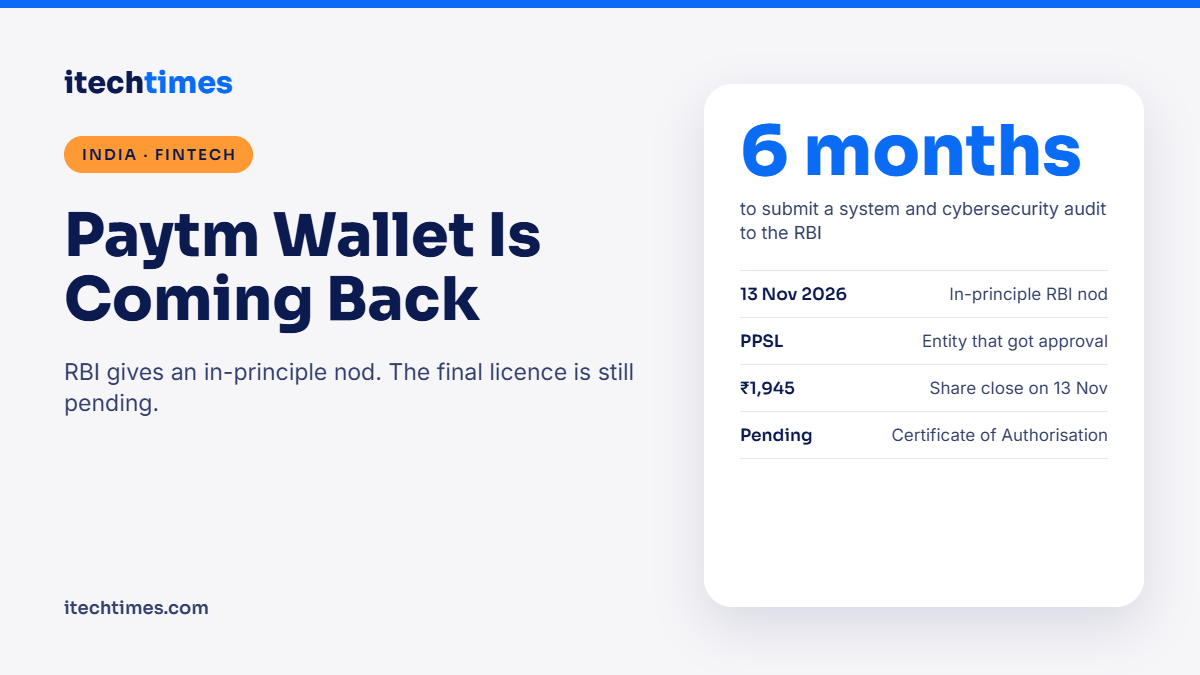
- On 13 November 2026, Paytm Payments Services Ltd (PPSL), a wholly owned subsidiary of One 97 Communications, received in-principle RBI authorisation to issue and operate prepaid payment instruments (PPIs), including wallets.
- This is not a final licence. PPSL needs a Certificate of Authorisation from the RBI before it can launch a wallet.
- PPSL must complete a system audit, including a cybersecurity audit, and submit it to the RBI within six months, or the in-principle approval lapses.
- The approval goes to PPSL, a different entity from Paytm Payments Bank, whose banking licence the RBI cancelled on 24 April 2026.
- Paytm shares touched a 52-week high of ₹1,958.80 on the BSE on Friday before closing about 1.1% higher at ₹1,945.
Is the Paytm wallet coming back? Yes, but not yet. On 13 November 2026, the RBI gave Paytm Payments Services Ltd in-principle approval to issue and operate prepaid wallets. Paytm still needs final RBI authorisation, after a mandatory system and cybersecurity audit, before any new Paytm wallet can go live for users.
What exactly did the RBI approve?
One 97 Communications, the listed parent of Paytm, told the stock exchanges that its subsidiary PPSL has received in-principle authorisation to set up and operate a payment system for issuing and operating prepaid payment instruments. The approval was granted under the Payment and Settlement Systems Act, 2007, and the RBI letter came from its Department of Payment and Settlement Systems.
Prepaid payment instruments are what most people simply call wallets: you load money in advance and then spend it from the app. The approval is tied to the RBI’s Master Directions on PPIs dated 27 August 2021, as amended, so any new Paytm wallet will have to follow the same rules as other licensed wallet providers.
PPSL had applied for a fresh PPI licence on 31 December 2025, which Paytm had disclosed in its Q1 FY27 earnings release.
Why did Paytm lose its wallet in the first place?
The old Paytm wallet was closely tied to Paytm Payments Bank (PPBL). In January 2024, the RBI barred PPBL from accepting fresh deposits, credit transactions and top-ups in customer accounts and wallets, with the restrictions taking effect from 15 March 2024. That effectively froze the wallet business for new money.
The story did not end there. On 24 April 2026, the RBI cancelled PPBL’s banking licence under Section 22(4) of the Banking Regulation Act, 1949, saying the bank’s affairs were being run in a manner detrimental to depositors and that it had not complied with its licence conditions.
The new approval is for PPSL, a separate wholly owned subsidiary of One 97 Communications. That separation is the key point: the wallet is being rebuilt under a different entity, not revived inside the payments bank.
What conditions does Paytm have to meet?
The in-principle nod comes with strict conditions. Here is how the process works, based on Paytm’s disclosure.
| Step | What it means | Status |
|---|---|---|
| Application | PPSL applied for a PPI licence | Filed on 31 December 2025 |
| In-principle authorisation | RBI agrees in principle, subject to conditions | Received on 13 November 2026 |
| System and cybersecurity audit | Audit by an eligible auditor, report sent to RBI | Due within six months |
| Ownership changes | Any change in shareholding or control needs prior RBI approval | Ongoing condition |
| Certificate of Authorisation | Final licence that allows a wallet launch | Pending |
If PPSL does not submit the audit report within six months, the in-principle authorisation lapses automatically and the RBI will not consider final authorisation. In other words, the earliest realistic launch depends on how fast Paytm clears this audit and how quickly the RBI reviews it.
Why does a wallet still matter in the age of UPI?
Most Indians now pay with UPI straight from a bank account, so it is fair to ask why Paytm wants a wallet back. Inc42’s analysis notes that the wallet may not add much revenue on its own. Its value is strategic.
- More users and more frequent use. A wallet gives people another reason to open the app for small payments.
- Cross-selling. Paytm can pair wallet users with its postpaid, personal loan, wealth and equity broking products.
- A possible link with Paytm Postpaid. On its Q2 FY27 earnings call, Paytm suggested combining the wallet with Paytm Postpaid, though it gave no timeline.
How is Paytm doing financially?
The approval comes in a strong quarter for the company. These figures are for Q2 FY27 (July to September 2026).
| Metric | Q2 FY27 | Change |
|---|---|---|
| Operating revenue | ₹2,648 crore | Up 28% year on year |
| Net profit | ₹225 crore | Up from ₹21 crore a year earlier |
| EBITDA margin | About 10% | EBITDA up 90% year on year |
| Share price, 13 November close | ₹1,945 | Still below the IPO price of ₹2,150 |
Brokerages remain split. Business Today lists target prices ranging from ₹1,340 (UBS, Neutral) to ₹2,200 (Bernstein, Outperform).
This article is for information only and is not investment advice.
What should Paytm users do right now?
- Do not look for a new wallet yet. There is no new Paytm wallet to sign up for today. Any message, link or call offering an “early Paytm wallet activation” is likely a scam.
- Keep using UPI as usual. Paytm UPI payments are not affected by this news.
- Watch for official communication only. When the wallet launches, expect the announcement in the Paytm app and in a stock exchange filing, not through unknown SMS links.
- Check KYC rules when it launches. Wallets in India follow the RBI’s PPI rules on KYC and limits. Read the in-app terms carefully before you load money.
- Report suspicious requests. If someone asks for your OTP or UPI PIN in the name of “wallet reactivation”, report it on the 1930 helpline or cybercrime.gov.in.
What does this mean for India’s fintech market?
For the wider market, the decision is a signal that the RBI is willing to let Paytm rebuild regulated businesses through PPSL, as long as it clears strict conditions. A returning Paytm wallet would compete with the PPI products from other apps and banks, and could push rivals to sharpen offers on small-ticket payments. For merchants, the bigger story remains UPI, but a wallet option gives Paytm another tool to hold on to users it lost after 2024.
Frequently asked questions
Can I use the Paytm wallet today?
No. PPSL has only received in-principle approval. It needs a final Certificate of Authorisation from the RBI before it can launch a wallet for users.
When will the new Paytm wallet launch?
Paytm has not given a date. PPSL must first submit a system and cybersecurity audit report within six months, after which the RBI decides on final authorisation.
Is this the same as the old Paytm Payments Bank wallet?
No. The old wallet was tied to Paytm Payments Bank, whose licence the RBI cancelled in April 2026. The new approval is for Paytm Payments Services Ltd, a separate subsidiary.
Does this affect my Paytm UPI payments?
No. This approval is about prepaid wallets. It does not change how UPI payments on the Paytm app work.
What is a prepaid payment instrument?
A PPI is a payment product, such as a digital wallet or prepaid card, that you load with money in advance and then spend from. In India, PPIs are regulated by the RBI under its Master Directions on PPIs.
Why did Paytm shares rise?
Investors read the approval as a sign that Paytm can rebuild a business it lost in 2024. The stock hit a 52-week high of ₹1,958.80 during the day and closed at ₹1,945, still below its IPO price.
Sources
- Inc42: Paytm Set To Revive Wallet Business With RBI In-Principle Nod
- Business Standard: Paytm gets RBI’s in-principle approval to issue prepaid wallets in India
- Business Today: Paytm arm gets RBI in-principle nod for prepaid payment instruments