Washington now polices who rents AI compute, not just who buys chips, and Indian data centres fall inside its reach.
Key takeaways
- The US Commerce Department released an interim final rule on 16 November 2026 targeting remote access to advanced AI chips.
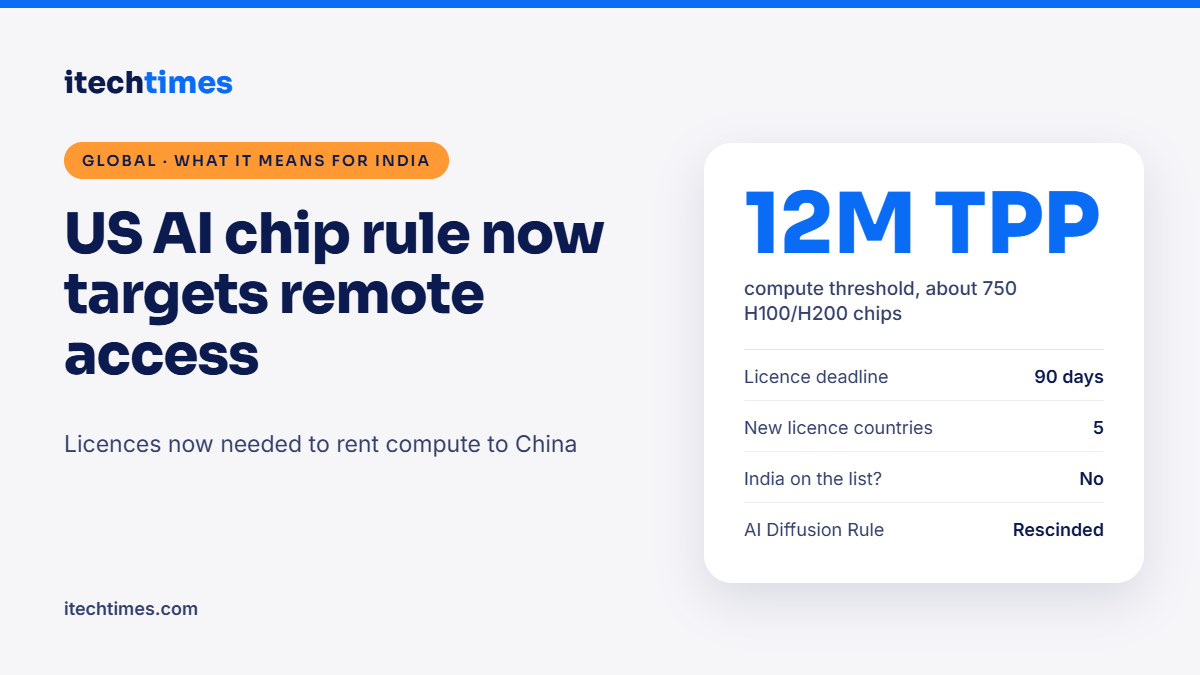
- Data centres anywhere in the world need a US licence if they provide more than 12 million “aggregate TPP” of compute to companies headquartered in China, Macau or other Country Group D:5 nations.
- 12 million TPP is roughly the power of about 750 Nvidia H100 or H200 chips, according to TechCrunch.
- Exports to Indonesia, Malaysia, Singapore, Thailand and Brazil now need licences. India is not on that list.
- The rule formally scraps the 2025 AI Diffusion Rule, which had placed India in a capped “Tier 2” group.
Does the new US AI chip rule restrict India? Not directly. India is not among the five countries that now need licences for AI chip imports, and the rule removes the old country caps that applied to India. But any Indian data centre renting large amounts of GPU compute to Chinese-owned or other D:5-owned firms would now need a US licence.
What did the US announce?
The Bureau of Industry and Security (BIS), part of the US Commerce Department, released an interim final rule on Monday, 16 November 2026. It was scheduled to be published in the US Federal Register on 19 November, and it takes effect on publication, according to law firms Pillsbury and WilmerHale. BIS will accept public comments for 60 days after publication.
The rule closes a gap that earlier export controls left open. Chinese firms could not easily buy top Nvidia chips, but they could rent computing power from data centres in other countries. The new rule targets that remote access.
It covers advanced chips under export categories 3A090 (excluding 3A090.c) and 4A090, along with servers containing them and related software and technology, Pillsbury said.
How does the remote access rule work?
A licence is needed to export, re-export or transfer covered chips to any data centre, “wherever located”, if that facility may supply compute above the threshold to companies headquartered in Macau or Country Group D:5. TechCrunch notes the D:5 group includes China, Russia, Iran and North Korea, among others. The rule also covers indirect access through brokers and middlemen.
| Provision | What it says |
|---|---|
| Compute threshold | More than 12 million aggregate TPP, about 750 H100 or H200 chips |
| Who it covers | Customers headquartered in Macau or D:5 countries, including China |
| Existing data centres | 90 days after the effective date to get a licence if they already serve such customers |
| Shipments already en route | Can proceed under old rules if completed within 30 days |
| Exemption | Data centres serving only commercial recommender systems, if reported to BIS |
| New licence countries | Indonesia, Malaysia, Singapore, Thailand, Brazil |
| Public comments | 60 days after Federal Register publication |
“Linked data centres” that work as a single unit are counted together, so splitting compute across buildings does not avoid the threshold, WilmerHale said. The firm also described the threshold as low enough that more companies may be caught than under the old diffusion rule.
Why are five countries singled out?
Commerce said Malaysia, Singapore, Indonesia, Thailand and Brazil “present a higher-than-normal risk of diversion”, TechCrunch reported. Shipments of covered chips to or within these countries now need a licence regardless of end use. Recipients headquartered in the US, or with a US-headquartered parent, are exempt if the supplier files monthly reports with BIS. The list may grow.
The timing follows the resignation of Nvidia co-founder Jensen Huang amid a scandal involving a chipmaker customer called Megaspeed, which is alleged to have bought thousands of Nvidia chips to provide compute to Chinese businesses. We covered Huang’s exit and its India angle in an earlier report.
What happens to the AI Diffusion Rule?
The new rule formally rescinds the AI Diffusion Rule issued on 15 January 2025. That rule would have required licences for advanced chip exports to almost every country, set caps on how much compute many countries could receive and controlled the weights of the most powerful AI models.
India was placed in Tier 2 under that framework, meaning access subject to limits, according to the Takshashila Institution. The US said in May 2025 it would not enforce the rule. Formal removal now ends the uncertainty for Indian buyers of AI hardware.
What does this mean for India?
There are three practical effects for Indian companies and policymakers.
1. No caps on India’s chip imports. With the diffusion rule gone and India absent from the five-country list, Indian firms and government programmes can continue buying advanced GPUs without country-level limits. That matters for sovereign AI efforts, startups building models and global capability centres running AI work from India.
2. More paperwork for Indian data centres. Indian cloud and GPU providers will likely face tougher know-your-customer questions from chip and server suppliers. Under the rule, if a data centre declines or cannot give enough information to show compliance, the exporter is presumed to know of a violation. Expect detailed questions on who your customers are and who owns them.
3. A possible opening, with strings attached. As Southeast Asian hubs like Singapore and Malaysia face new licence requirements, India could look more attractive for AI compute investment. But that advantage holds only if Indian operators keep clean customer records. Hosting a Chinese-headquartered client above the threshold would need a US licence.
The rule landed in the same week India joined nine other countries, including the US, Japan and the UK, in signing the San Francisco Declaration on secure AI supply chains on 15 November, as part of the US-led Pax Silica initiative. Together, the two moves place India firmly on the “trusted” side of the AI hardware map, at least for now.
What should Indian cloud and AI firms do?
- Map your customers. Know the headquarters and ultimate parent of every client renting significant GPU capacity.
- Measure your compute. Work out your aggregate TPP across linked facilities to see if you approach 12 million.
- Prepare for supplier questions. Keep ownership and end-use documents ready for Nvidia partners, server makers and distributors.
- Review contracts. Add clauses on end-use, ownership changes and the right to suspend access.
- Take legal advice. US export rules can apply to Indian entities handling US-origin chips, so get specialist guidance rather than guessing.
FAQs
Is India affected by the new US AI chip export rule?
India is not one of the five countries that now need licences for chip imports. However, Indian data centres that rent large amounts of compute to companies headquartered in China or other D:5 countries would need a US licence.
What is 12 million TPP?
TPP, or total processing performance, is a US export-control measure of computing power. TechCrunch says 12 million TPP is roughly the power of about 750 Nvidia H100 or H200 chips.
When does the rule take effect?
It takes effect when published in the US Federal Register, which was scheduled for 19 November 2026. Existing data centres serving covered customers get 90 days to obtain a licence.
Which countries need new licences for AI chips?
Indonesia, Malaysia, Singapore, Thailand and Brazil. US-headquartered recipients in those countries are exempt if suppliers file monthly reports.
What was India’s status under the AI Diffusion Rule?
India was in Tier 2, which faced limits on advanced chip purchases. The new rule formally rescinds that framework, removing the country caps.
Are recommendation engines covered?
No. Data centres serving only commercial recommender systems, such as those used in ecommerce or social media, are exempt, provided the arrangement is reported to BIS.
Sources
- TechCrunch: US tightens AI chip export controls to deter remote access
- WilmerHale: US restricts remote access to advanced AI chips and rescinds the AI Diffusion Rule
- Pillsbury: Commerce issues interim final rule restricting remote access to advanced chips
- Takshashila Institution: What the repeal of the AI Diffusion Framework means for India
- Inc42: India and nine other nations sign declaration to safeguard AI supply chains