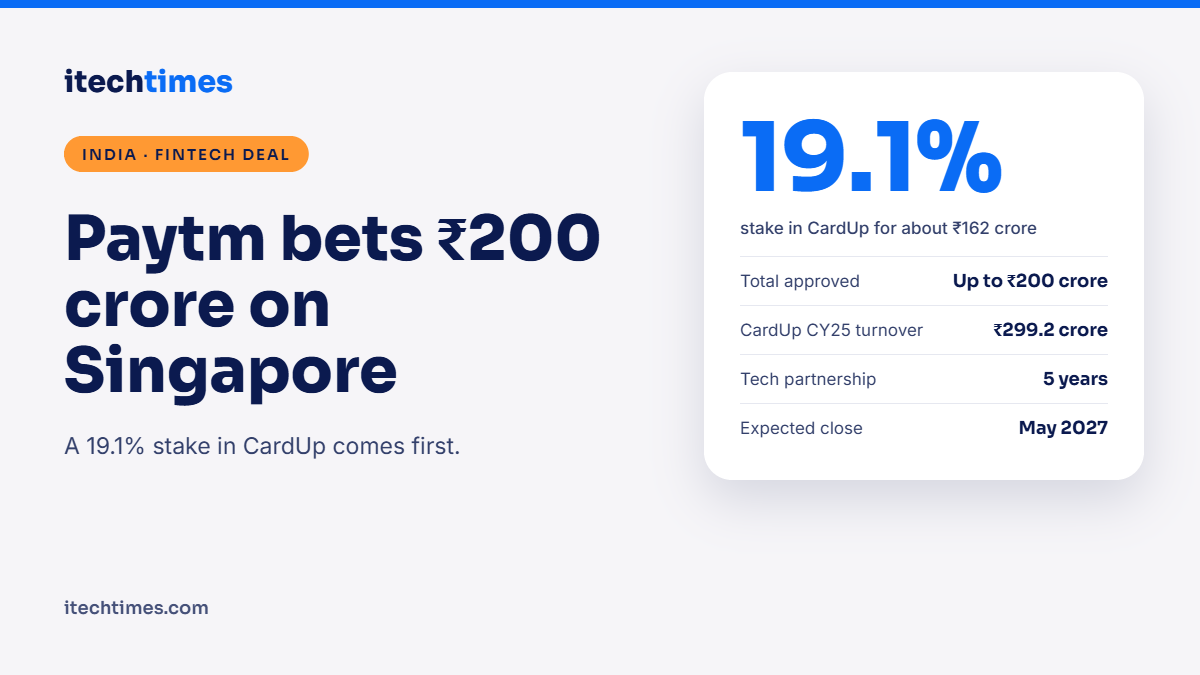
Paytm is putting up to ₹200 crore into Singapore’s Funding Societies group, starting with a minority stake in card payments firm CardUp. It is a small cheque with a big idea behind it: exporting India’s payments technology without spending heavily abroad.
Key takeaways
- Paytm’s board has approved an investment of up to ₹200 crore in subsidiaries of Singapore-based Funding Societies (Funding Asia Group).
- The first step is about ₹162 crore (SGD 21.8 million) for a 19.1% stake in CardUp, Funding Societies’ payments arm.
- The remaining ₹38 crore may go into another Funding Societies affiliate; the deal is expected to close by May 2027.
- Paytm also signs a five-year tech partnership with CardUp and will earn technology fees and a revenue share.
- CardUp’s turnover rose 53.9% to ₹299.2 crore in calendar year 2025.
What is the Paytm CardUp deal? Paytm, through its unit Paytm Singapore, will invest up to ₹200 crore in companies of Singapore’s Funding Societies group. It begins with about ₹162 crore for a 19.1% stake in CardUp, a card payments firm, plus a five-year deal to supply payments and lending technology. Paytm expects to complete it by May 2027.
What exactly has Paytm agreed to?
Paytm disclosed the plan in a stock exchange filing on Thursday, 19 November, as reported by Inc42. Its board approved an investment of up to ₹200 crore in subsidiaries of Funding Asia Group, better known as Funding Societies, a Singapore-based lender to small businesses.
The money will go through Paytm Singapore, a wholly owned subsidiary. The first tranche is about ₹162 crore, or SGD 21.8 million, for a 19.1% stake in CardUp. The remaining ₹38 crore may be invested in one of Funding Societies’ affiliates, though that part has not been firmed up.
Paytm said that, with regulatory approvals in place, it expects the acquisition to complete by May 2027. So this is an approved plan, not a finished deal.
| Part of the deal | Amount | Status |
|---|---|---|
| Total approved investment | Up to ₹200 crore | Board approved |
| 19.1% stake in CardUp | About ₹162 crore (SGD 21.8 million) | Expected to close by May 2027 |
| Investment in another affiliate | Up to ₹38 crore | May be invested |
| Tech partnership with CardUp | Fees plus revenue share | Five-year term |
What does CardUp do?
CardUp was set up in Singapore in October 2015. It lets individuals and businesses pay big or recurring bills with a credit card, even where the person being paid does not accept cards. Think of paying rent, supplier invoices or taxes by card, with CardUp sitting in the middle and paying the recipient by bank transfer.
The business has been growing quickly. According to figures reported by Inc42, its turnover rose from ₹104.16 crore in CY23 to ₹194.38 crore in CY24, and then to ₹299.2 crore in CY25.
| Year | CardUp turnover | Growth |
|---|---|---|
| CY2023 | ₹104.16 crore | – |
| CY2024 | ₹194.38 crore | About 87% |
| CY2025 | ₹299.2 crore | 53.9% |
Growth for CY2024 is calculated by iTechTimes from the reported turnover figures.
Why is Paytm doing this?
The deal fits what Paytm calls its “Partner Operated” international strategy. Under this model, Paytm and its subsidiaries provide the payment acceptance platform and devices, while a local partner handles sales, distribution and day-to-day work with merchants.
For Paytm, the attraction is that it can earn licensing fees and a share of revenue without building a large team or spending heavily in each new country. The five-year partnership with CardUp follows this pattern: Paytm supplies payments and lending technology and earns technology fees plus a revenue share.
In simple terms, Paytm is betting that the software it built for India’s crowded payments market can be sold to partners abroad, with the stake in CardUp giving it a seat at the table.
How does this fit Paytm’s wider money moves?
Alongside the CardUp plan, Paytm has completed a further ₹500 crore investment in its wholly owned unit Paytm Cloud Technologies Limited (PCTL). PCTL has, in turn, put another ₹500 crore into Paytm Singapore. This continues a capital infusion plan Paytm disclosed on 26 October.
The company is doing this from a stronger financial position than a year or two ago. For the September quarter, Paytm reported net profit of ₹225 crore, up 10.7 times from a year earlier, and operating revenue of ₹2,648 crore, up 28% year on year.
| Metric (September quarter) | Figure | Change |
|---|---|---|
| Net profit | ₹225 crore | 10.7x year on year |
| Operating revenue | ₹2,648 crore | Up 28% year on year, 8% quarter on quarter |
| Share price close on BSE, 19 November | ₹1,727.70 | Down 8.51% on the day |
Paytm’s shares closed 8.51% lower at ₹1,727.70 on the BSE on 19 November, the day of the filing. The reports we checked do not tie that fall to this deal, so it should not be read as the market’s verdict on it.
What does it mean for India?
For Indian users, nothing changes in the Paytm app because of this deal. The impact is more strategic:
- Indian fintech as an exporter. India has spent years building low-cost, high-volume payment systems. Deals like this show Indian firms trying to sell that know-how abroad, not just run it at home.
- Asset-light expansion. By partnering instead of building from scratch, Paytm limits how much capital it sends overseas, which matters for a listed company that shareholders watch closely.
- Singapore as a gateway. Singapore is already linked to India through UPI and PayNow, and is a common base for companies looking at South-East Asia. A foothold there could help Paytm reach other markets in the region.
- Regulatory steps remain. The deal still needs to close, and Paytm itself has given a May 2027 timeline, so the benefits, if any, are some way off.
What should you watch next?
- Whether the remaining ₹38 crore is committed, and to which Funding Societies affiliate.
- Whether Paytm signs similar partner-operated deals in other countries.
- Any update on the expected May 2027 completion.
- How much revenue Paytm starts reporting from international technology fees.
This article is for information only and is not investment advice. Please consult a SEBI-registered adviser before making investment decisions.
Frequently asked questions
How much is Paytm investing in Funding Societies?
Paytm’s board has approved up to ₹200 crore. About ₹162 crore is for a 19.1% stake in CardUp, and up to ₹38 crore may go into another Funding Societies affiliate.
What is CardUp?
CardUp is a Singapore company founded in October 2015. It lets people and businesses pay large or recurring bills by credit card, even when the payee does not accept cards.
When will the Paytm CardUp deal be completed?
Paytm has said it expects to complete the acquisition by May 2027, with regulatory approvals in place. Until then, it is an approved plan rather than a completed deal.
What is Paytm’s Partner Operated model?
Paytm supplies the payments platform and devices, while a local partner handles sales, distribution and merchant operations. Paytm earns licensing fees and a share of revenue without large overseas spending.
Will this change anything for Paytm users in India?
No direct change has been announced for Indian users. The deal is about Paytm’s international business and technology licensing.
Why did Paytm shares fall on 19 November?
Paytm shares closed 8.51% lower at ₹1,727.70 on the BSE that day. The reports we checked did not give a reason, so it is not clear whether the deal played any part.
Sources
- Inc42: Paytm lines up ₹200 Cr investment in Singapore’s Funding Societies (19 November 2026)
- Inc42 homepage, fintech headlines for 19 November 2026