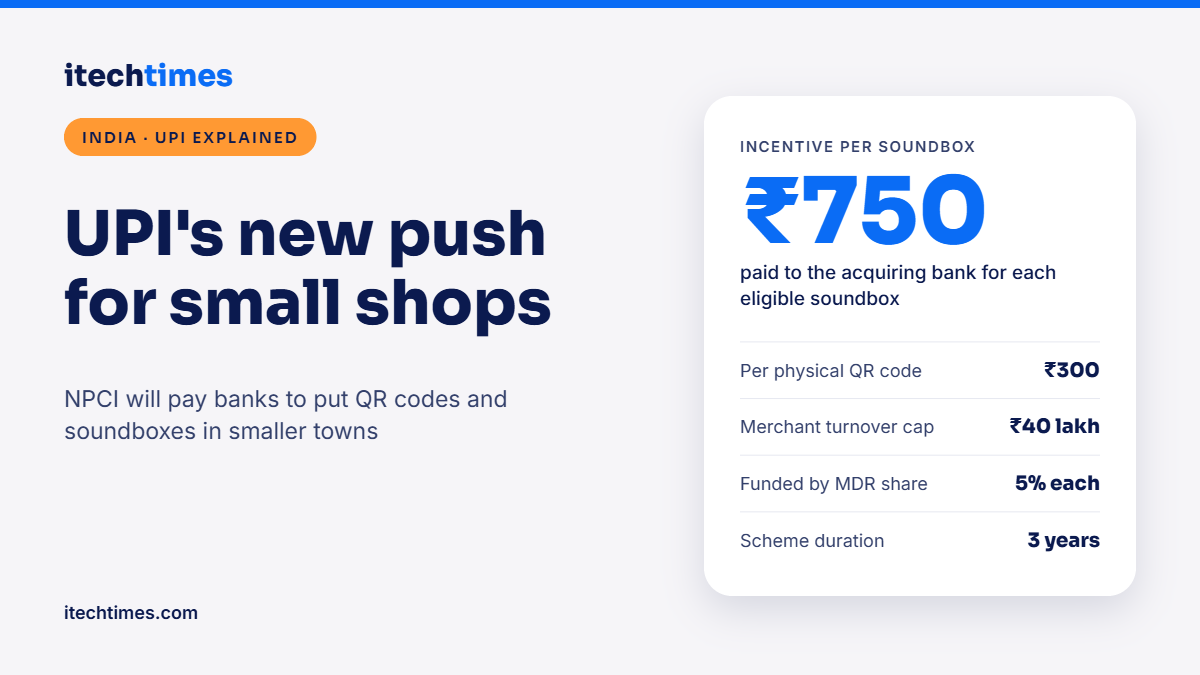
NPCI has set up a three-year incentive fund, paid for out of future UPI merchant fees, to get QR codes and soundboxes into small shops beyond India’s big cities.
Key takeaways
- NPCI notified the UPI Vyapaar Saksham Scheme through a circular dated 11 November 2026.
- Acquiring banks get ₹300 for every physical QR code and ₹750 for every soundbox placed with an eligible new small merchant.
- A small merchant means annual turnover of up to ₹40 lakh, mainly in Tier 3 to Tier 6 towns, the North East, Jammu and Kashmir, and Ladakh.
- The fund is built from 5% of the MDR share earned by issuing banks, acquiring banks, payer PSPs and UPI apps, so it starts only when UPI MDR does.
- NPCI’s targets: 60 lakh to 1 crore new QR codes and 5 lakh to 10 lakh soundboxes a year.
What is the UPI Vyapaar Saksham Scheme? It is an NPCI incentive programme that pays acquiring banks to sign up small merchants for UPI and grow their digital payments, with a focus on smaller towns and remote regions. Banks earn fixed amounts for each QR code and soundbox deployed, plus a small share of transaction value. The money comes from UPI merchant discount rate (MDR) collections, not the government.
What exactly has NPCI announced?
The National Payments Corporation of India (NPCI) sent a circular dated 11 November 2026 to all UPI members launching what it calls the UPI Vyapaar Saksham Scheme. The aim is to spread UPI acceptance among small merchants, especially outside Tier 1 and Tier 2 cities where most QR codes are concentrated today.
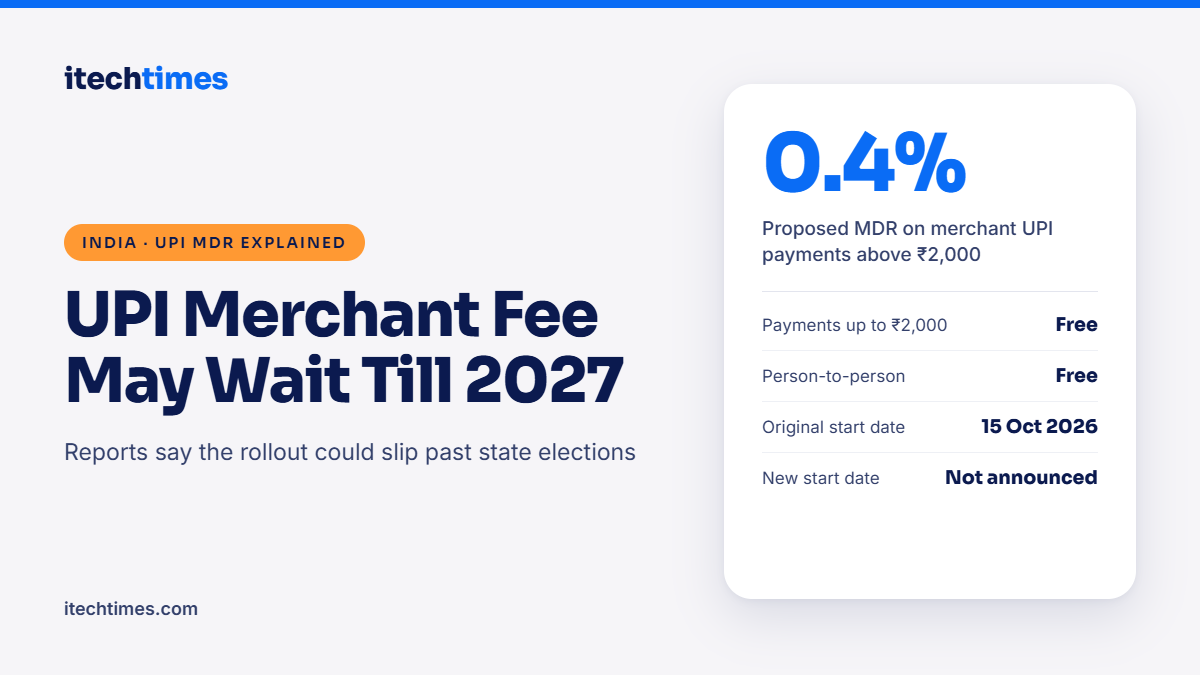
The scheme will run for three years from the date UPI MDR is actually implemented. That date has not been fixed yet. NPCI’s MDR framework was originally due on 15 October 2026 but was deferred until after Diwali, and no fresh date had been announced when this scheme was notified, according to MediaNama and Inc42.
Who qualifies as a small merchant?
The scheme defines a small merchant as a business with annual turnover of up to ₹40 lakh in the previous financial year. The core target areas are:
- Tier 3 to Tier 6 cities and towns
- The north-eastern states
- Jammu and Kashmir, and Ladakh
Merchants in Tier 1 and Tier 2 cities are covered only if they belong to a notified central government scheme, such as PM SVANidhi (for street vendors) or PM Vishwakarma (for artisans). The scheme counts two groups: new small merchants onboarded during the scheme period, and existing merchants who were already on UPI before it began.
Only successfully settled UPI payments of up to ₹2,000 at these merchants count. Reversed, refunded or cancelled transactions do not, and nor do payments split up to stay under the ₹2,000 line.
How much will banks get for QR codes and soundboxes?
The fund is divided into three parts that cannot be moved between each other. Here is how NPCI has structured it:
| Component | Share of fund | What the acquiring bank earns |
|---|---|---|
| A: New merchant onboarding | About 30% | ₹300 per physical QR code, ₹750 per soundbox |
| B: Transaction growth | About 50% | 0.03% of eligible transaction value, with 50% extra in target regions |
| C: Incremental growth in target regions | About 20% | 0.20% of the increase in eligible value over the previous quarter |
The onboarding payout is not automatic. The merchant must record at least 25 eligible transactions in any two months of a quarter, with a minimum monthly transaction value of ₹5,000, and the same device must not have received a subsidy under another scheme. Devices funded through institutional routes such as NABARD are excluded.
For Component B, banks have to show at least 5% quarter-on-quarter growth in eligible volumes among their small merchants. Component C is paid on top of Component B, so a bank that grows merchants in the North East or Ladakh fast can stack both.
Where does the money come from?
This is the interesting part. UPI has run at zero MDR since January 2020. In September 2026 the government amended the Payment and Settlement Systems Act, 2007, which allowed MDR on select merchant payments. Under NPCI’s framework, person-to-merchant UPI payments above ₹2,000 will carry a 0.4% MDR, capped at ₹300 for transactions of ₹75,000 and above. Payments up to ₹2,000, person-to-person transfers and small merchants receiving up to ₹1 lakh a month through UPI QR codes stay exempt.
Once that fee kicks in, issuing banks, acquiring banks, payer PSPs and UPI app providers will each put 5% of their share of the MDR into the Vyapaar Saksham fund. In simple terms, a slice of what big-ticket merchant payments pay will be used to pull small shops into UPI.
What does NPCI expect to achieve?
NPCI has set clear yearly targets for the scheme:
- 60 lakh to 1 crore new physical QR codes
- 5 lakh to 10 lakh new soundboxes
- 30% to 50% annual growth in transaction volumes among existing small merchants
Acquiring banks will claim incentives every quarter, with claims certified by internal and external auditors, and NPCI aims to settle within 30 days. NPCI will review the scheme every six months and may widen it to more regions and merchant categories.
Why does this matter for UPI right now?
The scheme lands in the middle of a heated debate over UPI charges. A Parliamentary Standing Committee on Finance warned in March 2026 that zero MDR made the system financially unsustainable, as MediaNama reported. Payment companies see MDR as a revenue opportunity, while investment platforms such as Zerodha and Groww, along with petrol pump dealers and retailers, have pushed back against the fee.
Vyapaar Saksham is NPCI’s answer to one obvious worry: that charging fees could slow UPI’s spread into small-town India. By ring-fencing part of the MDR for small merchants, it ties the new revenue directly to wider acceptance.
What should small merchants and shoppers do?
- Small shop owners: If you are in a smaller town and still take mostly cash, expect your bank or payment app to approach you with free or cheap QR codes and soundboxes once MDR starts. Ask whether the device is covered under this scheme.
- Check your MDR status: Payments up to ₹2,000 stay free, and small merchants receiving up to ₹1 lakh a month on QR codes are exempt. Most kirana stores should not pay anything.
- Shoppers: Nothing changes for you. NPCI has said customers should not be charged for UPI payments, and P2P transfers remain free.
- Watch the date: The three-year clock starts only when MDR goes live, so keep an eye on NPCI announcements for the rollout date.
This article is for information only and is not investment advice.
FAQs
When does the UPI Vyapaar Saksham Scheme start?
It starts on the date UPI MDR is implemented and runs for three years from then. NPCI had not announced the MDR start date when the scheme was notified on 11 November 2026.
Do merchants get the ₹300 and ₹750 directly?
No. The incentives are paid to acquiring banks, which deploy the QR codes and soundboxes. Whether a bank passes on the benefit as a free or discounted device is up to the bank.
Is my shop eligible if I am in a metro city?
Generally no. Tier 1 and Tier 2 merchants qualify only if they are covered under a notified central scheme such as PM SVANidhi or PM Vishwakarma, and their turnover must be within ₹40 lakh.
Will customers pay any UPI charge because of this scheme?
No. The scheme is funded from MDR paid on merchant transactions above ₹2,000. Payments up to ₹2,000 and person-to-person transfers are exempt from MDR.
Which transactions count towards the incentives?
Only successfully settled UPI payments of up to ₹2,000 at eligible small merchants. Refunded, reversed or cancelled payments, and payments split to stay under ₹2,000, are excluded.
How often will NPCI review the scheme?
Every six months. NPCI says it may expand the scheme to more regions and merchant categories based on those reviews.
Sources
- MediaNama: NPCI announces MDR-funded UPI scheme for small merchants
- Inc42: NPCI unveils new MDR-funded scheme to promote UPI among small merchants
- Angel One: NPCI notifies UPI Vyapaar Saksham Scheme for small merchants