Google’s first Gemini-powered smart glasses are up for pre-order in the US, with a strong focus on bystander privacy. They are not on sale in India yet, but they tell us a lot about where AI wearables are heading.
Key takeaways
- Pre-orders for Google’s first Android XR “Intelligent Eyewear” opened on 12 November 2026, with retail availability and shipping from 10 December.
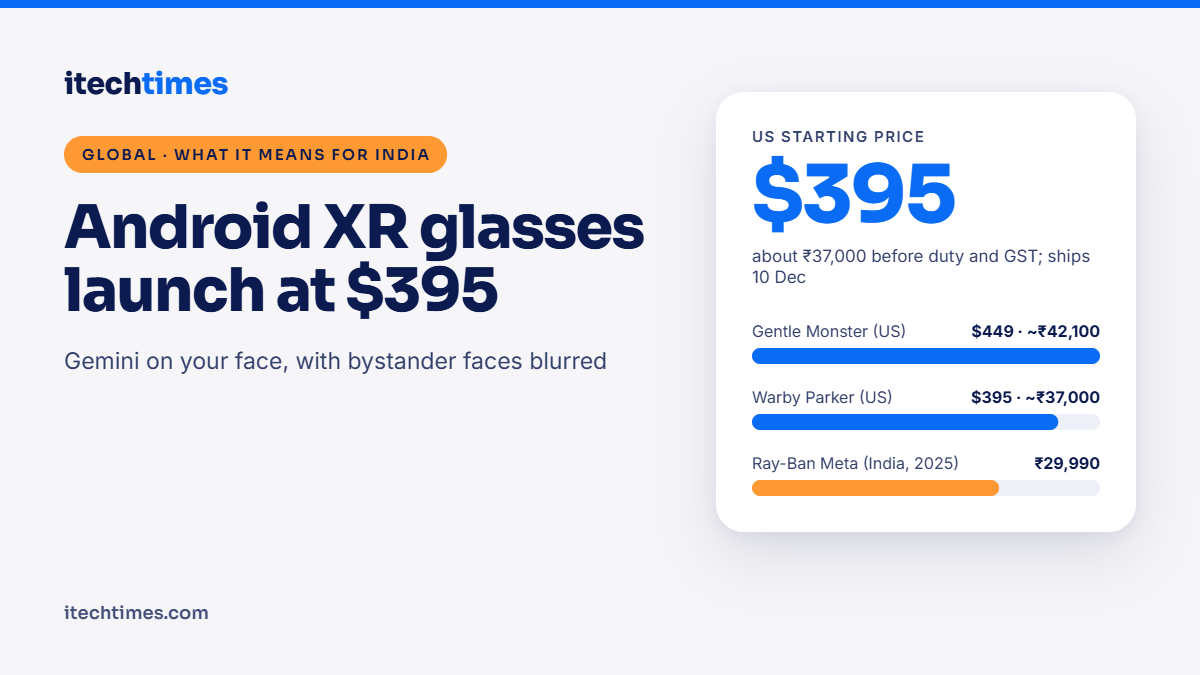
- Warby Parker frames start at $395 (about ₹37,000 at current exchange rates) and Gentle Monster frames start at $449 (about ₹42,100). Samsung engineers the hardware.
- The glasses have a 12MP ultra-wide camera, open-ear speakers, no display in the lens, a nine-hour battery and weigh 40 to 44 grams.
- Faces of bystanders are blurred before images reach Gemini, an outward light shows when you record, and recording is blocked if the light is covered.
- Google has not announced an India launch. Warby Parker is selling in the US, and Gentle Monster in the US and South Korea.
What are Android XR glasses and can you buy them in India? They are audio-first smart glasses with a camera and Google’s Gemini assistant built in, made with Samsung and sold through Warby Parker and Gentle Monster. Prices start at $395, and they ship on 10 December 2026. There is no India launch date yet, so Indian buyers will have to wait.
What has Google launched?
Google calls the product “Intelligent Eyewear”. It runs on Android XR, the platform Google built with Samsung and Qualcomm, and puts Gemini on your face. Samsung engineers the hardware, while eyewear brands Warby Parker and Gentle Monster handle the frame designs and retail.
Pre-orders went live on 12 November through both brands. Retail availability and shipping are set for 10 December. Warby Parker is also offering in-store demos in the US.
These glasses do not have a screen in the lens. Everything happens through audio, voice and a touchpad on the frame. A separate model with an in-lens display is reported to be in development, with no launch date.
How much do the Android XR glasses cost?
Here is how the two launch collections compare. Rupee figures are a simple conversion at about ₹93.7 to the dollar and do not include import duty, GST or any India pricing Google may set later.
| Collection | US starting price | Approx. in ₹ | Styles | Where sold |
|---|---|---|---|---|
| Warby Parker | $395 | About ₹37,000 | Alden, Reid, Wren in 14 variations | US |
| Gentle Monster | $449 | About ₹42,100 | Six frames in 16 variations | US and South Korea |
For context, Meta’s Ray-Ban smart glasses went on sale in India in May 2025 at a starting price of ₹29,990.
What are the key specs?
| Spec | Detail |
|---|---|
| Camera | 12MP ultra-wide, video at 3K 30fps or 1080p, with stabilisation and HDR |
| Display | None (audio-first) |
| Weight | 40 to 44 grams |
| Battery | 245mAh, rated at nine hours; case gives seven full charges |
| Chip | Qualcomm Snapdragon AR1 Gen 1, 2GB RAM, 64GB storage |
| Audio | Two open-ear speakers, four microphones |
| Connectivity and build | Bluetooth 5.4, Wi-Fi 6E, IPX4 water resistance |
| Phones supported | Pixel 7 and newer, recent Galaxy phones on One UI 9.0 or later, iPhone 13 Pro and newer |
Features include visual search (ask Gemini about what you are looking at), hands-free messages and calls, Google Maps directions, real-time Google Translate in more than 70 languages and Gemini Guided Vision, which gives spoken descriptions of surroundings for people with vision impairments. The glasses also work as open-ear headphones.
How do the glasses protect bystanders’ privacy?
Camera glasses raise an obvious worry: people around you may be photographed without knowing it. Google has made privacy the centre of its pitch, and set out these protections in a blog post on 12 November:
- Face blurring: Bystanders’ faces are automatically blurred or removed before an image is sent to Gemini. 9to5Google reports this redaction happens locally on your phone.
- Recording light: An outward-facing light turns on when you take a photo or video for your gallery. If the light is covered or tampered with, capture is blocked.
- Short clips: Video recording is capped at 90 seconds per session, according to 9to5Google.
- No training on your view: Images Gemini uses to answer a question are not saved to Gemini History and, Google says, are not used to train AI models or target ads.
- App limits: Google Play does not allow apps that use the glasses camera for social live-streaming or real-time facial identification.
- Hardware switch: A physical switch turns the glasses fully off, and only Google accounts for users aged 18 and above can be used.
Users must also agree not to record people without permission, not to record in sensitive places and not to cover the light. Google says breaking these rules breaches its terms and may lead to the glasses being disabled.
What does this mean for India?
There is no official word on an Indian launch. Still, the launch matters for Indian buyers and businesses in a few ways.
- Price expectations: Even before taxes, the US starting price converts to more than the ₹29,990 that Ray-Ban Meta glasses started at in India. Any Indian pricing would also depend on duty and GST.
- Privacy law: India’s DPDP Act is being phased in, with consent manager registration opening on 13 November 2026 and the main obligations starting on 13 May 2027. Camera wearables that capture other people will face closer scrutiny, and default face blurring is the kind of safeguard regulators are likely to look for.
- Language support: Real-time translation in over 70 languages could be useful in a multilingual country, though Google has not said which Indian languages will work on the glasses.
- Phone compatibility: Many Indians use mid-range Android phones. The current support list is limited to Pixel 7 and newer, recent Galaxy flagships and iPhone 13 Pro and newer.
What should you do if you are interested?
- Avoid grey-market imports for now. Warranty, service and app support may not work outside launch markets.
- Check your phone against the supported list before planning to buy, even if the glasses come to India later.
- Think about where you will wear them. Recording in offices, hospitals, temples or other sensitive places can be against the rules of the venue and against Google’s own terms.
- If you build apps, read Google Play’s rules for glasses. Facial identification and live-streaming with the glasses camera are not allowed.
Frequently asked questions
When will Android XR glasses launch in India?
Google has not announced an India launch. At launch, Warby Parker frames are sold in the US and Gentle Monster frames in the US and South Korea.
What is the price of Android XR glasses?
Warby Parker frames start at $395 and Gentle Monster frames start at $449. That is roughly ₹37,000 and ₹42,100 before any import duty or GST.
Do the glasses have a display?
No. The first models are audio-first, with a camera, speakers and microphones. You interact by voice, the touchpad on the frame or gestures from a supported smartwatch.
Do they work with iPhones?
Yes. The companion app supports iPhone 13 Pro and newer, as well as Pixel 7 and newer and recent Samsung Galaxy phones.
Can the glasses recognise people’s faces?
No. Google blurs bystanders’ faces before images reach Gemini, and its Play Store rules ban apps that use the glasses camera for real-time facial identification.
How long does the battery last?
Google rates the battery at about nine hours, and the charging case can recharge the glasses seven times.
Sources
- Google: Designing for privacy on intelligent eyewear
- 9to5Google: Google launches Intelligent Eyewear glasses: $395+, pre-order today, ships Dec. 10
- 9to5Google: How Google’s Android XR glasses are handling the camera and privacy
- The Gadgeteer: Samsung Intelligent Eyewear pre-orders
- TechCrunch: Meta to start selling its Ray-Ban smart glasses in India
- Telangana Today: Rupee closes at 93.70 against the US dollar (11 November 2026)