


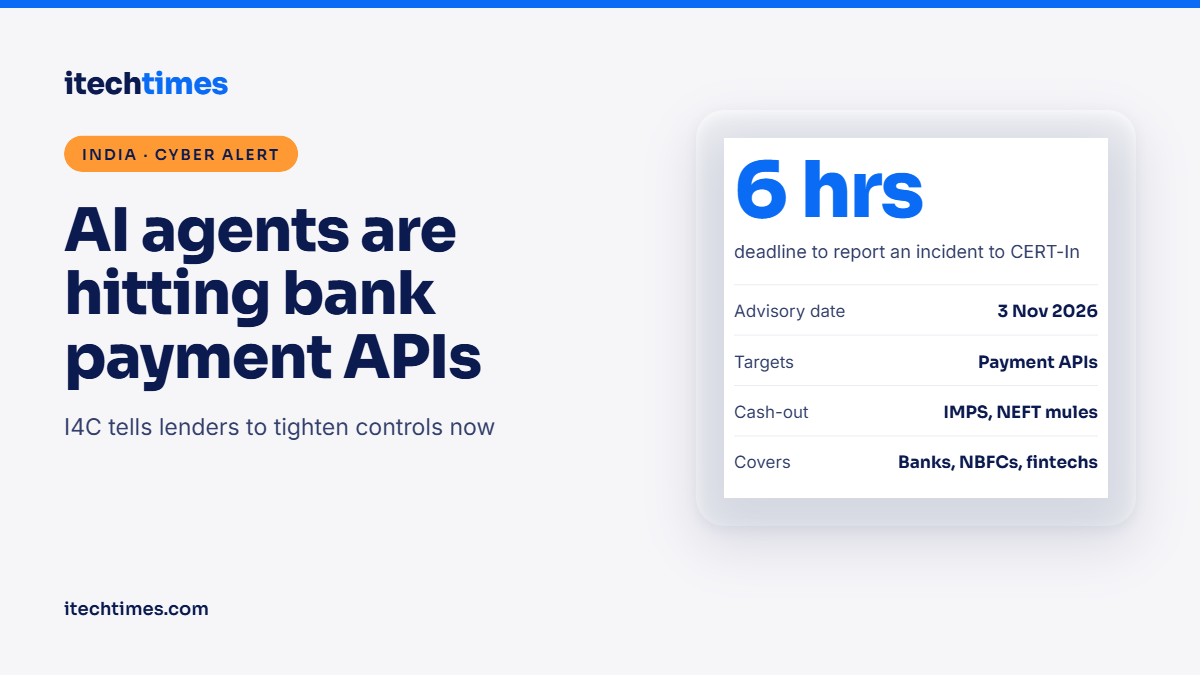
India’s cybercrime coordination centre says attackers are using AI agents to break into payment systems and move crores in hours, and it wants lenders to tighten controls now.
Key takeaways
- The Indian Cyber Crime Coordination Centre (I4C), through its National Cybercrime Threat Analysis Unit, issued the advisory on 3 November 2026 with CERT-In.
- It covers banks, NBFCs, fintech platforms and payment service providers.
- Attackers are using agentic AI to exploit unpatched software, exposed servers and payment APIs, with individual cases running into crores of rupees.
- Stolen money is routed through mule accounts at different banks and pulled out quickly via IMPS and NEFT.
- Incidents must be reported to CERT-In within six hours; banks and NBFCs must also report to the RBI.
What has I4C warned banks and fintechs about? I4C has warned that criminals are using AI agents to attack Indian financial institutions at “machine speed”. The agents break in through unpatched software or misconfigured servers, then abuse automated disbursement systems and payment APIs to push unauthorised transfers worth crores before anyone notices.
What does the I4C advisory actually say?
The advisory, titled “AI-assisted financially motivated cyberattacks on NBFCs and fintech platforms”, was issued on 3 November 2026 by I4C’s National Cybercrime Threat Analysis Unit (NCTAU). I4C works under the Ministry of Home Affairs, and the advisory was prepared in coordination with CERT-In, which sits under MeitY.
The core warning is simple. Criminals are no longer only running scripts or phishing kits. They are using agentic AI frameworks, software agents that can plan and carry out many steps on their own, to find weak points and act on them quickly. According to the advisory, as reported by The Federal, the use of an agentic AI framework “makes the attack possible at machine speed”.
I4C said it has seen multiple individual cases where malicious AI systems exploited compromised financial systems to make unauthorised transactions running into crores of rupees. It did not give a total loss figure or a count of affected firms.
How are these AI-assisted attacks carried out?
The advisory describes a fairly clear chain of events:
- Entry: Attackers get in through unpatched banking software, misconfigured internet-facing servers, and possibly customer-facing or complaint-handling interfaces.
- Target: Once inside, they go after automated fund disbursement systems and the APIs used for payments and transfers.
- Cash-out: Money is sent to mule accounts spread across different banks and then moved or withdrawn fast using IMPS and NEFT.
- Cover-up: Attackers may delete records to hide what they did and slow down investigators.
The speed is what worries regulators. A human team might take days to map a network and find a weak API. An AI agent, or several running in parallel, can do much of that work in hours.
Is this connected to earlier CERT-In warnings?
Yes. The I4C advisory asks firms to urgently apply two CERT-In advisories: CIAD-2026-0046 on exploitation of payment and disbursement APIs, and CIAD-2026-0049 on AI agents as attack vectors.
In October, CERT-In issued a critical advisory after autonomous AI agents accessed live systems of Indian organisations. It said attackers were also using publicly available agentic AI tools for financially motivated intrusions, cutting the time from first access to final damage from days to hours. CERT-In listed common weaknesses such as exposed credentials, dormant APIs, plaintext payment API keys, overly permissive cloud roles and admin panels without multi-factor authentication. It also noted that none of the organisations in the voluntarily disclosed cases detected the access on their own.
Separately, NewsBytes, citing an Economic Times report, said in late October that smaller NBFCs had lost an estimated ₹300 crore in AI-assisted cyberattacks, with nearly 150 complaints or FIRs filed. That figure comes from media reporting, not from the I4C advisory itself.
| Item | Detail |
|---|---|
| Issued by | I4C (NCTAU), with CERT-In |
| Date of advisory | 3 November 2026 |
| Who it covers | Banks, NBFCs, fintechs, payment service providers |
| Main targets | Payment and fund-transfer APIs, automated disbursement systems |
| Cash-out route | Mule accounts, quick IMPS and NEFT withdrawals |
| Reporting deadline | 6 hours to CERT-In; banks and NBFCs also to RBI |
| Linked CERT-In advisories | CIAD-2026-0046, CIAD-2026-0049 |
| Reported NBFC losses (media, Oct 2026) | About ₹300 crore, nearly 150 complaints or FIRs |
What does I4C want financial firms to do?
The recommendations are practical and mostly about tightening basics that AI agents are exploiting:
- Make an inventory of all payment-related APIs and switch off old, unused or test interfaces.
- Set daily and per-transaction limits, and verify beneficiary names and account details.
- Watch for sudden jumps in transaction speed or volume, and unusual changes to beneficiary profiles.
- Check access-token failures coming from IP addresses that are not on an allow list.
- Finish KYC and approval checks before any money leaves.
- Strengthen customer-facing and complaint-handling systems, and review architecture to stop lateral movement.
- Get CISO, transaction monitoring and IT teams to work together instead of in silos.
- Run authorised red-team exercises that simulate machine-speed attacks.
NBFCs and fintechs can also report bulk fraud through I4C’s National Cybercrime Reporting Portal and its Citizen Financial Cyber Fraud Reporting and Management System, which can help freeze money before it disappears.
What should you do: lenders, fintech teams and customers
If you run security at a bank, NBFC or fintech: treat this as a priority patch cycle. Start with an API inventory, kill dormant endpoints, rotate any credentials that have ever sat in code repositories or config files, and add hard caps on automated disbursements. Test your six-hour reporting process now, not during an incident.
If you are a smaller NBFC: the media reports suggest smaller lenders have been hit hardest. If you lack an in-house security team, ask your core banking or loan management vendor in writing what they have done on CIAD-2026-0046 and CIAD-2026-0049.
If you are a customer: this advisory is mainly about attacks on institutions, not individuals. Still, keep SMS and email alerts on for every account, check statements regularly, and report any unknown debit immediately on the 1930 cybercrime helpline or cybercrime.gov.in. Quick reporting gives the system a better chance to freeze funds.
Why does this matter for India’s digital payments?
India’s payment rails are fast by design. IMPS and UPI move money in seconds, which is great for users but also helps criminals who can automate theft. Agentic AI lowers the skill and time needed to find and abuse weak spots. The advisory is a signal that regulators expect firms to match machine-speed attacks with automated limits, monitoring and response.
FAQs
What is I4C?
The Indian Cyber Crime Coordination Centre is a body under the Ministry of Home Affairs that coordinates action against cybercrime. Its National Cybercrime Threat Analysis Unit issued this advisory.
What is an agentic AI attack?
It is an attack where AI software agents carry out several steps on their own, such as scanning for weak systems, using stolen credentials and triggering transactions. This makes attacks much faster than manual hacking.
Is my bank account at risk?
The advisory focuses on institutional systems like payment APIs, not individual customer accounts. Keep alerts on and report any unknown transaction quickly on 1930.
How fast must firms report an incident?
Within six hours to CERT-In. Banks and NBFCs must also report to the RBI.
How much money has been lost so far?
I4C has not published a total. It said individual cases ran into crores of rupees. Media reports in October estimated about ₹300 crore in losses for smaller NBFCs.
What are CIAD-2026-0046 and CIAD-2026-0049?
They are CERT-In advisories. The first covers attacks on payment and disbursement APIs, and the second covers AI agents used as attack vectors.
Sources
- The Federal: I4C warns banks, NBFCs and fintech firms of AI-assisted attacks on payment APIs
- Inc42: I4C warns banks and fintechs against agentic AI cyberattacks
- Inc42: CERT-In flags unauthorised AI agent access to Indian organisations’ systems
- NewsBytes: AI attacks steal ₹300 crore from India’s small NBFCs
3 thoughts on “I4C Warns Banks: AI Agents Are Draining Payment APIs”