The Union Cabinet has approved a five-year capital subsidy to build India’s first large lithium and nickel refining plants, a key missing link in the EV and battery supply chain.
Key takeaways
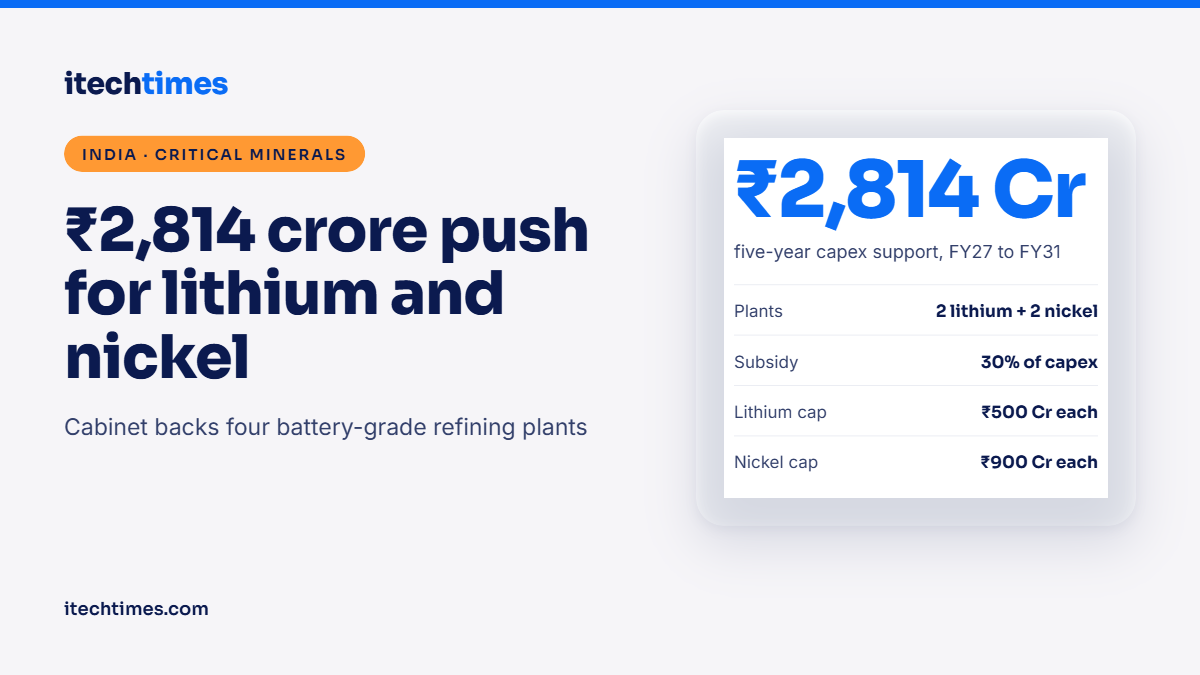
- The Cabinet approved the ₹2,814 crore Capex Support Scheme to Promote Critical Mineral Processing on 4 November 2026.
- It runs for five years, from FY 2026-27 to FY 2030-31.
- It will back four plants: two for lithium (at least 30 kilotonnes each) and two for nickel (at least 50 kilotonnes each).
- Winners get a 30% capital subsidy, capped at ₹500 crore per lithium plant and ₹900 crore per nickel plant.
- Cobalt is expected to come out as a by-product of nickel processing.
What is India’s new critical mineral processing scheme? It is a ₹2,814 crore capital subsidy, cleared by the Union Cabinet on 4 November 2026, to set up four domestic plants that turn lithium and nickel ores or intermediates into high-purity battery-grade compounds. The goal is to cut India’s dependence on imported refined materials used in EVs, energy storage and electronics.
What exactly did the Cabinet approve?
Union Minister Ashwini Vaishnaw announced the decision at a Cabinet briefing on Wednesday. The scheme is officially called the Capex Support Scheme to Promote Critical Mineral Processing. It offers capital expenditure support to companies that build and run processing units for lithium and nickel inside India.
Processing is the step between mining and manufacturing. Raw ore or an intermediate product is refined into high-purity chemicals, such as lithium compounds, that battery cell makers actually use. According to the government statement reported by ANI and Business Standard, India’s domestic processing for lithium, nickel and cobalt is still at a nascent stage, so the country relies heavily on imports of refined intermediates.
How much money will each company get?
The subsidy covers 30% of eligible investment, with clear ceilings per beneficiary. The money is released in three tranches, each tied to project milestones.
| Detail | Lithium | Nickel |
|---|---|---|
| Number of plants | 2 | 2 |
| Minimum capacity per plant | 30 kilotonnes | 50 kilotonnes |
| Capital subsidy | 30% of eligible investment | 30% of eligible investment |
| Maximum support per beneficiary | ₹500 crore | ₹900 crore |
| By-product | Not specified | Cobalt |
| Disbursement | Three milestone-linked tranches | |
| Scheme period | FY 2026-27 to FY 2030-31 (5 years) | |
| Total outlay | ₹2,814 crore | |
How will the government pick the companies?
Selection happens in two stages. First, applicants must clear a technical qualification. Then financial bids are compared on a least-cost basis, meaning the bidder asking for the lowest capital support wins. Two beneficiaries will be chosen for each mineral.
This reverse-bidding approach is meant to stretch public money. It also means companies with access to raw material, proven refining technology and cheaper financing will have an edge.
Why does India need lithium and nickel refining?
Lithium and nickel are core ingredients in many lithium-ion battery chemistries. Those batteries power electric two-wheelers, cars and buses, grid-scale battery energy storage systems (BESS), phones and laptops. The government also lists defence and speciality steel as sectors that will benefit, since nickel is widely used in steel alloys.
The Cabinet noted that critical mineral processing is concentrated in a few places globally. That leaves India exposed to price swings, export restrictions and geopolitical shocks. The scheme is framed as a way to build resilient domestic capacity, substitute imports and support decarbonisation and Atmanirbhar Bharat goals.
The government also pointed to the hurdles that have held back processing so far: high capital costs, limited access to suitable technology and restricted access to raw materials.
How does this fit with earlier critical mineral schemes?
This is not the first step. In September 2025, the Cabinet approved a ₹1,500 crore incentive scheme for recycling critical minerals from e-waste and lithium-ion battery scrap, as part of the National Critical Mineral Mission. That scheme targets at least 270 kilotonnes of annual recycling capacity and about 40 kilotonnes of annual critical mineral output.
Mines Secretary Keshav Chandra also said at an industry event last month that critical mineral processing parks are planned in Gujarat, Maharashtra, Odisha and Andhra Pradesh, according to Business Standard. Maharashtra is to focus on lithium and Odisha on nickel.
| Scheme | Approved | Outlay | Focus |
|---|---|---|---|
| Critical mineral recycling incentive scheme | September 2025 | ₹1,500 crore | Recovering minerals from e-waste and battery scrap |
| Capex Support Scheme for Critical Mineral Processing | November 2026 | ₹2,814 crore | Refining lithium and nickel ores or intermediates |
What it means for India: EV makers, startups and consumers
For battery and EV makers: a domestic source of battery-grade lithium and nickel compounds could reduce lead times and currency risk over the long run. It will not change costs overnight, since the plants still have to be bid out, financed and built during the five-year window.
For cleantech and recycling startups: the processing scheme pairs naturally with the recycling scheme. Recycled black mass and scrap can become feedstock for refiners, which could create more demand for Indian recyclers. Industry leaders from recycling firms such as Attero and LOHUM welcomed the decision, according to Business Standard.
For investors: watch for the bid documents, eligibility rules and which companies qualify. Large metals and chemicals groups are the most likely contenders given the minimum plant sizes. This is not investment advice; do your own research before acting on any company news.
For consumers: there is no immediate price effect on EVs or phones. The benefit, if the plants come up on time, is a steadier supply chain that is less exposed to global shocks.
FAQs
What is the total outlay of the scheme?
The total outlay is ₹2,814 crore over five years, from FY 2026-27 to FY 2030-31.
How many plants will be supported?
Four plants: two for lithium processing and two for nickel processing.
What is the maximum subsidy a company can get?
Up to ₹500 crore for a lithium plant and up to ₹900 crore for a nickel plant, within a 30% capital subsidy on eligible investment.
How are beneficiaries selected?
Through a two-stage process: technical qualification first, then financial bidding. The bidder seeking the lowest capital support wins, with two winners per mineral.
Will this make EVs cheaper?
Not immediately. The plants have to be built first. Over time, local refining could help stabilise supply and reduce import exposure.
Where does cobalt fit in?
Cobalt is expected to be recovered as a by-product of nickel processing, though no volumes have been given.
Sources
- ANI: Cabinet approves Rs 2,814 crore capex scheme for domestic lithium and nickel processing
- Business Standard: Cabinet clears ₹2,814 crore support for lithium, nickel processing plants
- Inc42: Cabinet clears ₹2,814 crore scheme to boost lithium and nickel processing
- All India Radio News: Cabinet approves incentive scheme to promote critical mineral recycling (September 2025)