A build isolation flaw at cloud platform Railway let an attacker decrypt customer secrets and burn through AI API keys, and it is part of a wider wave hitting developer platforms.
By Rajan | Published 12 November 2026 | 7 min read
Key takeaways
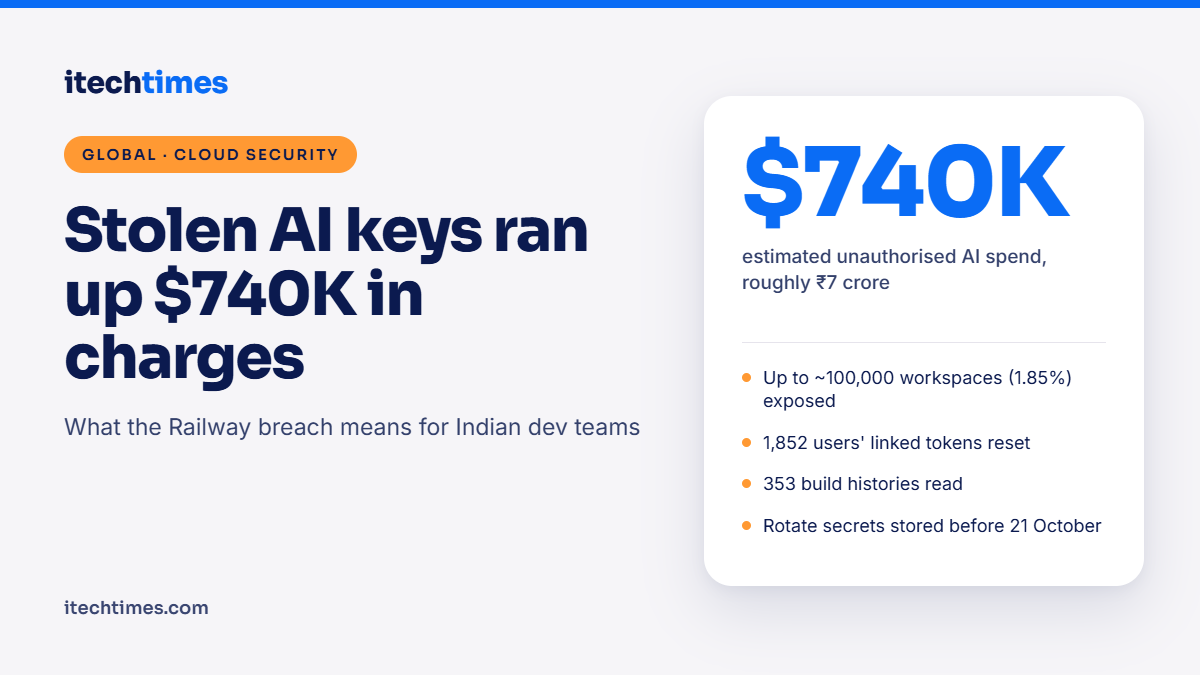
- Railway, a cloud platform used by developers to deploy apps, says an attacker decrypted stored variables for at most 1.85% of workspaces, about 100,000, between 20 and 21 October 2026.
- Unauthorised use of stolen AI provider keys is estimated at about $740,000, or roughly ₹7 crore.
- Linked account tokens, including GitHub OAuth tokens and bring-your-own AI keys, were exposed for 1,852 users. All were reset.
- Railway says it will pay AI charges that providers refuse to refund, and asks every customer to rotate secrets stored before 21 October.
- Security firm Wiz counts more than a dozen AI developer platforms that disclosed incidents in October and early November, with attackers hunting for stored AI keys.
What happened in the Railway breach? An attacker exploited an unknown flaw in Railway’s build system on 20 October 2026, moved through its internal cloud systems and decrypted customer environment variables, focusing on AI provider keys. Railway’s incident report, published on 10 November, estimates about $740,000 in unauthorised AI usage on the stolen keys.
How did the attacker get in?
Railway’s full incident report sets out a chain of weaknesses rather than a single bug. All times below are in UTC, with IST about five and a half hours ahead.
| Time (UTC) | What happened |
|---|---|
| 20 Oct, 07:28 | Attacker exploits a previously unknown flaw to partly escape build isolation and read files on the host machine |
| 20 Oct, 13:58 | On-call engineer is paged about unusual registry calls, about six and a half hours after the first exploit |
| 20 Oct, 17:03 to 17:28 | Builds are halted and the stolen build credential is revoked |
| 21 Oct, 03:26 | Attacker uses a misconfigured OIDC setting to obtain a short-lived cloud credential |
| 21 Oct, 04:42 to 07:15 | Per-environment encryption keys are decrypted and variables read, filtered for AI key names |
| 21 Oct, 09:24 | Attacker fully removed; AI providers notified |
| 21 Oct, 20:19 | All user sessions and tokens invalidated |
Before the cloud step, the stolen build credential was accepted by Railway’s internal workflow system. That exposed the stored histories of 353 builds, including secrets passed to them, and a copy of Railway’s internal code. From there, the attacker reached a database read credential and an SSH key, then used the orchestration machine’s access to the cloud key management service to decrypt variables.
The attacker did not break Railway’s encryption. They reached a machine that was allowed to use it.
How big is the damage?
Railway is careful to call its main figure an upper bound, because its logs show which environments were touched, not which individual variables.
| Measure | Figure |
|---|---|
| Workspaces with decrypted variables | At most 1.85%, about 100,000 |
| Users with linked account tokens exposed | 1,852 |
| Build histories read | 353 |
| Estimated unauthorised AI spend | About $740,000 (roughly ₹7 crore at about ₹94 to the dollar) |
| Customer databases accessed | None found |
| Logins with stolen credentials | None found |
Because some AI providers received every key Railway held for them, reset requests went to more than 100,000 users. Railway believes the stolen keys were used by services that relay or resell AI access, possibly for model distillation, but has not named the attacker.
Who pays for the AI bills?
Railway says it will cover charges where the AI provider will not refund them. According to the report, AWS Bedrock and Google Gemini have started refunds under their existing fraud policies. OpenAI is reviewing claims case by case. Talks with Anthropic are ongoing, and Railway is covering breached Anthropic key costs in the meantime. OpenRouter is applying its no-refund policy, so Railway is paying those costs itself.
Customers are asked to report any charges they did not make using Railway’s charge report form, and to contact their AI providers directly.
Is this part of a bigger trend?
Yes. Wiz researchers describe October 2026 as “Black October” for AI developer platforms. Their running list includes Fireworks AI, Zeabur, Lightning AI, OpenCode, Warp, Northflank and others, alongside Railway. The common thread is that attackers went looking for stored environment variables, especially keys that grant access to AI models, a practice often called LLMjacking. Wiz says stolen keys were typically tested within about 30 minutes and then abused at high volume, often through resellers. It found no single flaw linking all the incidents.
What it means for India
Platforms like Railway appeal to startups and freelance developers, in India as elsewhere, because they are quick to set up. The same convenience means production secrets for payments, databases and AI providers can end up sitting in one place.
There are three Indian angles to keep in mind:
- Your bill is in dollars. AI API charges are usually billed in US dollars, so a stolen key can create a large rupee bill quickly, and card or forex charges may add to it.
- Reporting duties may apply. Under CERT-In’s April 2022 directions, service providers, data centres and body corporates must report listed cyber incidents, including unauthorised access and incidents affecting cloud computing, within 6 hours of noticing them. They must also keep logs of their ICT systems for 180 days in India. If your company’s systems or customer data were exposed through a third-party platform, speak to your legal or compliance team about whether a report is needed.
- Payment keys deserve extra care. If you stored payment gateway or banking API credentials on Railway, rotate them and tell your payment partner. RBI has been tightening API security across the payment chain this month.
What should you do now?
Railway’s own guidance, plus basic hygiene, gives a clear checklist:
- Revoke and replace every sensitive variable you stored on Railway before 21 October. Rotate keys with the issuing provider itself, because reporting a charge does not revoke a key.
- Check your AI provider dashboards for unusual usage since 20 October, and set hard spending limits and alerts.
- Review GitHub audit logs and the list of apps with access to your account, then reconnect GitHub to Railway.
- Check container registry audit logs, such as Docker Hub.
- Remove public network access to databases where you can.
- Recreate CLI and CI tokens and redeploy your latest commit.
- Report any unrecognised AI charges to Railway and to the provider.
Longer term, avoid putting long-lived, all-powerful keys in environment variables. Use scoped keys with spending caps, separate keys per environment, and a secrets manager with automatic rotation where your stack allows it.
Frequently asked questions
What is Railway?
Railway is a cloud platform that lets developers deploy apps, databases and services without managing servers themselves. Customers store configuration and secrets, such as API keys, as environment variables.
Was my data stolen if I use Railway?
Railway says it found no access to customer databases and no sign that customer code repositories were downloaded. However, stored variables in up to about 100,000 workspaces may have been decrypted, so treat any secret stored before 21 October as exposed.
Will Railway refund the AI charges?
Railway says it will cover charges that AI providers refuse to refund. Report unauthorised charges through Railway’s form and contact your provider, since some providers are processing refunds under their own fraud policies.
What is LLMjacking?
It is the theft of access to AI models, usually by stealing API keys and running large volumes of requests on the victim’s account. Wiz notes that stolen access is often resold through so-called LLM brokers.
Do Indian companies have to report this to CERT-In?
CERT-In’s 2022 directions require covered entities to report listed incidents, including unauthorised access, within 6 hours of noticing them. Whether that applies to your company depends on your situation, so check with your compliance or legal adviser.
Has Railway fixed the problem?
Railway says every weakness used in the attack has been closed. Each build now runs in its own short-lived virtual machine, and build credentials can push only one specific image.
Sources
- Railway: Incident report, October security incident
- The Hacker News: Railway says stolen customer AI keys led to $740,000 in estimated unauthorized charges
- Wiz: “Black October” for AI developer platforms
- PSA Legal: New CERT-In directions, overview and implications
- HDFC Sky: Rupee closes at 93.93 against US dollar