India’s data protection law has taken its first live step. Companies can now apply to become consent managers, the platforms that will let you see, give and pull back permission for how your personal data is used.
Key takeaways
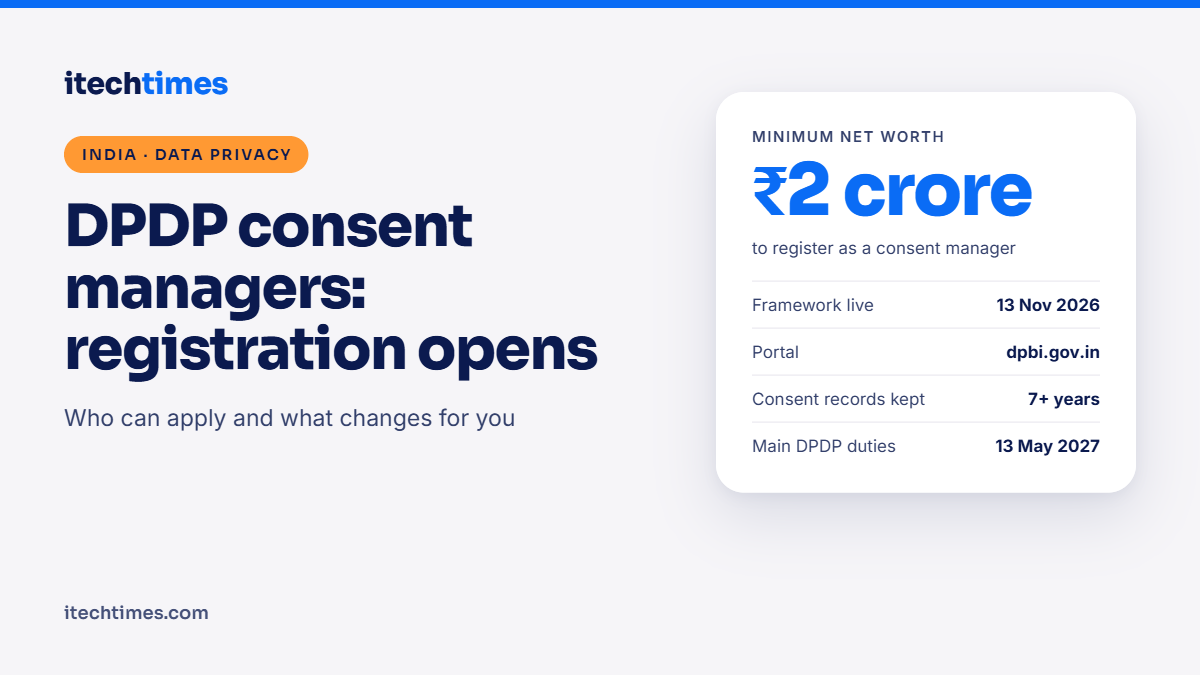
- The consent manager registration framework under the Digital Personal Data Protection (DPDP) Act, 2023 came into effect on 13 November 2026.
- IT Secretary S. Krishnan launched the online portal dpbi.gov.in, where companies apply to the Data Protection Board of India (DPBI).
- Applicants must be companies incorporated in India with a minimum net worth of ₹2 crore and adequate technical, operational and financial capacity.
- Consent managers must not be able to read the personal data that flows through them, and must keep consent records for at least seven years.
- The bigger phase, covering your data rights, company obligations and the Board’s penalty powers, starts on 13 May 2027.
What is a DPDP consent manager and why does registration matter? A consent manager is a company registered with the Data Protection Board that gives you one platform to give, review, manage and withdraw consent for how businesses use your personal data. Registration opened on 13 November 2026 through dpbi.gov.in, the first operational step of India’s DPDP Act.
What has MeitY launched?
The Ministry of Electronics and Information Technology (MeitY) has opened registration for consent managers under the DPDP Act, 2023 and the DPDP Rules, 2025. The registration framework took effect on 13 November, and the portal was launched by IT Secretary S. Krishnan.
Companies submit their applications to the Data Protection Board of India through dpbi.gov.in. The Board will check each application against the conditions in the Rules and register those that qualify. A public list of registered consent managers will be published on the Board’s website.
What does a consent manager actually do?
Today, every app and website asks for your consent separately, and it is hard to remember what you agreed to. A consent manager is meant to fix that. It runs an accessible, transparent and interoperable platform, through a website, an app or both, where you can:
- Give consent to a company (a “data fiduciary”) to process your personal data.
- See a record of every consent you have given, refused or withdrawn.
- Withdraw consent in one place instead of hunting through each app’s settings.
- Download your consent records in a machine-readable format on request.
India already has a similar idea in finance. RBI’s account aggregator system lets people share financial data with lenders through a consent layer. The DPDP consent manager framework applies the consent idea to personal data more broadly.
Who can apply to become a consent manager?
The First Schedule of the DPDP Rules, 2025 sets the conditions. The key ones are listed below.
| Condition | Requirement |
|---|---|
| Legal entity | Company incorporated in India |
| Minimum net worth | ₹2 crore (assets minus liabilities) |
| Capacity | Adequate technical, operational and financial capacity |
| Management | Directors and senior staff with a reputation for fairness and integrity |
| Conflict of interest | Rules on avoiding conflicts with data fiduciaries written into its articles |
| Platform check | Independent certification that the platform meets the Board’s standards |
What rules must consent managers follow?
Registration is not a one-time formality. The Rules set out ongoing duties. The most important ones for ordinary users are:
- No peeking: The consent manager must ensure it cannot read the contents of the personal data shared through it.
- Seven-year records: Records of consents given, denied or withdrawn must be kept for at least seven years.
- Act for you: It must act in a fiduciary capacity towards the individual and is accountable to data principals.
- No outsourcing: It cannot sub-contract or assign its obligations to another company.
- Conflict checks: It must avoid conflicts with the companies it connects to and publish who owns it, including every shareholder with more than 2%.
- Audits and control: It must run regular audits, report results to the Board and cannot change control through a sale or merger without the Board’s approval.
What is the DPDP Act timeline from here?
The DPDP Rules were notified in November 2025 with a phased timeline of about 18 months. Here is where things stand.
| Date | What happens |
|---|---|
| August 2023 | DPDP Act passed by Parliament |
| November 2025 | DPDP Rules, 2025 notified by MeitY |
| 13 November 2026 | Consent manager registration opens |
| 13 May 2027 | Data principal rights, data fiduciary obligations and Board inquiry and penalty processes take effect |
Once the main provisions apply, the penalties are steep. According to a government backgrounder on the Rules, failing to maintain reasonable security safeguards can attract a penalty of up to ₹250 crore, failing to notify a data breach or breaking the rules on children’s data up to ₹200 crore, and other violations up to ₹50 crore.
What should you do now?
If you are an ordinary user
- Nothing changes in your apps overnight. Consent managers first need to be registered and then connected to the businesses you use.
- Watch for the Board’s public list of registered consent managers before trusting any app that claims to be one.
- Keep in mind your bigger rights, such as asking a company what data it holds or getting it erased, become enforceable from 13 May 2027.
If you run a business or startup
- Map where you collect personal data and how you record consent today. Consent managers will need clean, auditable consent flows to connect to.
- Plan for the 13 May 2027 deadline, including breach notification processes and responding to user requests within the time limits in the Rules.
- If you are thinking of becoming a consent manager, check the ₹2 crore net worth rule, the conflict-of-interest limits and the independent platform certification before applying.
- Treat security as a board-level issue. The ₹250 crore maximum penalty is linked to failing to protect personal data.
Frequently asked questions
Where do companies apply to become a consent manager?
Applications go to the Data Protection Board of India through the portal dpbi.gov.in. The Board assesses each application and publishes a list of registered consent managers.
Who is eligible to be a consent manager?
Only companies incorporated in India can apply. They need a net worth of at least ₹2 crore and adequate technical, operational and financial capacity, among other conditions in the DPDP Rules.
Can a consent manager see my personal data?
No. The Rules require consent managers to ensure they are not able to read the contents of the personal data shared through their platform. Their job is to manage your consent, not your data.
Do I have to use a consent manager?
The DPDP framework presents consent managers as a way to manage consent on one platform. You can still give and withdraw consent directly with the companies you deal with.
When do the DPDP penalties start?
The provisions on the Board’s inquiry and penalty processes take effect on 13 May 2027, along with data principal rights and company obligations.
How long must consent records be kept?
Consent managers must keep records of consents given, denied or withdrawn for at least seven years, or longer if agreed with the user or required by law.
Sources
- Inc42: DPDP Act Implementation: MeitY Opens Consent Manager Registration Portal
- VARINDIA: India Opens DPDP Consent Manager Registration
- Babushahi: Who are Consent Managers? Centre opens registration portal
- PIB backgrounder on the DPDP Rules, 2025
- DPDP Rules, 2025, First Schedule: conditions and obligations of consent managers