Eligible Indian businesses can now have GPT-6 Luna process and answer API requests on servers in India, not just store data here.
By Rajan | Published 13 November 2026 | 6 min read
Key takeaways
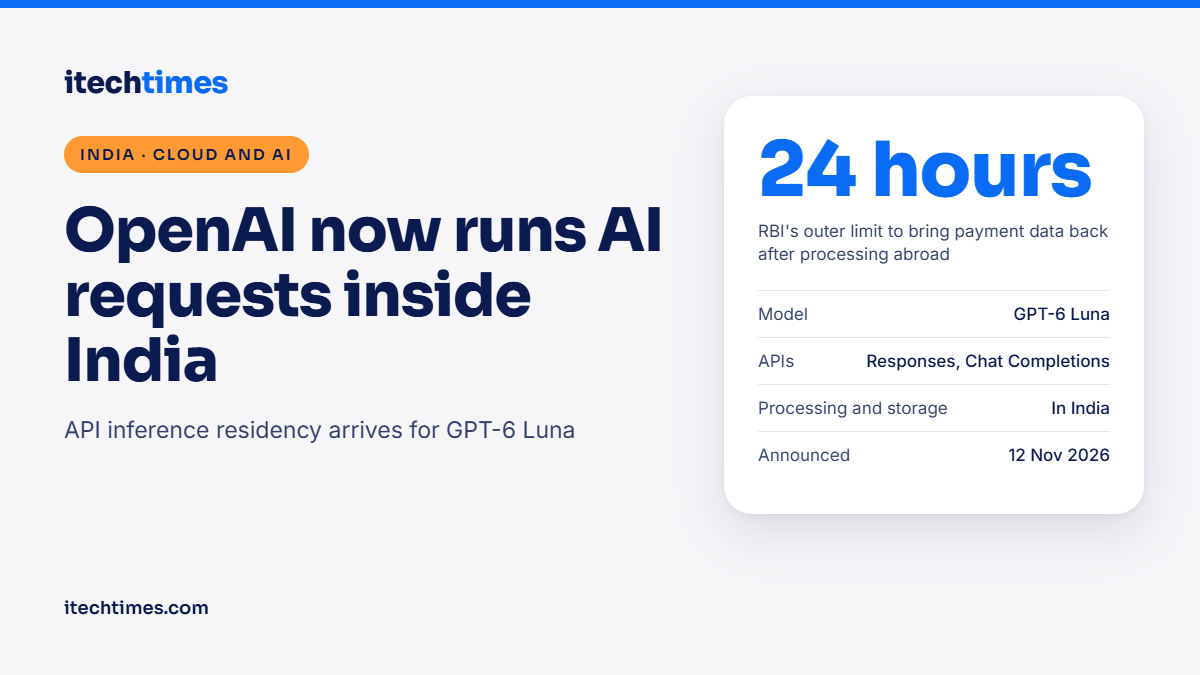
- OpenAI announced on 12 November 2026 that eligible businesses can run supported API workloads with in-country processing in India.
- Both the request handling and the model computation that produces the answer happen in India, and supported customer content is stored in India.
- At launch it covers only GPT-6 Luna, through the Responses API and Chat Completions API, for text-based work.
- To use it, developers create a new API project with India selected for storage and processing, and call the India regional endpoint.
- India joins Australia and Japan as the latest markets for OpenAI’s API inference residency. OpenAI has not published separate India pricing.
What is OpenAI’s India inference residency? It is a new option that keeps both the processing and the storage of supported API workloads inside India. Until now, OpenAI’s India data residency covered only where customer data was stored. Now the GPT-6 Luna model can also run on Indian infrastructure for eligible customers, which matters for banks, insurers and others with strict localisation rules.
What exactly did OpenAI launch?
On 12 November, OpenAI extended its existing data residency offer in India to include inference. “Inference” is the step where an AI model reads your input and generates a response. With this change, an eligible company sending a request to OpenAI’s API can have that request received, processed and answered by servers located in India.
Here is how the launch is scoped, based on reports from PTI (via Business Standard), Analytics India Magazine and Inc42:
| Item | What OpenAI has said |
|---|---|
| Model | GPT-6 Luna only, at launch |
| APIs supported | Responses API and Chat Completions API |
| Type of work | Text-based tasks such as summarising documents, drafting replies and helping staff analyse information |
| Where processing happens | In India, for supported workloads |
| Where data is stored | Supported customer content is stored in India |
| Access route | Direct API use, through a new project set to India and the India regional endpoint |
| Other recent markets | Australia and Japan |
| Pricing | No India-specific pricing announced |
OpenAI has not publicly listed which customers count as “eligible” or every workload that is “supported”. If you are planning a rollout, confirm both points with OpenAI before you commit.
Why does processing location matter so much in India?
Many Indian organisations, especially in financial services, are not allowed to send certain data abroad, or must bring it back quickly. Sending a prompt with customer details to a model running overseas can create a compliance problem even if the final record is stored in India.
Nitin Bawankule, OpenAI’s head of enterprise for India, said local inference gives businesses more control over where supported workloads run. OpenAI also said that some Indian businesses had held back from using AI for important work because their data had to be processed in the country, and that this decision often determines whether a project moves from a pilot into production.
How does this fit with RBI’s data rules?
The clearest example of Indian localisation is the Reserve Bank of India’s 2018 circular on storage of payment system data. RBI requires the entire payment data of payment system operators, including customer data, payment credentials and transaction details, to be stored only in India.
Processing abroad is allowed under that circular, but the data must then be deleted from overseas systems and brought back to India within one business day or 24 hours, whichever is earlier. An AI pipeline that keeps both processing and storage in India avoids that round trip altogether, which simplifies the compliance story for fintechs and payment companies. Each firm should still check its own obligations with its compliance team, because rules differ by sector and data type.
What do developers need to change?
The setup is simple, but it is not automatic for existing projects.
- Create a new API project. Inference residency is set at the project level, so you cannot simply switch on a setting in an old project.
- Select India for both storage and processing. Both options must point to India for the full benefit.
- Use the India regional endpoint. Your code must call the regional endpoint rather than the default global one.
- Use GPT-6 Luna through the supported APIs. Calls to other models or unsupported APIs will not get in-country processing at launch.
- Re-test your app. Check latency, rate limits and any tool or feature you depend on, since a regional project may not support every capability on day one.
How does it compare with other options in India?
OpenAI already offered India data residency for storage, and a similar residency capability for some of its models has been available through Amazon Web Services’ Bedrock platform. Earlier this year, OpenAI also announced a tie-up with the Tata Group to build domestic AI data centre capacity under its “OpenAI for India” programme.
It is not alone. According to Inc42, Anthropic announced plans in August for in-country inference for Claude in India through Amazon Bedrock. Indian AI companies such as Sarvam AI have pitched local hosting as an advantage, and large global providers offering in-country processing could narrow that gap.
What it means for Indian businesses
- Banks, NBFCs and insurers can look again at use cases that were blocked by localisation concerns, such as summarising customer documents or drafting service replies.
- Fintech and payment companies may find it easier to explain their AI data flows to auditors when both processing and storage stay in India.
- SaaS startups selling to Indian enterprises can offer customers an India-only AI processing option, which often comes up in procurement questionnaires.
- IT services firms building AI tools for Indian clients get another hosting choice alongside cloud marketplaces and domestic GPU providers.
The limits matter too. Only one model is covered for now, the focus is on text, and eligibility is not fully public. Treat it as a first step rather than a full India-hosted version of OpenAI’s platform.
FAQs
Does this change how ChatGPT works for ordinary users?
No. This launch is for businesses and developers using OpenAI’s API directly. It does not change how the consumer ChatGPT app processes your chats.
Which OpenAI model runs in India?
At launch, only GPT-6 Luna, accessed through the Responses API and the Chat Completions API. OpenAI has not said when other models will be added.
Is my existing API project covered automatically?
No. You need to create a new API project with India selected for both data storage and processing, and send requests to the India regional endpoint.
Does in-country processing cost more?
OpenAI has not announced India-specific pricing for inference residency. Check the pricing shown for your project or ask OpenAI’s sales team before you plan budgets.
Does this make my app compliant with RBI or DPDP rules?
Not by itself. Keeping processing and storage in India helps, but compliance depends on what data you send, your contracts, your security controls and your sector’s rules. Get your compliance or legal team to review your setup.
Which other countries have OpenAI’s API inference residency?
OpenAI’s inference residency exists in other regions, and India, Australia and Japan are the most recent additions.
Sources
- Business Standard (PTI): OpenAI to process AI requests in India to meet data localisation needs
- Analytics India Magazine: OpenAI Launches API Inference Residency in India
- Inc42: OpenAI Brings API Inference Residency To India
- FoneArena: OpenAI API now processes and runs locally in India
- Reserve Bank of India: FAQs on Storage of Payment System Data