


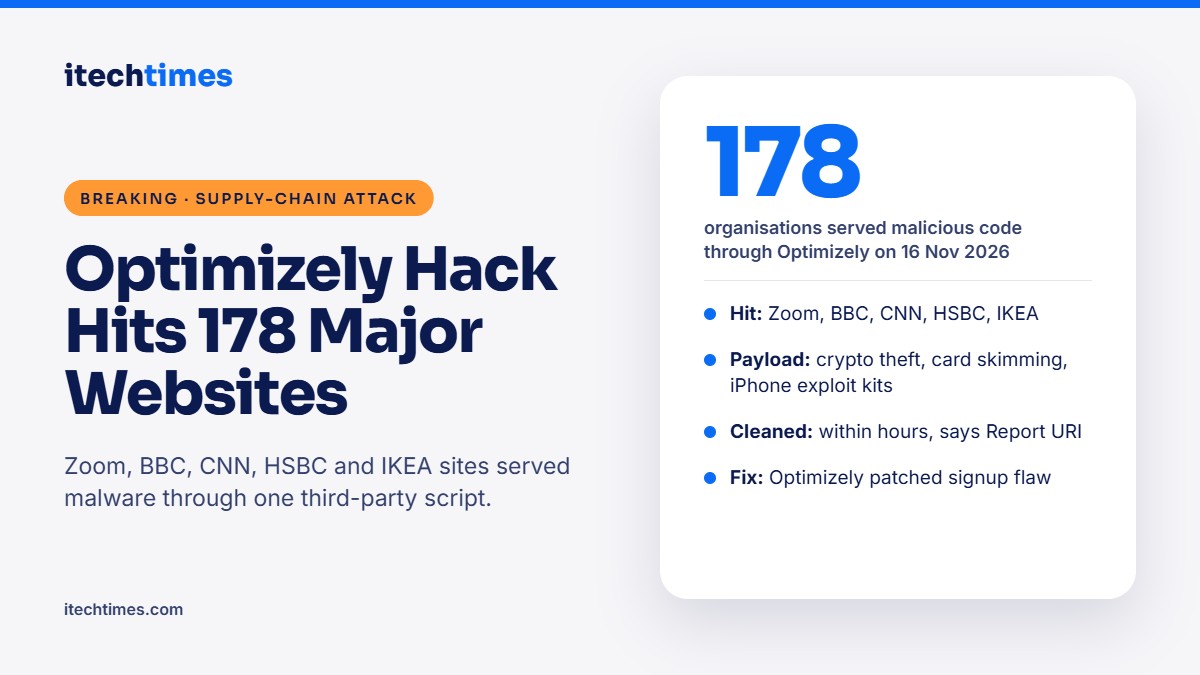
A single compromised website tool put crypto-stealing, card-skimming and iPhone-hacking code on the sites of Zoom, the BBC, CNN, HSBC, IKEA and 173 other organisations. Here is what happened, who was affected, and what visitors and website owners should do now.
Last updated: 17 November 2026, 3:30 PM IST. This is a developing story.
Key takeaways
- On 16 November 2026, attackers planted malicious JavaScript in the Optimizely Web experimentation platform, and it reached visitors of 178 organisations.
- Security researcher Scott Helme of Report URI found the code in 188 of 1,611 Optimizely snippets he checked. Affected sites include Zoom, BBC, CNN, Fox News, HSBC, Salesforce, GitLab, IKEA, Equifax, Ledger and Air France-KLM.
- The code could swap crypto wallet addresses, skim card details, steal cookies and screenshots, and load exploit kits on older iPhones and iPads.
- Optimizely says an attacker exploited a flaw in its account signup flow. It has blocked the flaw, removed the code and contacted affected customers.
- This was a supply-chain attack through one vendor, not a breach of each company’s internal systems. Most infected scripts were cleaned within about 17 hours.
Is it true that 178 organisations were hit? Yes. Report URI, the security firm that discovered the attack, lists 178 organisations whose websites served malicious code through Optimizely on 16 November 2026. However, the companies themselves were not hacked directly. The attacker abused a flaw at Optimizely, a third-party tool these sites load, so its trusted script delivered malware to their visitors.
What happened in the Optimizely attack?
Optimizely is a popular platform that big brands use to A/B test and personalise their websites. To work, each customer adds a small Optimizely script, called a snippet, to its web pages. That snippet is loaded from Optimizely’s own servers on every visit.
The attacker wrote malicious code into the Project JavaScript field of customer projects, a setting that runs on every page where the snippet loads. Because the code was delivered from Optimizely’s genuine servers with a valid security certificate, browsers and many security tools treated it as trusted. Report URI found the same code even on Optimizely’s own website and login page.
Optimizely later said an unauthorised party had exploited a vulnerability in its Experimentation account signup flow to insert the code into some customer projects.
Timeline of the attack
| Time (IST) | What happened |
|---|---|
| Mon 16 Nov, 9:51 AM | First malicious code appears in the BBC’s Optimizely snippet |
| Mon 16 Nov, 4:50 PM | Zoom’s snippet is modified |
| Mon 16 Nov, 6:33 PM | Attacker moves stolen crypto to exchanges |
| Mon 16 Nov, 7:13 PM | Card-skimming code is added |
| Mon 16 Nov, 10:43 to 11:27 PM | iPhone exploit kit is added for older iOS versions |
| Tue 17 Nov, around 1:00 AM | Report URI finds 186 of 1,611 snippets infected |
| Tue 17 Nov, 3:22 AM | Mass clean-up leaves only 1 of 188 infected snippets |
| Tue 17 Nov, 6:32 AM | Optimizely posts an official incident notice |
Report URI says the attacker rebuilt the malicious payload 26 times during the day. Researchers at Hudson Rock also traced the same attacker’s code to three other web services, Kissmetrics, StorifyMe and Minute Media, as early as 13 November.
Which websites were affected?
Report URI published the full list of 178 organisations. They span almost every sector:
| Sector | Examples of affected sites |
|---|---|
| Banking and finance (32) | HSBC (several countries), Equifax, ABN AMRO, Paychex |
| Technology and SaaS (23) | Zoom, Salesforce, GitLab, Bitly, Tableau, Hootsuite |
| Retail and fashion (20) | IKEA, ASOS, Mattel, Levi’s (several countries), Crocs India |
| Streaming and entertainment (12) | Peacock, NOW TV, Starz, SkyShowtime |
| News and media (10) | CNN, BBC, Fox News, NPR, Fox Sports |
| Airlines and travel (9) | Air France-KLM, Alaska Airlines, Transavia |
| Crypto and trading (6) | Ledger, IG, OANDA |
The only Indian site on the list is Crocs India (crocs.in). But millions of Indians visit global sites such as Zoom, the BBC, CNN and IKEA, so Indian users may have been exposed even though few Indian companies were named.
What could the malicious code do?
- Crypto address swapping: it replaced Bitcoin, Ethereum, TRON, Solana and other wallet addresses with the attacker’s, on the page, in the clipboard and even in the iPhone share sheet.
- Card skimming: it captured card numbers, expiry dates and CVVs typed into forms. Cards entered inside a separate, hosted payment window were out of its reach.
- Cookie and screenshot theft: it sent page addresses, some cookies and screenshots to the attacker.
- iPhone and iPad exploits: it loaded the Coruna and DarkSword exploit kits on older iOS versions. iOS 18.7.3, iOS 26.3 and later are protected.
Report URI traced about US$7,040 (roughly ₹6 lakh) in crypto to the attacker’s wallets by the evening of 16 November. Card data theft is harder to measure and may not show up for weeks.
How did companies respond?
- Optimizely said it had identified and contained the incident, blocked the vulnerable path, removed the injected code, ended sessions, revoked access tokens and contacted affected customers directly. Its investigation is continuing.
- Salesforce disabled Optimizely scripts across its websites as a precaution and said it would notify customers if it finds their data was accessed.
- Equifax stopped using Optimizely and said it found no evidence that its own systems were compromised.
What should you do if you visited these sites?
- Update your iPhone or iPad now. Install iOS 18.7.3, iOS 26.3 or later from Settings, General, Software Update.
- Check any crypto transfer you made on 16 November. Make sure the wallet address you pasted matches the one you intended.
- Watch your card statements. If you paid by card on an affected site that day, look for unknown charges and block the card through your bank app if anything looks wrong.
- Report fraud quickly. In India, call the cyber fraud helpline 1930 or file a complaint at cybercrime.gov.in.
- Beware of follow-up scams. Fraudsters often send fake “your account was affected” emails after big breaches. Do not click links or share OTPs.
What should website owners learn from this?
Most business websites in India load dozens of third-party scripts for analytics, A/B testing, chat and ads. Each one runs with full access to the page, so one compromised vendor can put every visitor at risk. Report URI recommends these steps:
- Audit your third-party scripts and remove any you no longer use.
- Check tools like Optimizely for custom JavaScript you did not write, and review who has write access to those accounts.
- Use a Content Security Policy (CSP) to control which domains scripts can load from and send data to, and turn on violation reporting.
- Keep card fields in hosted payment pages or payment gateway iframes, which the skimmer could not reach.
- Rotate exposed session tokens and consider notifying customers. Indian organisations should also check their CERT-In and data protection reporting duties.
Frequently asked questions
Were Zoom, BBC and HSBC hacked?
Not directly. Their websites loaded a script from Optimizely, and the attacker abused a flaw at Optimizely to plant malicious code in it. There is no evidence their internal systems were breached.
What is a supply-chain attack?
It is an attack on a supplier or tool that many companies use, so a single breach reaches all of that supplier’s customers at once. Here, one compromised website tool reached 178 organisations.
Am I affected if I visited one of these sites?
Only if you visited on 16 November 2026 while the code was live. The main risks were swapped crypto addresses, card details typed into forms, and exploits on outdated iPhones.
Is the malicious code still active?
Report URI found almost all infected scripts were cleaned by early 17 November IST, and Optimizely says the code has been removed and the flaw blocked.
Were any Indian websites affected?
Crocs India is the only Indian site on Report URI’s list. Indian users of global sites such as Zoom and the BBC may still have been exposed.
How much money was stolen?
Report URI traced about US$7,040 in crypto to the attacker’s wallets on 16 November. The amount taken through card skimming is not yet known.
Sources
- World’s largest brands infected with malware via Optimizely, Report URI (Scott Helme)
- Optimizely hack infected CNN, Fox News, BBC, Salesforce sites with malware, BleepingComputer
- Hackers infect 178 major websites via Optimizely, Cyber Security News
- Beyond Optimizely: malicious scripts traced across four web services, Infostealers (Hudson Rock)
- Optimizely supply chain attack hits 178 organizations, Cyber Nexora
- Optimizely status page
One thought on “Optimizely Hack: Malware Hit 178 Sites Including Zoom, BBC”